 By st20113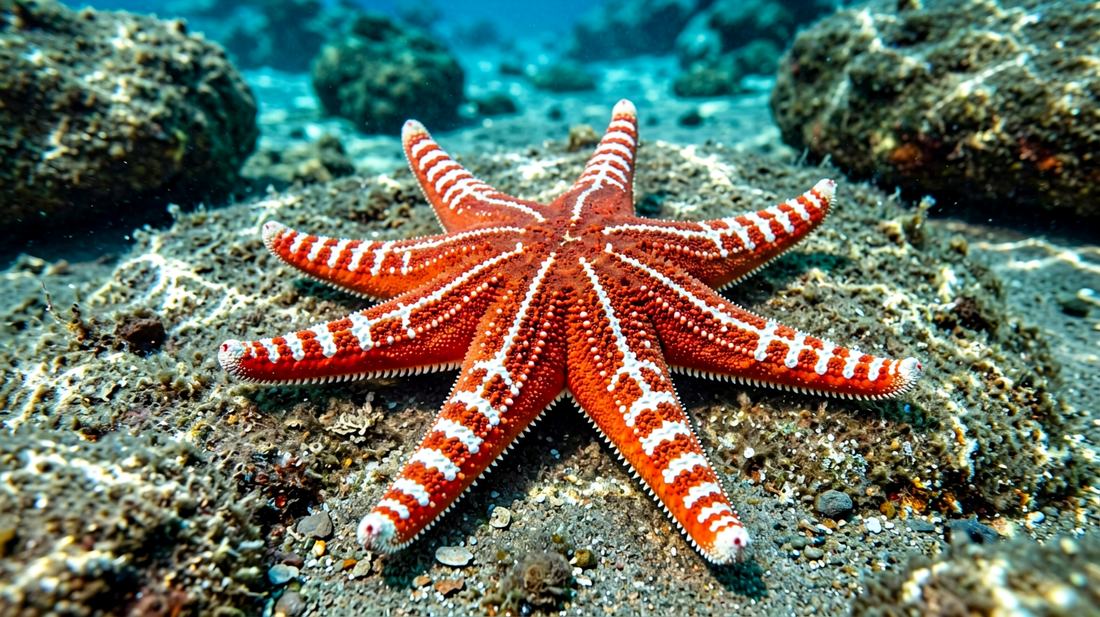
Crossaster papposus | Common Sunstar
Species Profile · Solasteridae
Common Sunstar
A many-armed seabed hunter painted in red, orange and cream, and a specialist eater of urchins and other starfish.
IUCN: Not Evaluated
Range
Arms
Span
Depth
Status
A star with many arms
The common sunstar
The common sunstar is the brightest hunter on northern Europe’s seabed. It has ten, eleven or twelve arms. Most starfish have only five. Its central disc is broad. The top is red, orange and cream. From above it looks like a child’s drawing of a sun.
Sunstars live on rock, gravel and sand. They live from the shallows to deep cold water. They are found around the Arctic. They are found across the North Atlantic. They eat animals most hunters avoid. Their food includes sea urchins and other starfish.
They can swallow prey almost as big as themselves. Bottom trawling has wiped them out in some areas. In untrawled water they stay common. They are easy to find there.
Family tree
Among the sea stars
The common sunstar is in the class Asteroidea. Asteroidea are the sea stars. It is in the family Solasteridae. Its nearest European kin is the Common Starfish. This starfish shares the same body plan. Its arms spread from a central disc. Rows of tube feet sit underneath.
The two are easy to tell apart. The common starfish has five tapering arms. The sunstar has more than eight arms. Its disc is far wider. The name Crossaster means fringed-looking arms. The name papposus means downy or fuzzy. The species was named in 1777.
Solasteridae is a family of cool-water hunters. Several of them feed on other echinoderms. Sunstars are not fish. They are echinoderms. They are closer kin to sea urchins than to backboned animals.
Fuzzy, colourful armour
How a sunstar is built
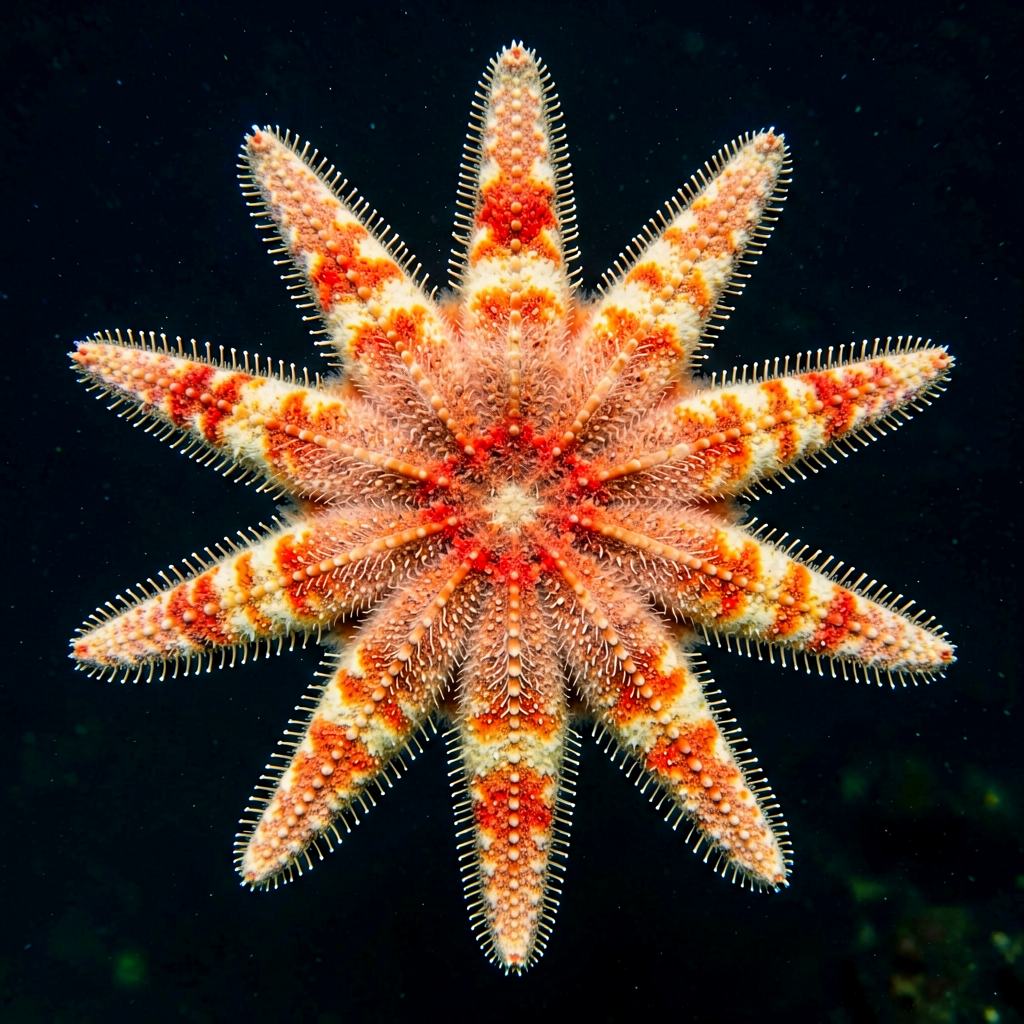
The arm span is usually 10 to 20 centimetres. Big northern ones can reach 30 centimetres or more. The disc is wide. The arms are short and taper fast. The animal looks like a star with a full centre. Most have ten to twelve arms. The count ranges from eight to fourteen. It changes as the animal grows. The top has tiny spines on short stalks.
They give the skin a fuzzy, velvety look. The colour pattern is the species’ mark. A red or orange base is crossed by bands. The bands are white and cream. The arm tips are paler. The underside is flat and pale. It has four rows of tube feet along each arm. Tube feet work by water pressure. They grip rock and prey.
They also move the animal. Sea stars have no brain and no blood. They pump seawater through a canal system. The mouth sits in the centre of the underside. The stomach can be pushed out through it. It digests food outside the body. Sunstars regrow lost arms. This helps them survive attacks.
1
2
3
Cold water, hard ground
Where the sunstar is found
The common sunstar lives in cold and cool water. It is found around the Arctic. It lives on both sides of the North Atlantic. Its range runs from the Canadian Arctic and Greenland. It reaches Iceland, Norway, the British Isles and the North Sea. It goes south to the Bay of Biscay. It lives on the seabed in the shallow sea zone. It is found just below the tide line.
It is seen down to about 300 metres in most areas. In the far north it lives deeper. It likes hard ground, gravel and coarse sand with stones. It also turns up among kelp holdfasts. It lives in mussel beds and on muddy bottoms. In shallow water divers find it on steep rock faces. It hides under ledges. It is often found in groups.
It tolerates very cold water. It is one of the species seen under ice in Arctic surveys. Adults cannot travel far. Local groups depend on drifting young. The young drift with the currents. Where the home is damaged, they recover slowly.
What it eats
A predator of urchins
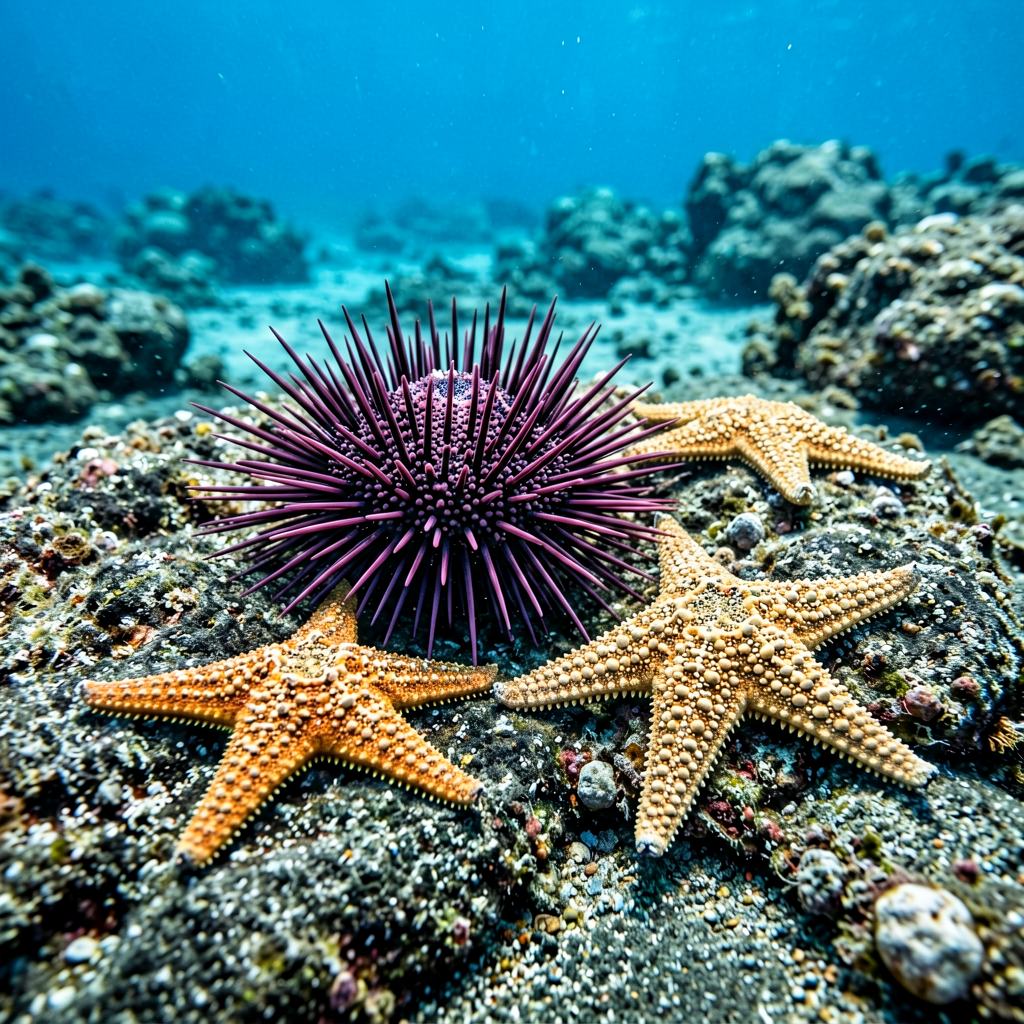
The common sunstar is a hunter and a scavenger. Its menu is very wide. Sea urchins are a main food. Brittle stars are also a main food. So are other sea stars, including the common starfish. It also eats sea cucumbers and bivalve molluscs. It eats barnacles, small crustaceans and worms.
It takes dead animals too. It feeds by pushing its stomach out through the mouth. It pours digestive juices over the prey. Then it draws the softened flesh back inside. Sunstars use their many arms to wrap around prey. They prise it open. They can eat food only slightly smaller than themselves.
In tanks they eat other sea stars. They may eat their own kind. In the wild they have few foes once full grown. Cod, wolffish and big crabs take smaller ones. A torn arm is usually regrown. By eating urchins, sunstars help keep grazed seaweed beds in balance.
Larvae in the plankton
Slow to grow up
Common sunstars have two sexes. They release eggs and sperm into the sea in spring. This is often between March and May. The joined egg becomes a free-swimming larva. It feeds on plankton for weeks. Then it settles on the seabed. It turns into a small star.
This long drifting stage lets the species spread. It spreads across wide seas. But larvae live only where plankton is rich. They also need the right currents. A settled young star grows slowly. Northern groups may take several years to reach full size. They can live for a decade or more.
Sea stars can repair damage. If an arm is bitten off, it regrows. The animal can sometimes split its disc. The common sunstar does not do this often. Slow growth, few young and a long life put it at risk. They are at risk from repeated scraping of the seabed.
Trawling the seabed
Why the seabed matters
The common sunstar has not been rated for the IUCN Red List. It is still widespread. It is common in patches across the North Atlantic and the Arctic. Its main problem is fishing gear. Bottom trawls and dredges scrape the seabed. They crush or remove sea stars.
They also remove the animals they feed on. Surveys show sunstar numbers fall fast in heavily trawled areas. They recover slowly. Silt stirred up by dredging also hurts feeding. It hurts settlement too. The species lives in the path of many commercial fisheries.
Protected areas with no bottom contact are its best guard. Climate change adds a second pressure. Warming water is likely to push right habitat north. The Arctic groups are most at risk. Close watching of sunstars is patchy. They are rarely the target of surveys.
Quick hits
Five things to remember
- Most common sunstars have ten to twelve arms, not five like a starfish.
- Each animal’s red, orange and cream pattern is unique, like a fingerprint.
- It digests prey outside its body after pushing its stomach out through the mouth.
- Sea urchins and other starfish are its main food, making it a top hunter.
- A lost arm grows back. Some sea stars even regrow most of the disc.