 By st20113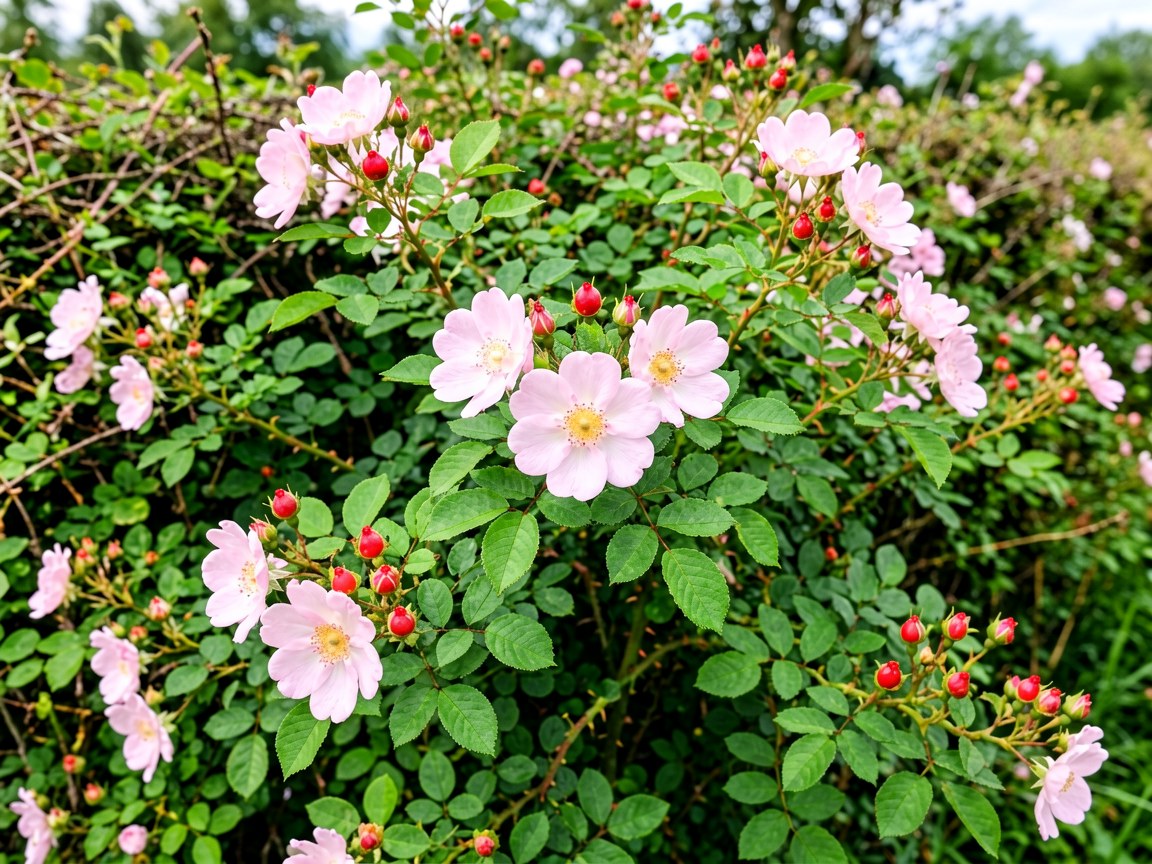
Rosa canina | Dog Rose
Introduction
The Dog Rose (Rosa canina) is the archetypal wild rose of European hedgerows, a scrambling, arching shrub armed with stout hooked prickles and crowned in early summer with five-petalled pink flowers that scent the lanes. By autumn those flowers have become the familiar scarlet hips, a vital late food for birds and a traditional source of vitamin C for people.
More than just a pretty hedge plant, the dog rose is a structural species of the countryside, knitting together scrub and hedgerow, slowing livestock, and offering nest sites, petals, and fruit to a wide cast of wildlife. It is the wild ancestor of countless garden roses, yet remains supremely well adapted to life on the edge of field and woodland.
Taxonomy
Rosa canina was described by Linnaeus in 1753; the genus name Rosa is the classical Latin for rose, and canina (“dog-like”) is an old name of uncertain origin, perhaps referring to a former medicinal use. It belongs to the family Rosaceae, the rose family, alongside apples, cherries, and strawberries.
Like all green plants, the dog rose depends on the process described in our article on Photosynthesis (the plant energy process), by which its leaves build the sugars that fuel its vigorous growth and its profusion of flowers and hips. Within Rosaceae it is a thorny, sprawling specialist, thriving where it can climb and clamber rather than stand alone.
Physical Characteristics
The dog rose is a deciduous shrub with long, slender, arching stems up to 3 m, armed with stout, curved, hooked prickles that help it scramble through other vegetation. Its leaves are pinnate, divided into five to seven toothed leaflets, and its flowers are 4–5 cm across, pale to deep pink with five notched petals and a cluster of yellow stamens at the centre.
After flowering it produces fleshy red hips—false fruits—each enclosing many hairy seeds (achenes). The true fruits are the seeds inside the hip; the red fleshy part is the swollen receptacle. A single plant can root from its arching tips where they touch soil, gradually forming thickets.
Habitat
The dog rose grows across Europe and western Asia in hedgerows, woodland edges, scrub, and rough grassland, favouring reasonably sunny, well-drained places but tolerating a wide range of soils. It is a classic component of mixed hedges and of the scrub phase of succession on abandoned land.
It needs light to flower well and is usually found at the sunny margins rather than deep shade. Because it is robust and fast-growing, it is one of the first woody plants to reclaim disturbed ground, and it is deliberately included in hedgerow mixtures planted for wildlife and stock-proofing.
Diet
The dog rose is autotrophic, making its own food by photosynthesis in its leaves and drawing water and minerals from the soil through a spreading root system. It is a strong net producer, channelling the energy it captures into a great mass of stems, flowers, and hips each year.
Its energy economy is woven into the hedgerow web: the flowers feed bees and other insects with nectar and pollen, the leaves host a remarkable array of caterpillars and aphids, and the hips are eaten by birds such as thrushes and finches that disperse the seeds. In this way the plant’s photosynthesis ultimately supports much of the hedge’s animal life.
Reproduction
The dog rose is insect-pollinated, its open pink flowers attracting bees, flies, and beetles in early summer. Each fertilised flower develops into a hip containing several hard, hairy seeds, which are eaten and dispersed by birds, or fall and are occasionally moved by mammals.
Seedlings grow slowly at first and the plant also spreads vegetatively, layering from stems that root where they touch the ground. Established plants flower from their second or third year and can persist for decades, forming the backbone of long-lived hedgerows that are cut on a rotation rather than grubbed out.
Conservation
The dog rose is widespread and rated Least Concern, but its abundance tracks the fate of hedgerows and scrub, which have been lost or “flailed” to a uniform low line across much of intensive farmland. Where hedges are managed sympathetically—cut on rotation and allowed to flower and fruit—the dog rose thrives.
Because it supports such a breadth of wildlife, from pollinating insects to hip-eating birds and the caterpillars of many moths, retaining dog rose in hedgerows and scrub is one of the simplest ways to boost hedgerow biodiversity. Conservation effort centres on protecting and restoring connected hedgerow networks rather than the species itself.
Fun Facts
- Its hips contain far more vitamin C than oranges and were gathered in Britain during both World Wars as a national source of the vitamin.
- The “hair” inside the hip is an irritant traditionally used as a mild itching-powder by children.
- It is the wild parent of many cultivated roses, yet out-performs most garden varieties for wildlife value.
- The hooked prickles give the stems their climbing grip, letting the plant sprawl several metres through a hedge.
- A single hedgerow dog rose can produce thousands of hips in a good autumn, feeding birds well into winter.
[…] Despite its flower’s size, it is a true angiosperm and shares the basic floral plan of Rosa canina (Dog Rose) and every other flowering plant, though its evolutionary path has been radically altered by […]