 By st20113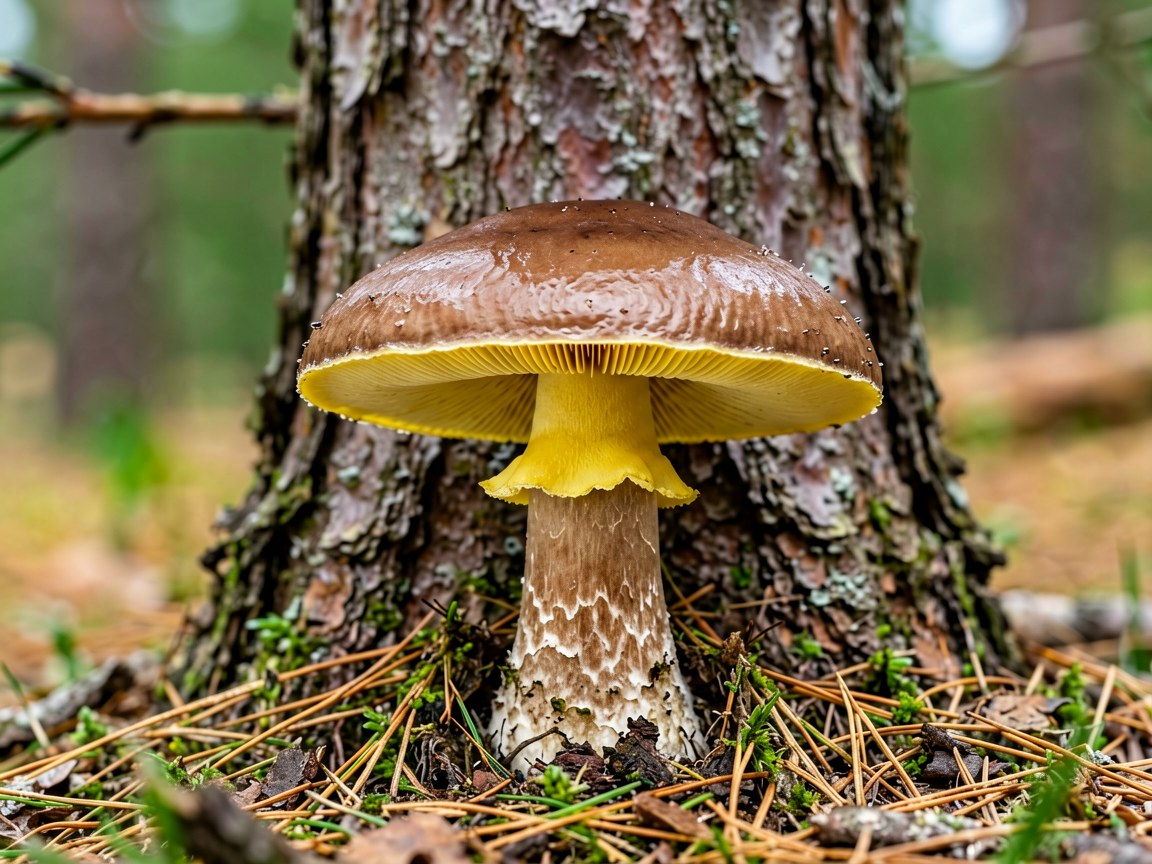
Suillus luteus | Slippery Jack
Introduction
The slippery jack (Suillus luteus) is a greasy-capped mushroom of pine woods, so named for the slimy, slippery skin that covers its brown cap in damp weather. A familiar sight under conifers in autumn, it is a reliable edible fungus across Europe and beyond, valued for its mild flavour and its close ties to pine trees. Its sticky cap and ringed stem make it one of the easier boletes to recognise.
Taxonomy
Suillus luteus is a fungus in the family Suillaceae, within the order Boletales—the bolete mushrooms, which bear spores in a sponge of tubes rather than on gills. It is a relative of the prized cep and, like other fungi, shares the lifestyle of Amanita muscaria: both feed by absorption instead of by photosynthesis.
Physical Characteristics
The slippery jack has a cap 5–12 cm across, chestnut to chocolate brown and, when moist, distinctly slimy to the touch. Underneath is a spongy layer of yellow pores that bruises olive-brown, not gills. The stem is pale, capped at the top by a ragged, floppy ring, and the flesh is soft and pale yellow. The slimy cap skin can be peeled off—a useful identification trick.
Habitat
This bolete is almost always found under pines, with which it forms a partnership that helps the tree take up nutrients. It fruits from summer into late autumn on the needle litter of pine plantations and natural pine woods, often in troops. Introduced pines around the world have carried it with them, so it is now widespread wherever pines grow in suitable climates.
Diet
Slippery jacks are mycorrhizal fungi: their mycelium wraps around pine roots and trades sugars from the tree for minerals and water from the soil, a two-way partnership. The mushroom itself does not photosynthesise; it is the fruiting body of that underground alliance. This dependence on living pine roots is why the fungus is never found far from its tree.
Reproduction
The mushroom reproduces by spores formed in the pores under the cap. These drop as a dusty brown cloud and are carried on the air; those that land in pine soil may join a new mycorrhizal network. The cap’s slime is thought to help it survive dry spells and may protect the developing spores, so a wet autumn brings the best flush of slippery jacks.
Conservation
The slippery jack is common and not threatened. Its fortunes are tied to pine woodland, both natural and planted, so it benefits from conifer forests even where these replace native broadleaf. As a mycorrhizal partner it helps pines thrive, and as a food it supports foragers. It is a benign and abundant member of the autumn woods.
Fun Facts
- Its cap is genuinely slippery when wet, thanks to a layer of slime you can peel off.
- It grows only under pine trees, with which it trades nutrients through its roots.
- The stem wears a ragged ring, a tell-tale feature of the species.
- It is a close cousin of the prized cep, though milder and slimier in texture.
- Pine plantations around the world have spread it far beyond its native Europe.