 By st20113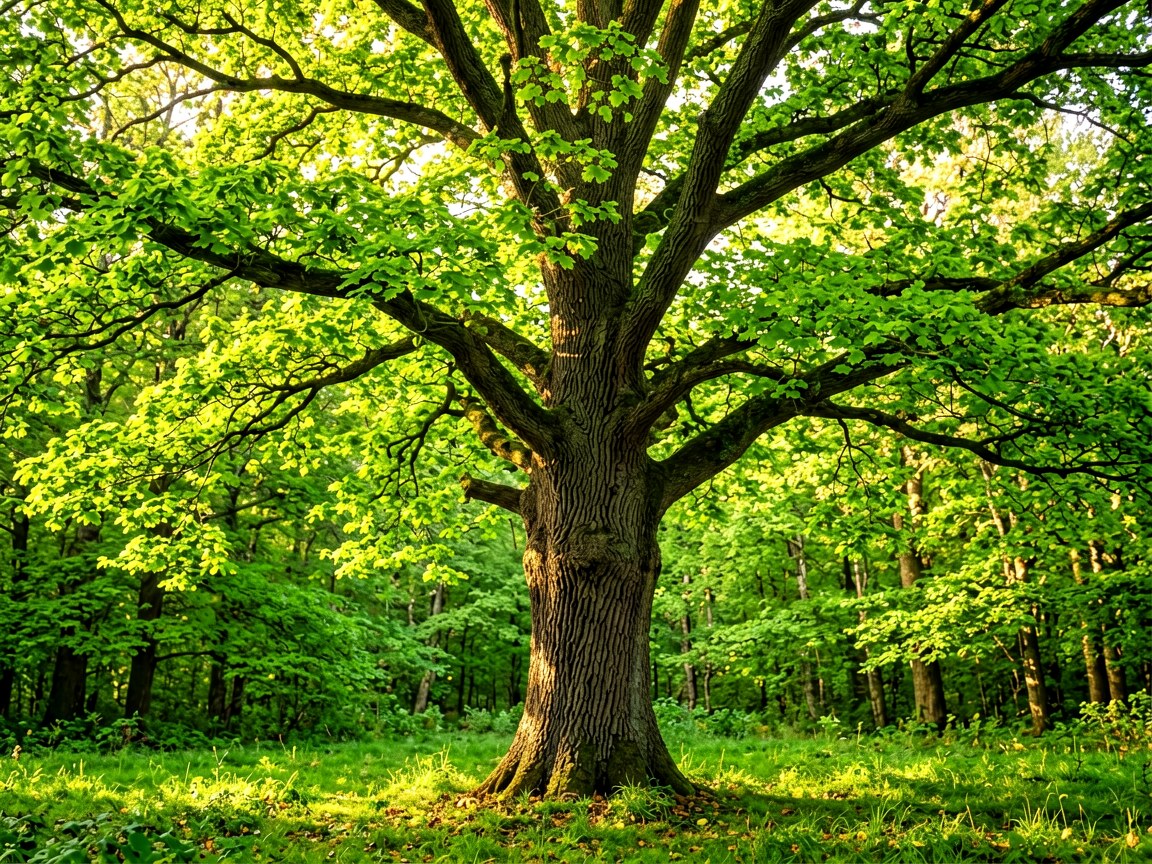
Quercus robur | English Oak
Introduction
The English Oak (Quercus robur), also called the pedunculate oak, is a majestic deciduous tree and one of the most iconic and ecologically important inhabitants of European woodlands. Reaching 20–40 m in height, it can live for several centuries and, in exceptional cases, over a thousand years, becoming a towering, gnarled keystone of the landscape. Few trees support as much life: a single mature oak may host hundreds of species of insects, fungi, birds, and mammals.
Long revered in European culture as a symbol of strength and endurance, the English Oak is a cornerstone of lowland and temperate broadleaved forest, hedgerows, and parkland. Its annually produced acorns are a vital autumn food for woodland wildlife, and its deep, spreading canopy creates the cool, stable conditions beneath which a rich understory thrives.
Taxonomy
Quercus robur was formally described by Linnaeus in 1758; the genus name Quercus is the classical Latin for oak, and robur means “strength” or “hard timber.” It belongs to the family Fagaceae, the beech family, alongside beeches, chestnuts, and hornbeams. The English Oak is distinguished from the related sessile oak (Quercus petraea) by its stalked acorns and stalked leaf bases.
Like all green plants, the oak is fundamentally dependent on the process described in our article on Photosynthesis (the plant energy process), by which it captures sunlight in its leaves to build the sugars that fuel its enormous growth and prolific acorn crops. Within Fagaceae it is especially close to the beech (Fagus sylvatica), sharing the hallmark of heavy, animal-dispersed nuts.
Physical Characteristics
The English Oak is a large, broad-crowned tree with a massive, often irregular trunk and stout branches. In maturity its bark is grey-brown and deeply fissured, while young trees have smoother, greyish bark. Its leaves are 5–12 cm long, lobed but with the lobes rounded and the leaf base tapering into a short stalk (petiole); unlike the sessile oak, the leaves and the acorns are both carried on stalks.
The acorns are its defining fruit: oval, 2–4 cm long, borne on elongated stalks (peduncles) and enclosed at the base by a scaly cup. The wood is pale brown, hard, and durable, especially underground, which made it prized for shipbuilding, timber-framing, and furniture. A mature oak’s canopy can span 10–15 m, and its root system is correspondingly extensive, anchoring the tree and cycling nutrients through the soil.
Habitat
The English Oak favours deep, fertile, well-drained soils and a temperate, moist climate. It grows across most of Europe, from the British Isles and Iberia east to the Caucasus, and from southern Scandinavia to the Mediterranean mountains, tolerating a wide range of conditions but doing best in lowland and hill country below about 1,000 m. It is a major component of oak-hornbeam, oak-ash, and mixed deciduous woods, as well as hedgerows and wood-pasture.
It is moderately shade-tolerant when young and eventually becomes a light-demanding canopy tree. Oaks establish readily on disturbed ground and are frequently planted in parks, avenues, and reforestation schemes. Because it supports such a vast associated fauna, the presence of veteran oaks is a reliable indicator of high habitat value, and dead or dying oaks are kept wherever safety allows for their irreplaceable role as invertebrate habitat.
Diet
The English Oak is autotrophic, manufacturing its own food by photosynthesis in its leaves and drawing water and mineral nutrients from the soil through its roots. It is a strong net producer, converting sunlight, carbon dioxide, and soil minerals into the enormous mass of wood, leaf, and reproductive tissue that builds a centuries-old tree.
Its energy economy is tightly linked to its associates: the tree supplies carbon-rich sugars to mycorrhizal fungi in the soil and, in turn, receives improved access to water and nutrients; and its leaves, when they fall, become a long-lasting leaf litter that feeds a specialised decomposer community. Acorns represent a massive seasonal investment of stored energy, packaged to be dispersed and cached by animals.
Reproduction
The English Oak is monoecious, bearing both male and female flowers on the same tree. In spring, long pendulous male catkins release vast quantities of wind-borne pollen, while tiny female flowers emerge at the base of the new shoots. Fertilised flowers develop into the familiar acorns, which ripen through summer and are shed in autumn.
Acorns are dispersed largely by animals—jays, squirrels, mice, and badgers cache them, and many are forgotten and germinate. A seedling requires an open, sunny gap to establish, and growth is initially slow. Oaks typically begin bearing acorns at 40–50 years, with bumper “mast” years every few seasons that can flood the woodland floor with seedlings and provision a superabundance of winter food for wildlife.
Conservation
The English Oak is widespread and listed as Least Concern, but its ancient and veteran trees—the most valuable life-supporting stage—are declining as old wood-pasture and traditional management disappear. New threats include acute oak decline, oak processionary moth, and introduced pathogens, alongside the fragmentation of continuous woodland that many associated species require.
Climate change poses a subtler risk: the oak’s long life means today’s seedlings must endure conditions decades ahead, and prolonged drought and heat can check regeneration in parts of its southern range. Conservation effort centres on protecting veteran trees, restoring connected broadleaved woodland, and planting diverse, locally sourced stock. As a foundation species, safeguarding the oak safeguards hundreds of dependent organisms at once.
Fun Facts
- A single mature English Oak can support over 2,000 species, more than any other native European tree.
- The famous “Royal Oak” in which King Charles II hid in 1651 was a *Quercus robur*, embedding the species in British history.
- Oak wood buried in water or wet soil becomes “tank oak,” almost impervious to rot—Roman and medieval builders used it for foundations and waterfronts.
- Oak galls, produced by wasps, supplied the iron-rich ink used for centuries of European manuscripts, including the Magna Carta.
- Some English Oaks are estimated to be more than 1,000 years old, having stood since the Norman Conquest.
[…] single year and its leaf veins do not end in bristle tips. The holm oak is a close relative of the English oak. The deciduous oak of northern Europe. And the two share the same genus. The English oak sheds its […]