 By st20113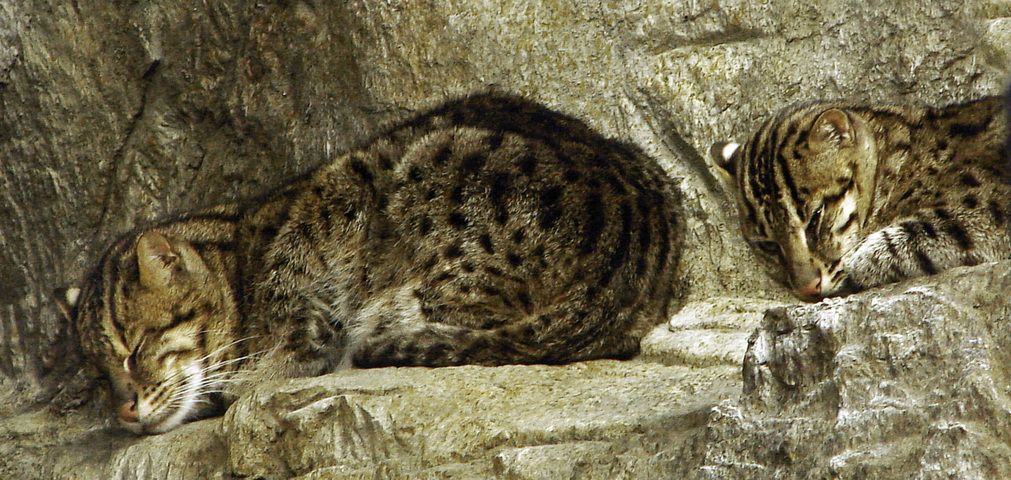
Introduction
The fishing cat (Prionailurus viverrinus) is a medium-sized wild cat native to the wetlands, marshes, and mangrove forests of South and Southeast Asia. Superbly adapted to a semi-aquatic life, it is one of the few felids that readily enters water to hunt. Its webbed front paws, water-resistant coat, and strong swimming ability set it apart from most of its relatives. Despite its specialized lifestyle, this elusive cat remains poorly known and is threatened across its range.
Taxonomy
The fishing cat belongs to the family Felidae and the genus Prionailurus, which includes several small Asian cat species. It is most closely related to the leopard cat and the rusty-spotted cat. First described scientifically in the early nineteenth century, the species has no widely recognized subspecies today, though populations from different river systems show subtle variation in size and coloration. Recent genetic work has clarified its position within the genus and supported its status as a single widespread species rather than a cluster of isolated forms.
Physical Characteristics
Fishing cats are robust and muscular, larger than domestic cats, weighing 5 to 16 kilograms and measuring up to 85 centimeters in body length plus a short tail. Their coat is olive gray to brown with dark spots and stripes, providing camouflage among reeds and shadows. Uniquely, their claws are only partially retractable, aiding grip on slippery prey. The rounded ears, short muzzle, and slightly elongated body give the fishing cat a distinctive, otter-like appearance. A layer of insulating underfur beneath the guard hairs helps keep the cat warm during long hours in cold water.
Habitat
This cat is bound to water. It inhabits freshwater wetlands, oxbow lakes, tidal creeks, and mangrove swamps from India and Nepal through Bangladesh, Sri Lanka, Thailand, and Cambodia. It is most active at night along water edges, where it patrols banks in search of fish. Human conversion of wetlands to agriculture has severely fragmented its range, pushing it into closer contact with the Bengal tiger and other wetland predators such as the saltwater crocodile.
Diet
As its name suggests, fish make up the bulk of the fishing cat’s diet, but it is an opportunistic hunter. It uses a characteristic paw-patting technique to strike fish near the surface, and will also dive to catch prey. Beyond fish, it eats frogs, crustaceans, snakes, birds, and small mammals. It is strong enough to overpower prey larger than itself and will drag catches ashore to eat them in safety. Like the adaptable red fox, it exploits whatever food is locally abundant, including livestock and poultry near villages.
Reproduction
Fishing cats breed throughout the year in most parts of their range, with a peak linked to local rainfall and prey availability. After a gestation of about 63 to 70 days, females give birth to a litter of typically two to three kittens in a sheltered den near water. The mother raises the young alone, teaching them to swim and hunt at a few months of age. Kittens begin to accompany their mother on short hunting trips before they are fully grown. Young cats become independent at around eight to ten months.
Conservation
The fishing cat is classified as Vulnerable by the IUCN, with populations declining due to wetland loss, pollution, and retaliatory killing by fishers who blame it for lost catch. It is protected by law in most range countries, but enforcement is weak. Community-based conservation and wetland restoration offer the best hope. Camera-trap surveys are helping scientists map the few remaining strongholds. Public awareness programs in countries like India and Cambodia are slowly improving its fortunes.
Fun Facts
The fishing cat’s toes are partially webbed, a rare trait among cats. It can scoop fish from the water with a rapid downward slap of its paw. Unlike most cats, it does not avoid water and often swims long distances between habitats. Its scientific name viverrinus refers to its resemblance to the civet, a slender nocturnal mammal. Researchers track individuals using radio collars to learn how far they roam along river systems. The fishing cat remains one of the least studied cats in Asia, and much of its wild behavior is still being documented.