 By st20113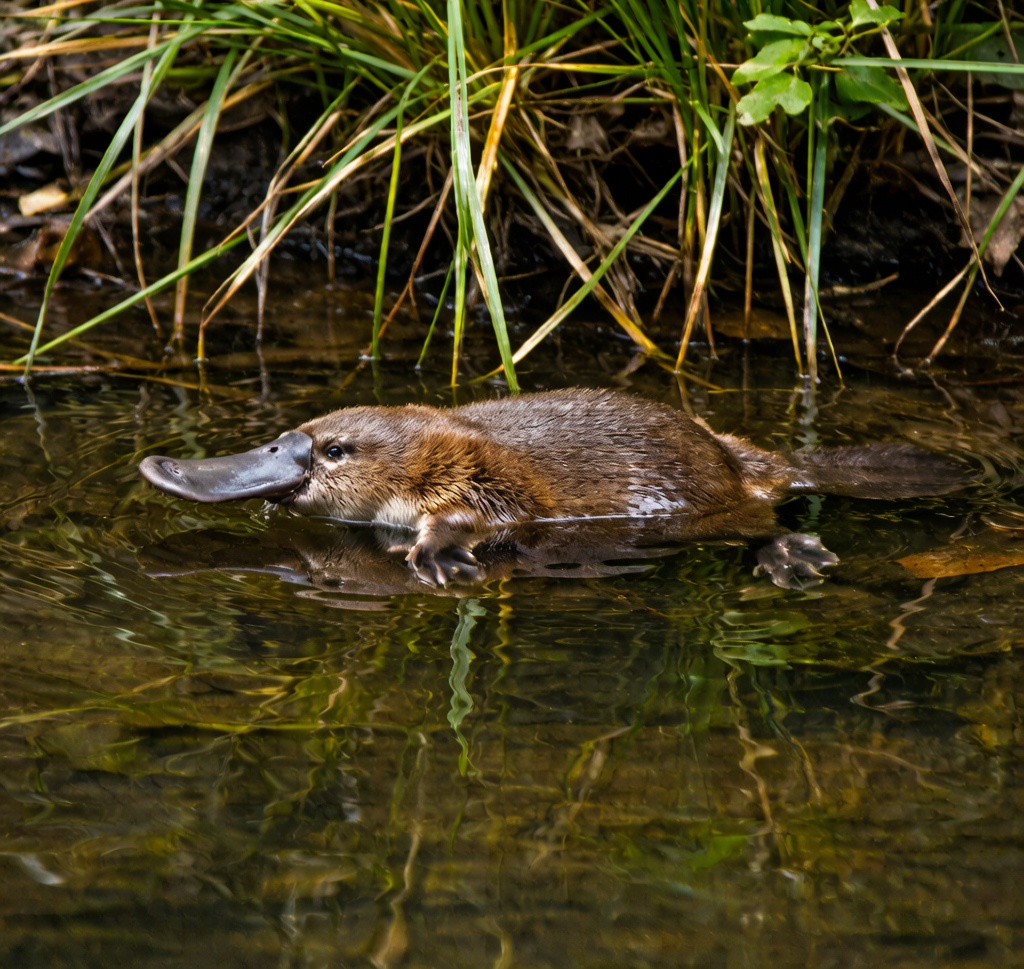
The platypus (Ornithorhynchus anatinus) is perhaps the most extraordinary mammal on Earth — a bizarre, duck-billed, egg-laying monotreme from eastern Australia that confounded European naturalists so thoroughly upon its first description that they initially assumed it to be an elaborate hoax. Its peculiar anatomy — a mammal’s body topped with a duck’s bill, laid flat with a beaver’s tail and otter’s feet — represents a unique branch of the mammalian family tree. Perhaps most remarkably, male platypuses carry venomous spurs on their hind legs — one of the very few venomous mammals on Earth. Found in the freshwater streams and rivers of Australia’s eastern seaboard, the platypus remains one of the most difficult wild animals to study, spending up to 17 hours per day submerged in murky water.
## Physical Characteristics
The platypus has a streamlined, torpedo-shaped body measuring 40 to 60 centimeters in length, with a flat, paddle-shaped tail of 10 to 15 centimeters, weighing 1.0 to 2.4 kilograms, with males significantly larger than females. Its most distinctive feature is its broad, flat, rubbery snout — covered in soft, moist skin rich in electroreceptors that detect the weak electrical fields generated by the muscle contractions of its prey. The eyes and ears are located in a groove behind the bill, which is closed when the animal is swimming underwater. The fur is dense, waterproof, and woolly next to the skin. Males possess a hollow, barbed spur on each hind ankle, connected to a venom gland, which can inflict a painful wound.
## Habitat and Distribution
The platypus is found throughout the freshwater systems of eastern Australia, from Cooktown in far north Queensland to Tasmania and South Australia. It inhabits streams, rivers, lakes, and dams — any freshwater environment that provides clear, slow-moving water with suitable banks for burrows and an adequate supply of invertebrate prey. Each individual occupies a home range along a stretch of water approximately 3 to 7 kilometers in length. They excavate burrows in the banks of waterways — complex tunnel systems with multiple chambers and entrances, one of which is typically submerged below the waterline to provide an underwater escape route.
## Behavior and Diet
The platypus forages by swimming along the bottom of streams and ponds with its eyes, ears, and nostrils closed, using its exquisitely sensitive bill to detect the electrical signals produced by the movement of its prey — primarily aquatic and semi-aquatic invertebrates. It scoops these prey items into cheek pouches and surfaces to eat, grinding them between keratinous pads in its mouth. Each foraging bout lasts approximately 30 seconds to two minutes. Beneath the water, it can remain submerged for up to 10 minutes. While underwater, its heart rate drops dramatically — a diving reflex that conserves oxygen during extended foraging dives.
## Reproduction
The platypus is one of only five monotreme species — the egg-laying mammals. Mating occurs between June and October. The female lays one to three (typically two) leathery eggs, which she incubates by curling around them, regulating their temperature by controlling the flow of blood through the veins in her tail. After approximately 10 days, the eggs hatch into blind, hairless young that are entirely dependent on milk — which the mother secretes through mammary glands without nipples, lapped from skin pores. The young remain in the burrow for approximately three to four months. Sexual maturity is reached at approximately two years of age. Wild platypuses can live up to 20 years.
## Conservation
The platypus is classified as Least Concern on the IUCN Red List, though there is growing concern about its long-term survival. Recent studies suggest that platypus populations may have declined by up to 30 percent since European colonization. The species faces threats including habitat loss and fragmentation, water extraction, pollution, drought, and climate change. The 2019-2020 Black Summer bushfires devastated enormous areas of platypus habitat across eastern Australia. Conservation efforts include the protection of riverine habitat, the regulation of water extraction, and ongoing research using environmental DNA (eDNA) sampling.