 By st20113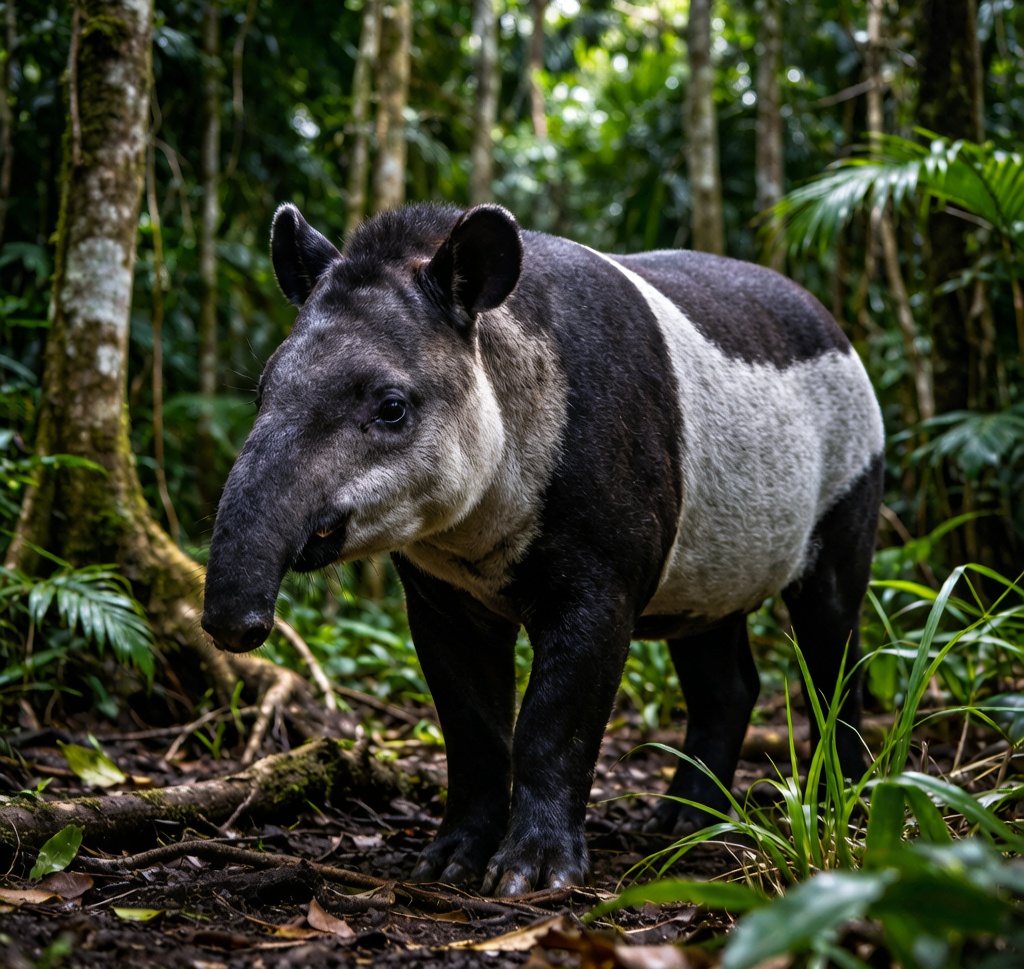
The Malayan tapir (Tapirus indicus) is the largest of the five tapir species and the only one found in Asia — a distinctive herbivore whose striking black-and-white markings make it one of the most visually unmistakable large mammals in Southeast Asia. Often described as a “living fossil,” the tapir represents a unique branch of the mammalian family tree, possessing a suite of primitive characteristics alongside highly specialized adaptations for its forest habitat. Most distinctive is its flexible, trunk-like proboscis — a shortened snout formed by the fusion of the nose and upper lip — which the tapir uses to grasp leaves, pluck fruit, and sniff for danger. Found in the forests of the Malay Peninsula, Sumatra, and southern Thailand, the Malayan tapir is an important ecosystem engineer and seed disperser.
## Physical Characteristics
The Malayan tapir is the largest of the tapir species, with a body length of 1.8 to 2.4 meters, a shoulder height of 90 to 110 centimeters, and a weight of 250 to 320 kilograms, with males slightly smaller than females. Its most striking feature is its bold, sharply defined coat pattern: the head, neck, forelegs, and rear legs are solid black, while the rest of the body — the midsection, flanks, and rump — is white or creamy off-white. The face is characterized by a moderate-sized head with small, rounded ears with white edges, small dark eyes, and a short, flexible trunk. The body is heavy and barrel-shaped. The legs are relatively short but sturdy, each ending in three toes on the front feet and three on the hind feet.
## Habitat and Distribution
The Malayan tapir is found in the Malay Peninsula and on the island of Sumatra (Indonesia). Its habitat consists primarily of primary and secondary tropical and subtropical broadleaf forests, including lowland and montane rainforests, freshwater swamp forests, and cloud forests up to approximately 2,000 meters elevation. Tapirs are highly dependent on the availability of water and are almost always found in proximity to rivers, streams, and pools. Each tapir maintains a large home range — typically 12 to 28 square kilometers for females and up to 40 square kilometers for males. The tapir’s forest habitat has been severely fragmented and reduced by palm oil and rubber plantation development.
## Behavior and Diet
The Malayan tapir is primarily nocturnal and crepuscular. It is a solitary forager, with males and females coming together only briefly for mating. Its diet consists of the leaves, twigs, shoots, and fruit of a wide variety of forest plants — over 100 species have been recorded. Fruit consumption is particularly important for seed dispersal: the tapir swallows large seeds whole and passes them intact through its digestive system. Tapirs are excellent swimmers and often feed while partially submerged in water, using their trunk as a snorkel. When threatened, they can run surprisingly fast — up to 45 kilometers per hour — and will often take to the water to escape predators.
## Reproduction
Malayan tapirs reach sexual maturity at approximately three years of age. After a long gestation of approximately 390 to 410 days (approximately 13 months), the female gives birth to a single calf. Newborn tapirs are striped and spotted — a camouflage pattern that they lose gradually over the first six to eight months of life as they acquire the adult’s solid black-and-white coat. Calves are able to stand and run within hours of birth and begin consuming solid food within the first few weeks. They nurse for approximately six to eight months. The long interbirth interval — approximately 14 to 15 months — means that tapir populations recover slowly from depletion. Wild Malayan tapirs can live 25 to 30 years.
## Conservation
The Malayan tapir is classified as Endangered on the IUCN Red List. Its population has declined by more than 50 percent over the past 36 years. The primary threats are habitat loss and fragmentation due to palm oil, rubber, and timber plantation development; illegal hunting for meat and medicinal use; and climate change. Conservation efforts include the protection of critical forest habitats within national parks and reserves, anti-poaching patrols, and ongoing research into tapir populations, movement patterns, and ecological requirements.