 By st20113
Platalea leucorodia | Eurasian Spoonbill
Species Profile · Threskiornithidae
Eurasian Spoonbill
A tall white waterbird that sweeps a flat, spoon-shaped bill through shallow water, feeling for fish instead of looking for them.
IUCN: Least Concern
Range
Length
Wingspan
Weight
Clutch
The bird with a spoon
The Eurasian spoonbill
The Eurasian spoonbill is a tall white waterbird. Its bill is long, flat and shaped like a spoon. It is one of the most distinctive birds of the European ibis family. It feeds in a special way. It walks slowly through shallow water. It sweeps its bill from side to side.
It feels for fish and shrimps. It does not look for them. The method only works in very shallow, calm water. So the bird needs lagoons, estuaries, marshes and wet meadows. Those places must stay wet all through the breeding season. The bird once vanished from much of western Europe.
Then it recovered. It is now common again in the Netherlands. It has spread back into France, Germany, Britain and Spain. It is a clear case of a wetland bird that gained from protection.
Family tree
An ibis among the herons
The Eurasian spoonbill is in the family Threskiornithidae. That family holds the ibises and spoonbills. Modern schemes place it with herons, egrets, pelicans and cormorants. Older schemes grouped it with the storks. Three subspecies are usually accepted. The first lives in Europe, North Africa and the Middle East. The second lives only in Mauritania on the Atlantic coast of Africa.
The third lives along the Red Sea and the Horn of Africa. Its bill is unique among the region’s waterbirds. It is long and flat and widens at the tip. Its nostrils are small and set far back. That lets the bird breathe as the tip probes mud. A Swedish naturalist described the species in 1758. A bird that shares the same marshes is the Grey Heron.
Both are large and long-legged. But the heron hunts by sight. It stabs at prey it can see. The spoonbill hunts by touch. The two can feed side by side in the same water using totally different methods.
Bill, crest and white plumage
How to identify one
An adult spoonbill is 80 to 93 cm long. It stands about 70 to 80 cm tall. Its wingspan is 120 to 135 cm. It weighs 1.1 to 1.5 kilograms. That is about the size of a small heron. But it is much lighter in build. Its plumage is all white at every age. Its bill is black over most of its length.
The tip carries a yellow patch. Its legs are black. Breeding adults grow a long shaggy white crest. They also grow an orange-yellow patch on the throat and breast. That patch brightens as the season goes on. Some birds show a small pink patch at the base of the bill. Its eye is red. A patch of bare skin around the eye is yellowish.
Young birds look different. Their bills are pale with dark marks. Their outer wing feathers have dark tips. Their legs are pinkish. Its wings are broad and rounded. It flies with the neck out and the legs trailing. The wingbeats are slow and regular. The flight looks unhurried.

1
2
3
Lagoons, deltas and marshes
Where it feeds
The spoonbill lives in shallow wetlands. It uses coastal lagoons, salt marshes, river deltas and estuaries. It also uses freshwater marshes, reedbeds and flooded floodplains. It needs two things at once. It needs shallow water full of small animals. It also needs a safe, isolated nesting spot. Islands, low bushes in reedbeds and tree tops all work. The Netherlands is the European stronghold.
Several thousand pairs nest there. Many more birds winter there too. The species also nests in Spain, France, Germany, Italy, Austria and Hungary. It nests in the Balkans as well. It has returned to Britain inside fenced reserves. It had been away for more than 300 years. It feeds in water less than 30 cm deep. It avoids dry ground and deep water.
So a change in water level can ruin a lagoon for weeks. Most European birds migrate. They winter in West Africa from Senegal to Nigeria. Some winter in Morocco, Tunisia and the Mediterranean. Some Dutch birds stay all winter. Ringing shows they return to the same wintering area each year.
What it eats
Sweeping the shallows
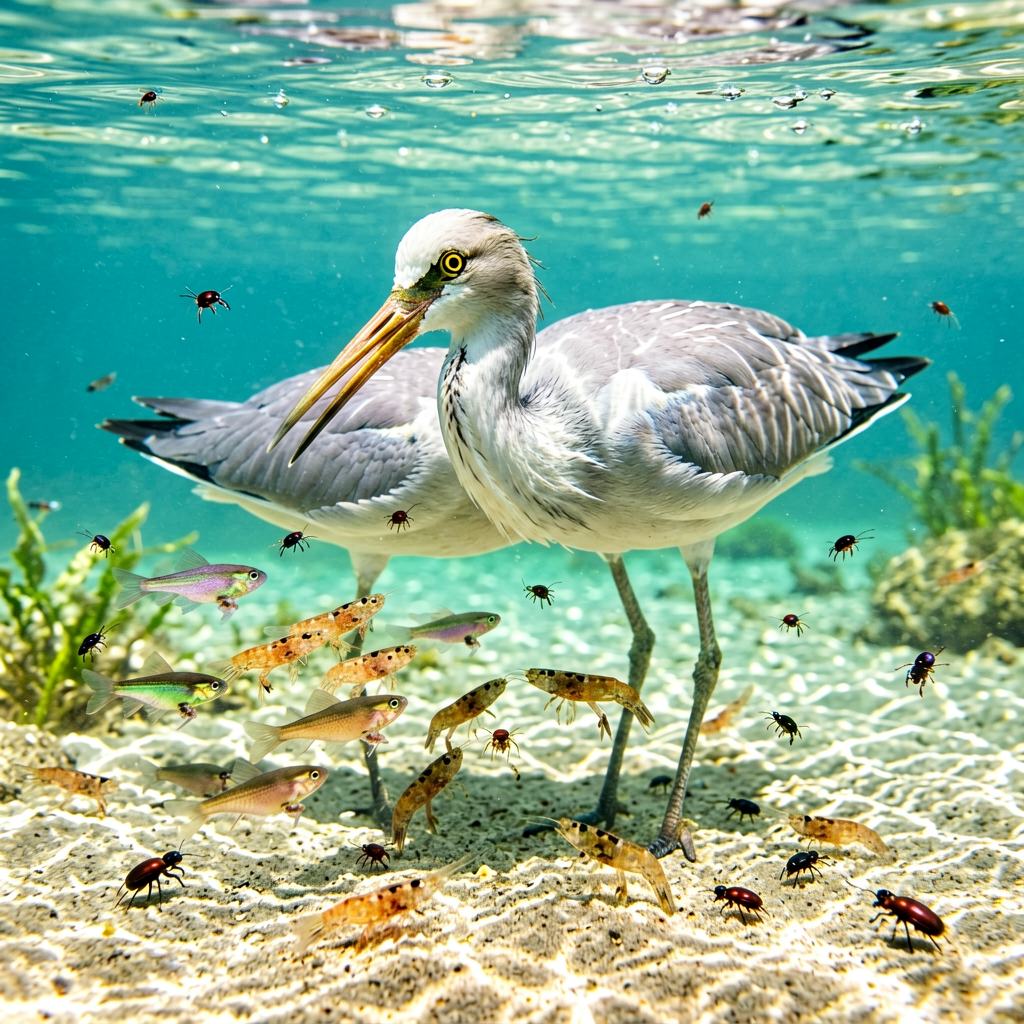
The spoonbill finds food by touch, not by sight. It sweeps its flat bill through the water. The bird walks forward with its head down. The tip of the bill passes through mud and water. It picks up small objects and swallows them. This works at night as well as by day. It also works in muddy water. A sight-feeding heron could not feed there. But the bird cannot choose its prey carefully.
It takes whatever comes within reach. So its diet is broad. Small fish form much of the food. It also takes shrimps, prawns and water beetles. Dragonfly larvae and other water insects are eaten too. So are small frogs and newts. It sometimes swallows plant material. The mix depends on the wetland. Birds in lagoons take many shrimps and small flatfish.
Birds on inland marshes take more insects and amphibians. Spoonbills often feed in loose groups. They walk the shallows in the same direction. Group feeding may stir prey out of the mud. It also clouds the water. The birds must keep moving as levels change. Tracked birds use a chain of wetlands along the coast.
Stick nests in colonies
Three to five eggs
Spoonbills nest in colonies. The nests are made of sticks and reed stems. They sit in low plants, on the ground on islands, or in trees. Many sit in mixed heronries with herons, egrets and cormorants. Pairs are usually faithful within a season. They form at the colony with much bill-snapping and display. The female lays 3 to 5 eggs.
Both adults share incubation. It lasts about 24 to 25 days. Then both parents brood and feed the chicks. The adults feed the young by regurgitation. The chicks stay in or near the nest for 4 to 5 weeks. After that they can move about the branches. They fledge at about 7 weeks of age.
Then they follow the adults to feeding areas for some weeks. Spoonbills are slow to mature. They usually first breed in their third or fourth year. Ringed birds have lived more than 20 years. But many colonies produce few young. A wet, cold summer can kill most chicks. So the species needs good years to balance the bad ones.
Back from a low point
A European recovery
The Eurasian spoonbill is Least Concern worldwide. The world population is large. It spreads across Europe, Africa and Asia. But the European story is mixed. The bird vanished from Britain and Germany. It left much of its old nesting area between the 1600s and the 1900s. Draining, hunting and egg collecting caused this. Then protection began to work.
Dutch colonies were guarded. New wetland reserves were made. Nesting islands were fenced. The Dutch population grew to several thousand pairs. Birds from there recolonised nearby countries. Today the main problem is the loss of shallow wetlands. Drainage, land-claim, flood defences and water abstraction all damage them. Disturbance is another threat.
Visitors, boats and low-flying aircraft flush adults off nests. That exposes eggs and chicks to gulls and crows. Pollution also matters. Pesticides and heavy metals build up in the food chain. Nutrients change the plants and animals of a lagoon. Wintering sites in West Africa face their own pressures. Dams, salt works and building work have damaged several. Protection of sites, not one single measure, explains the recovery.
Quick hits
Five things to remember
- It feeds entirely by touch, sweeping its flat bill through the water instead of looking for prey.
- Its nostrils sit far back on the bill so it can breathe while the tip probes through mud.
- Breeding adults grow a shaggy white crest and an orange patch on the breast that deepens with the season.
- European birds fly to West Africa for the winter and return to the same wintering site year after year.
- The species was absent from Britain for more than 300 years before returning to breed inside fenced reserves.