 By Iris
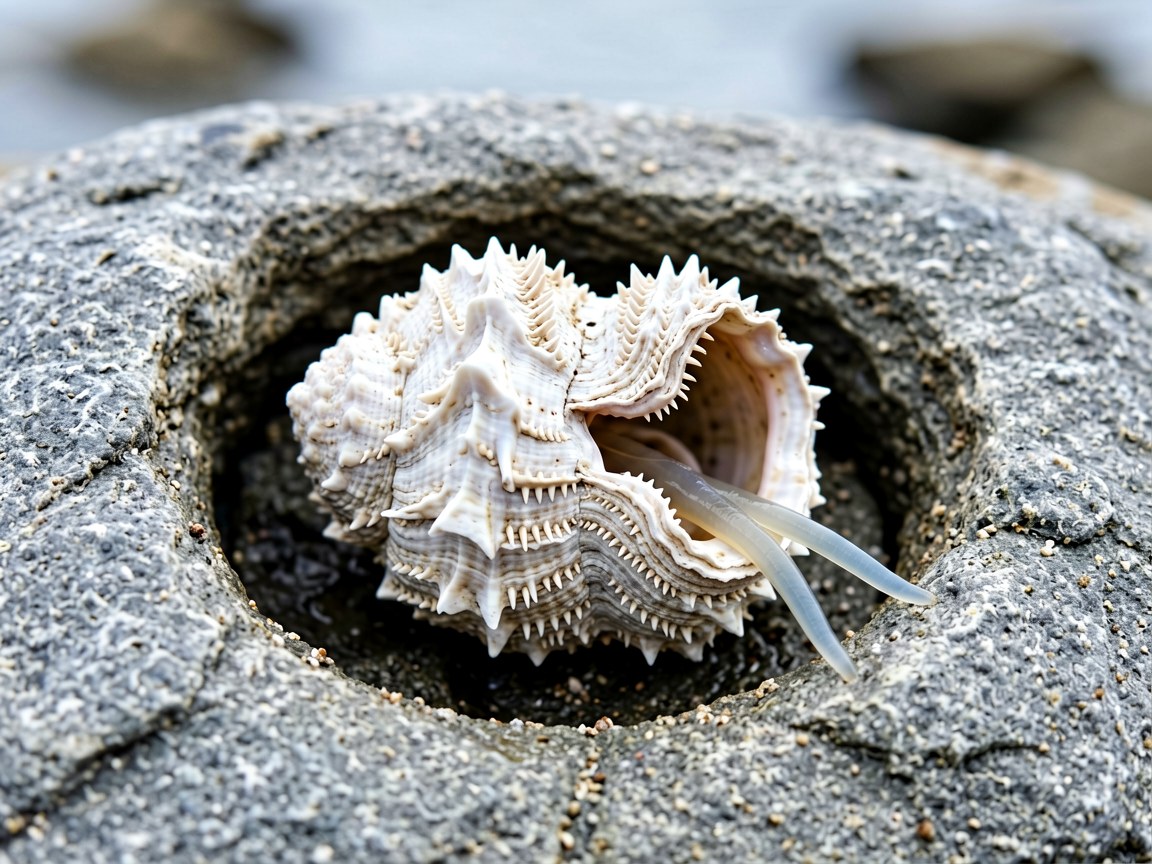
Pholas dactylus | Common Piddock
Introduction
The common piddock (Pholas dactylus) is a bivalve that bores into rock. Elongate, chalky-white, and armed with a shell covered in rows of tiny rasp-like teeth, it grinds its way into soft stone, clay, and wood and then lives out its life inside the burrow, reaching the surface only with its long siphons. It is also the animal behind a curious legend: when distressed it glows in the dark, and its faint blue-green light was written about by the Roman naturalist Pliny.
Taxonomy
Pholas dactylus is a marine bivalve mollusc in the family Pholadidae, the piddocks or angelwings. It belongs to the same class as the common mussel, Mytilus edulis, sharing the two-valved shell, the muscular foot, and the filter-feeding habit, but where the mussel lives exposed on the shore anchored by threads, the piddock has turned the shell into a drilling tool and lives hidden inside solid ground.
Physical Characteristics
The shell is elongate and oval, five to fifteen centimetres long, thin, brittle, and chalky-white, gaping at both ends. Its surface is covered in concentric ridges and radiating rows of tiny, sharp, file-like teeth that are used to rasp the burrow; new teeth are added at the growing edge as the shell is worn away. Two long, fleshy, fused siphons extend from one end and can stretch several times the length of the shell. Extra shell plates sit over the hinge area.
Habitat
Piddocks bore into soft rock such as chalk, limestone, shale, and clay, as well as into peat, hard-packed mud, and wood. They live from the low shore down to depths of several metres, and their burrows—round holes with a smooth interior—often riddle the same rock in large numbers. They occur on both sides of the North Atlantic and in the Mediterranean, wherever suitable soft stone is exposed at or below low water.
Diet
They are suspension feeders. The long siphons reach out of the burrow mouth to the water above, drawing in a current from which the gills strain plankton and fine organic particles, which are then carried to the mouth in mucus. Because the animal is sealed inside rock, feeding depends entirely on these siphons, which can be withdrawn quickly and are often the only living part of the animal visible at all.
Reproduction
The sexes are separate, and in some populations individuals change sex during life. Spawning takes place in summer, with eggs and sperm released into the water where fertilisation occurs. The larvae drift in the plankton for some weeks before settling onto suitable soft rock and beginning to bore immediately, using a young foot and the rasp-like shell. Once inside, the animal rarely if ever leaves its burrow, and it enlarges the hole as it grows.
Conservation
The species is not considered threatened and remains locally common where suitable soft rock is exposed. Because it is a borer, it can damage wooden structures, soft-stone harbour works, and historic chalk features, and it is sometimes treated as a pest rather than a species to protect. Its burrows, once abandoned, provide homes for many other small marine animals and are an important part of soft-rock shore habitats.
Fun Facts
- It bores into solid rock using its toothed shell, not chemicals.
- The burrows it leaves behind become homes for dozens of other small sea animals.
- It glows faintly blue-green in the dark, a phenomenon noted by the Roman writer Pliny.
- The shell gapes permanently at both ends and cannot close fully.
- Its siphons can extend several times the length of the shell to reach clean water.