 By st20113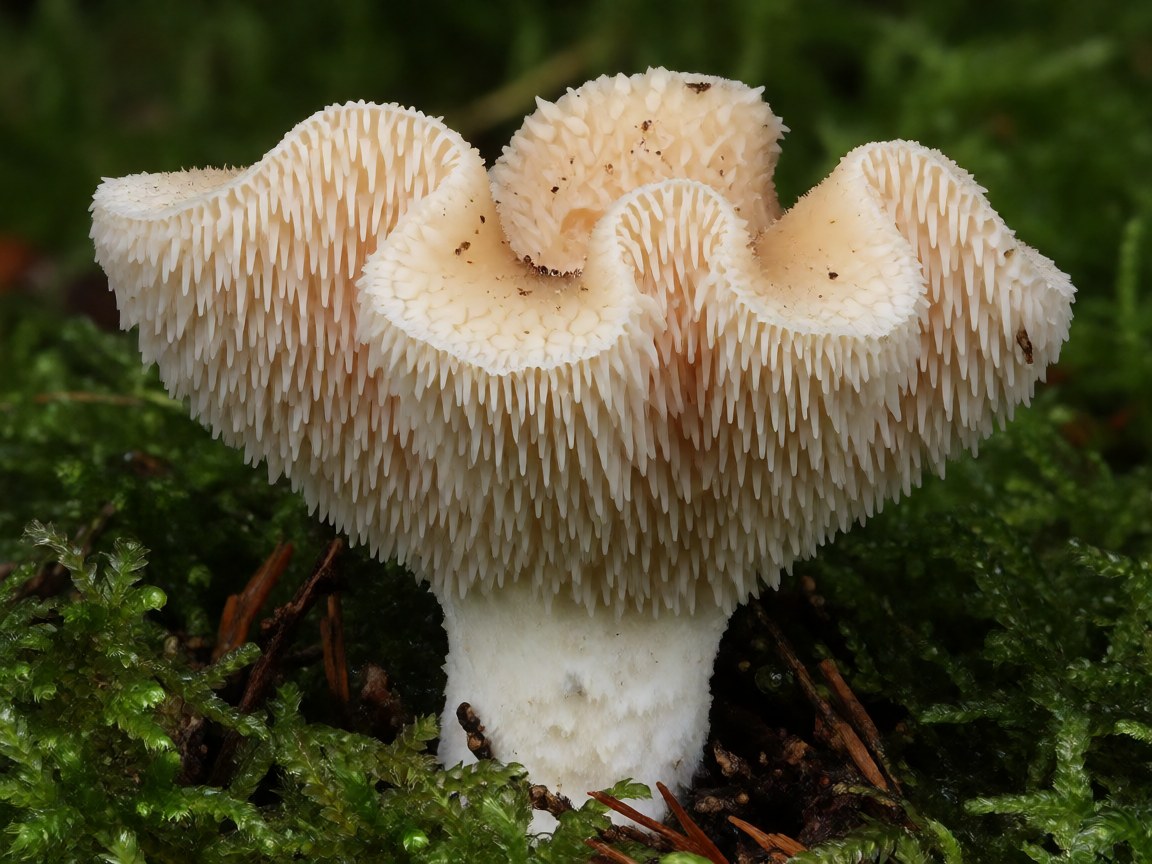
Hydnum repandum | Hedgehog Fungus
Introduction
The hedgehog fungus (Hydnum repandum) is an unmistakable woodland mushroom: instead of gills or pores, the underside of its pale cap is covered in a dense mass of soft, pale, downward-pointing spines or “teeth”. A good edible species with a firm, peppery flesh, it appears in broadleaf and conifer woodland from late summer into autumn, often in rings or troops. Few fungi are easier to recognise once you have looked beneath the cap.
Taxonomy
Hydnum repandum is a basidiomycete in the family Hydnaceae, the tooth fungi. Its spore-bearing surface is made of spines rather than the gills of the typical capped mushrooms or the pores of the brackets, and this arrangement places it well away from the familiar woodland genus Amanita, such as the fly agaric, even though both produce their spores on the underside of a cap and live in association with tree roots.
Physical Characteristics
The cap is three to fifteen centimetres across, irregular and often lobed or wavy, convex at first then flattening and sometimes slightly funnel-shaped, in pale cream, buff, or pale apricot with a slightly velvety, dry surface. The underside carries crowded, soft, brittle spines two to six millimetres long, pale cream to pinkish-buff, running a little way down the stem. The stem is stout, whitish, often off-centre, three to ten centimetres tall. Several caps often fuse into a single clustered mass. The flesh is firm, white, and has a slightly peppery taste.
Habitat
It grows on the ground in broadleaf and mixed woodland, especially under beech, oak, and birch, and also in conifer plantations, favouring mossy, well-drained ground. It appears from late summer to late autumn, sometimes into winter in mild years, and often fruits in rings, arcs, or small troops. It is common and widespread across Europe and North America.
Diet
The fungus is mycorrhizal: it forms a partnership with the fine roots of trees. Its threads sheathe the root tips and reach out into the soil, taking up water and minerals and passing some to the tree, in exchange for sugars produced by the tree’s own photosynthesis. It is not a decomposer and does not feed on dead wood or leaf litter; the cap is only the temporary fruiting stage of a long-lived underground network.
Reproduction
Spores are produced on the surface of the countless tiny spines under the cap and are released into the air, drifting to land on ground near a suitable tree root. The greatly increased surface area provided by the spines is thought to boost spore production substantially. Where a spore finds a compatible host root, a new partnership begins, and the resulting network may go on to produce mushrooms in the same place for many years.
Conservation
The species is common, widespread, and not threatened, and it is one of the better-known edible wild mushrooms. It is collected in many countries, but there is no evidence that careful picking harms the underlying network, which lives on beneath the soil. Its main requirement is simply mature woodland with undisturbed, mossy ground and living tree roots to partner with.
Fun Facts
- Its underside is covered in soft spines or teeth rather than gills or pores.
- The spines greatly increase the surface area available for producing spores.
- Caps often fuse together into irregular, wavy masses of several “mushrooms”.
- It is a good edible species, with firm flesh and a faintly peppery taste.
- Old specimens often have hollow stems and are frequently riddled by insect larvae.