 By st20113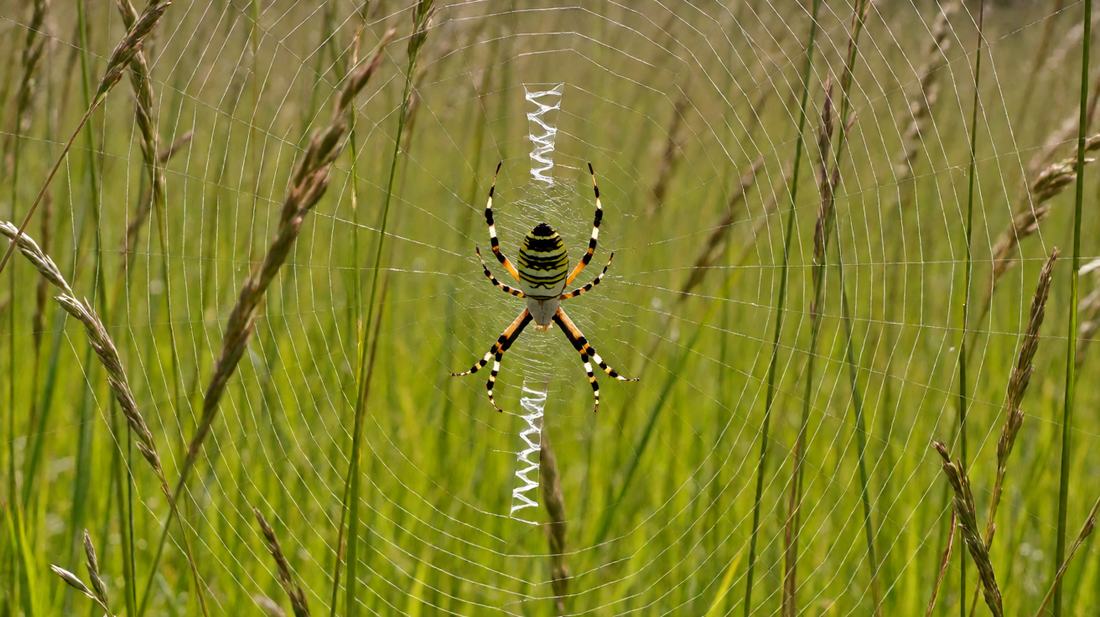
Argiope bruennichi | Wasp Spider
Species Profile · Araneidae
Wasp Spider
The big yellow-and-black orb-weaver of late summer grass, with a white zigzag of silk across its web and a spread north that is still going.
IUCN: Not Evaluated
Range
Female
Male
Web
Eggs
The banded late-summer spider
A wasp look-alike in the grass
The wasp spider is a big, boldly banded orb-weaver. It now sits in the middle of tall grass across much of Europe. It is one of the few spiders that most people notice. It is also one of the few they can name. The female has bright yellow and black bands across her abdomen. At a glance she looks like a wasp. That look may warn off birds. How well it works is still argued about.
The spider builds a big, neat, upright orb web. The web sits low in grass or heather. She usually waits head-down in the centre with her legs paired. A broad white zigzag of silk runs across the web. The mark is known as a stabilimentum. It makes the web easy to know. The species was once a southern and central European animal. Over the last century it has moved north into Britain, Germany, the Netherlands and Scandinavia.
It is now common in southern England and Wales. It is a late-summer spider. Adults come out in July and August. They breed and are gone by the first hard frosts of October. The young stay in the egg sac through winter. They come out in spring.
Family tree
Araneidae, the orb-weavers
The wasp spider is in the family Araneidae, the orb-weaving spiders. It sits in the genus Argiope. Scopoli named the species in 1772. The genus name comes from Greek. It is the name of a figure from myth. Argiope is a large genus. It lives across the warm parts of the world. The family Araneidae is one of the biggest spider families. It is defined by the wheel-shaped orb web.
The animals build, use and often rebuild that web. Within the family, Argiope is known by the shape of the abdomen. It is humped or lobed. The genus is also known for adding a stabilimentum to the web. There are about 80 named species in the genus. The wasp spider is the only Argiope native to northern Europe. Its spread north over the last hundred years has made it the best-known member of the genus there. Araneidae sits in the order Araneae, the true spiders. That sits in the class Arachnida.
The wasp spider shares the genus with the yellow garden spider. That is a North American species of much the same size and looks. The two are close kin. People often compare them. The American species builds the same kind of big orb web. It uses the same kind of white zigzag. That suggests the mark evolved once in a shared ancestor. It did not evolve twice.
Bands, silver hair, long legs
How to identify one
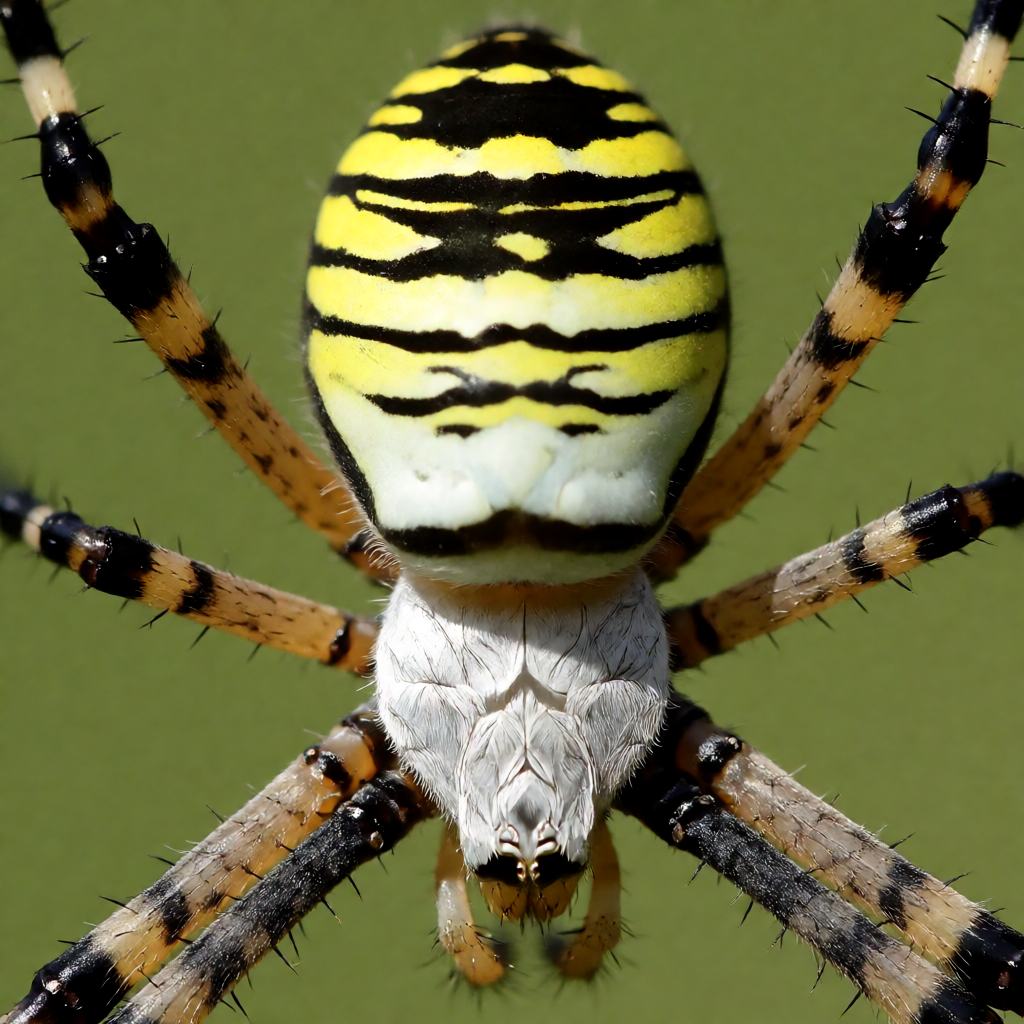
The wasp spider shows one of the biggest size gaps between the sexes of any European spider. A grown female has a body 12 to 20 mm long. With her legs spread she can span 40 mm or more. A grown male is 4 to 6 mm. That is about a quarter of the female’s length. He is slim and far less easy to see. The female’s abdomen is large, oval and slightly humped. It carries the pattern that gives the animal its name.
Broad bands of bright yellow and deep black run across the top. White spots sometimes sit between them. The underside has pale stripes running lengthwise. The front part of the body is the cephalothorax. It is covered in fine silvery-white hair. That is why the animal is sometimes called the silver argiope. The legs are long and thin. They are pale at the base and banded with dark rings.
There are 8 eyes in 2 rows. Like most orb-weavers, the spider uses vibration far more than sight. The male is duller and browner. His abdomen is smaller. His legs are longer for his size. The female can change how bright her bands look. Animals in cooler parts of the range tend to show more black.
1
2
3
Tall grass in warm open places
Where it lives
The wasp spider lives in open, sunny places with tall growth that can hold a web. The classic home is rough grassland, meadow, heath, roadside verge and railway bank. It also uses woodland clearings, garden meadows and marsh edges. It needs stems strong enough to anchor a web about 30 to 60 cm across. It needs open space round the web so flying insects can be caught. It does not live in dense woodland. It does not live in short mown grass or in deep shade.
Webs are usually built low. They sit from a few centimetres to about a metre above the ground. They sit among grasses, heather, bramble, nettles and tall weeds. The species likes warm, dry, sheltered sites. It is most common in the south of its range. It reaches farther north in warm years and in warm spots. Its spread has been linked to warmer summers.
The range now covers most of Europe. It runs from the Mediterranean north to southern Scandinavia. It runs east through central Asia to Japan. In Britain it was a rare southern insect for most of the 20th century. It has since become common in southern England and Wales. It is still moving north. It also lives in parts of North America now.
Insects caught in the orb
What it eats
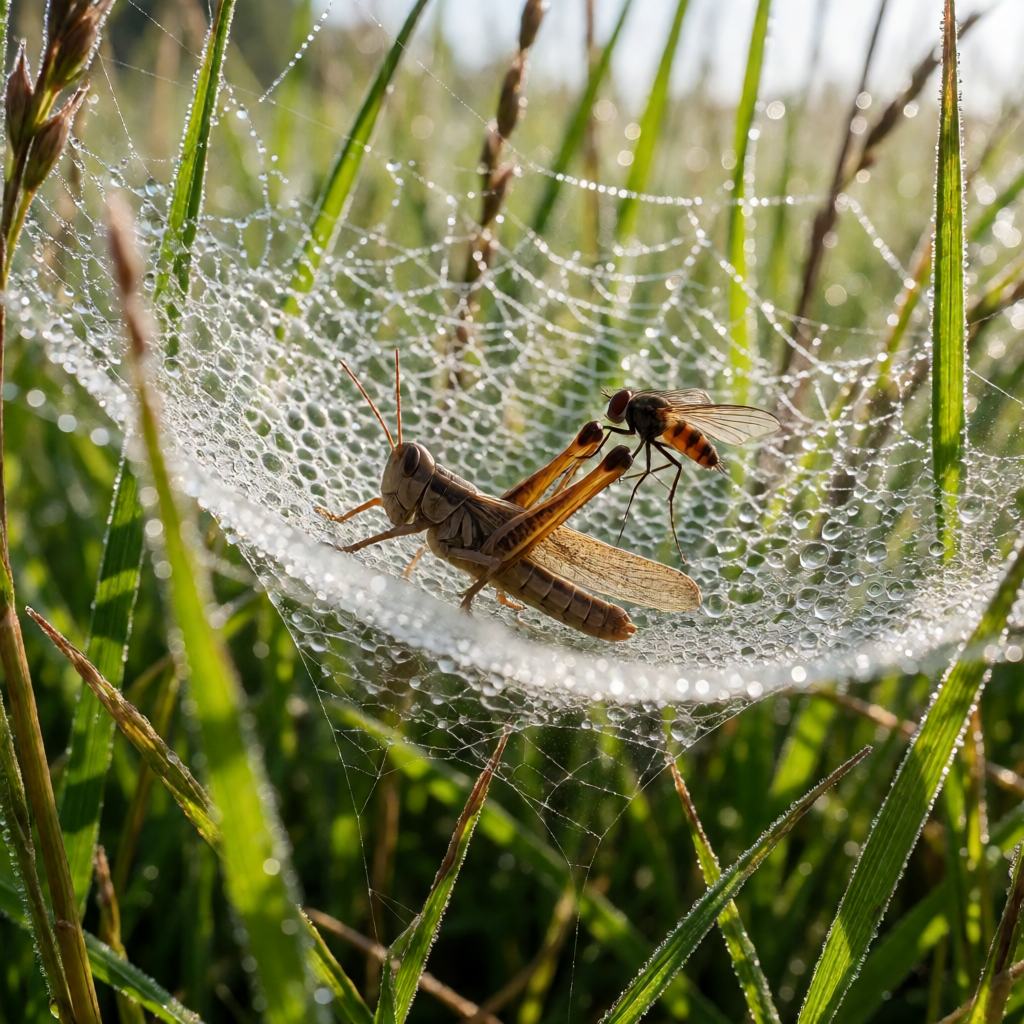
The wasp spider eats flying and jumping insects that hit the web. The main prey is grasshoppers and other orthopterans. It takes flies, bees and wasps. It takes moths and butterflies, beetles and bugs. It takes other spiders too. It takes prey much bigger than itself. A female will tackle a grasshopper several times her own weight. The sequence is standard for an orb-weaver. The spider feels the shake.
It runs to the prey. It bites and injects venom. Then it wraps the prey in bands of silk while turning it. Small prey may be carried to the centre of the web and eaten there. Big prey is bitten again and wrapped more fully. Digestion happens outside the body. The spider pumps enzymes into the prey. Then it drinks the liquid tissue. An empty husk is left behind.
The web is rebuilt or mended most days. That is usually at dusk or early in the morning. The old silk is often eaten so the protein is not wasted. The spider also eats the stabilimentum with the rest of the web. Hunting is passive. But the animal is not slow to act. It feels a struggling insect within a fraction of a second. It can cross the web fast.
One sac, and a short life
The breeding cycle
Breeding happens in late summer. The male wanders to find a female. When he finds her web he courts with care from the edge. He plucks and shakes the silk in a set rhythm. The signal matters. A male that rushes in may be taken as prey. Mating happens while the female feeds or is held still by his approach. It is brief. Sexual cannibalism is common.
The female often attacks and eats the male during or just after mating. This is not always the case. But it happens often enough that males in many groups mate once and die. A male that lives may guard the female or move on. The female makes an egg sac in autumn. That is usually in September or October. The sac is a rounded, flask-shaped or pear-shaped case. It is made of brown papery silk and is about 20 mm across. She hangs it among grass stems close to the ground.
It is hidden among dead plants. It holds several hundred eggs. The eggs spend the winter inside the sac. The spiderlings hatch in late spring. They come out through a small hole at the top. They spread on silk threads. The female dies with the first hard frost. Males mature earlier in the season than females.
Not Evaluated, spreading north
Conservation
The wasp spider is not assessed on the global Red List. It is not thought to be at risk. It is abundant and adaptable. Over the last century it has been spreading, not shrinking. Its move north through Europe is one of the best-documented range expansions among European invertebrates. Records from Britain, the Netherlands, Germany, Denmark and Sweden show a clear pattern.
The spider moves in, then its numbers rise fast. Warmer summers and milder winters are thought to be the cause. The life cycle depends on reaching full growth and laying eggs before autumn. The pressures on it are the usual ones for grassland invertebrates. Heavy grassland management hurts it. Mowing at the wrong time hurts it.
The loss of rough grass and weedy margins takes away the structure it needs for webs. Autumn mowing and the burning of rough ground destroy egg sacs. Pesticides cut the insect prey. The species is not protected by law anywhere. Its value is mostly as a sign of warm, varied, unimproved grassland. It is also one of the best-known spiders for getting the public interested in invertebrate conservation.
Quick hits
Five things to remember
- The white zigzag of silk across the web is called a stabilimentum, and its use is still argued about: it may draw in prey, warn birds off the web, or make the web stronger.
- The female’s yellow and black bands copy a wasp, and the spider will shake the whole web hard when disturbed, which makes her hard to hit.
- Males are only about a quarter of the female’s size and are often eaten by her during or right after mating.
- The egg sac is a brown papery flask hung in grass, and the spiderlings spend the whole winter inside it before they come out in late spring.
- The spider eats its own web most mornings and spins a fresh one, so the silk protein is used again rather than lost.