 By st20113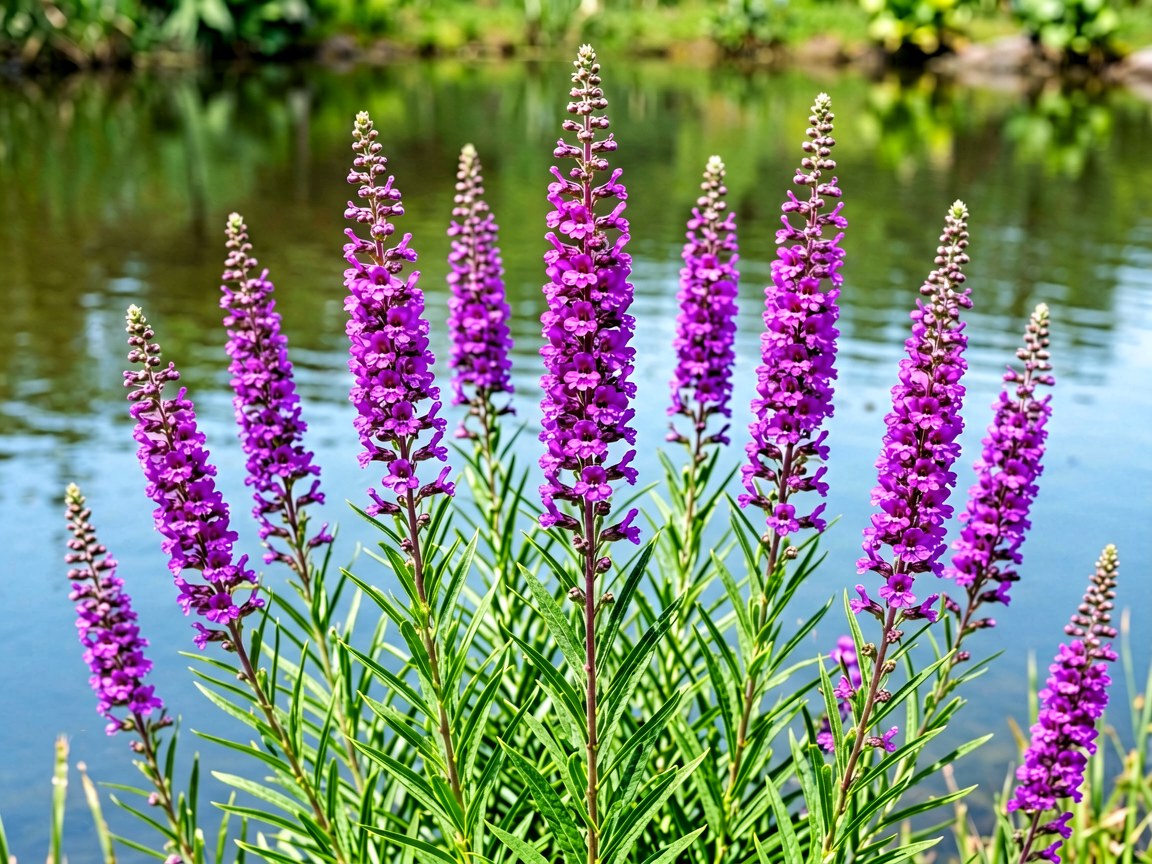
Lythrum salicaria | Purple Loosestrife
Introduction
Purple loosestrife (Lythrum salicaria) is the tall, stately plant with willow-shaped leaves and dense spires of vivid magenta-purple flowers that dominates wet ground in high summer. A single clump can carry dozens of flower spikes and produce millions of seeds in a season, and where conditions suit it, it forms spectacular purplish-red stands along riverbanks, around pond margins, and across wet meadows. Within its native range across Europe and Asia it is a familiar and valued part of wetland vegetation, and a magnet for bees. Introduced to North America in the nineteenth century, it became one of the most notorious invasive plants on the continent, choking wetlands and displacing native species on a continental scale — the same biology that makes it a fine native wild flower makes it a serious weed where nothing has evolved to hold it in check.
Taxonomy
Lythrum salicaria belongs to the family Lythraceae, the loosestrife family, a moderate-sized family of herbs, shrubs, and trees found mainly in warm and temperate regions and including the henna plant, the pomegranate, and the water chestnuts. The genus Lythrum contains about three dozen species of mostly wet-ground herbs, and the specific epithet salicaria means “willow-like”, a reference to the narrow leaves. Despite the English name it is not closely related to the yellow loosestrife, Lysimachia vulgaris, which belongs to the primrose family, and the shared name is simply an old descriptive term of uncertain origin. One of the most studied features of the species is its heterostyly: flowers come in three different forms with styles and stamens of differing lengths, a system that promotes cross-pollination and was famously analysed by Darwin. As a green plant it depends on Photosynthesis, and it is a fast-growing, competitive species that converts that energy into enormous quantities of seed.
Physical Characteristics
The plant is a stiffly upright, clump-forming perennial, usually sixty centimetres to a metre and a half tall, occasionally more, arising from a thick, woody, creeping rootstock. Several to many square, slightly hairy, reddish-tinged stems rise from the base, branching towards the top. The leaves are narrow, lance-shaped, and pointed, four to ten centimetres long, stalkless, with a heart-shaped or rounded base clasping the stem, and they are arranged in opposite pairs or in whorls of three around the square stem. The flowers are borne in dense, tapering, spike-like clusters at the top of the stems and in the upper leaf axils. Each flower is about one to one and a half centimetres across, with a tubular, ridged, reddish-purple calyx and five or six crumpled, spreading petals of a vivid magenta-purple or reddish-purple, and six or twelve stamens of two different lengths. The fruit is a small, oval capsule enclosed in the persistent calyx, and it contains numerous very small seeds. Flowering runs from June to September.
Habitat
It grows in wet places of every description: the margins of rivers, streams, canals, ponds, and lakes, marshes, fens, wet meadows, ditches, reedbeds, and damp woodland, and it will grow in shallow standing water as well as on wet mud. It favours nutrient-rich, neutral to slightly alkaline soils and open, sunny situations, and it is tolerant of a wide range of water levels, surviving both summer drawdown and winter flooding. Native across Europe, temperate Asia, and north-west Africa, it is common throughout most of Britain and Ireland, though it becomes scarce in the far north and west. It was introduced to North America, where it has spread across much of the continent, and it is also naturalised in parts of South America, Australia, and New Zealand.
Diet
Purple loosestrife is autotrophic and highly productive, growing fast and tall on the nutrient-rich sediments of wetland margins where nitrogen and phosphorus are plentiful. It responds strongly to enrichment, which is one reason it thrives in the ditches and wet places of farmed lowland and in the disturbed, nutrient-flushed ground of new wetlands. Its extensive, woody rootstock stores large reserves, which allows a clump to survive cutting, grazing, fire, and drought and to regrow vigorously. Like most wetland plants it has internal air spaces that carry oxygen down to the roots in waterlogged soil. It is a strong competitor: a dense stand shades out smaller species, and in its introduced range this is the main mechanism by which it displaces native wetland vegetation. Its foliage contains tannins and other compounds that make it unpalatable to most grazing animals, so it is largely left alone by livestock.
Reproduction
Flowering runs from June to September, and the bright spikes are extremely attractive to bees — honeybees, bumblebees, and solitary bees all work them heavily for nectar and pollen — along with butterflies, hoverflies, and beetles. The species is tristylous: individual plants have flowers of one of three types, in which the style and the two sets of stamens are arranged at three different heights, so that pollen is most effectively transferred between flowers of the same type on different plants. This arrangement strongly promotes outcrossing and was one of the classic examples used by Darwin in his work on plant reproduction. Seed production is prodigious: a single large plant can produce well over a million tiny seeds in a season, and although they have no special dispersal mechanism, they are very small and light, float on water, and are carried in mud on the feet of birds and on the tyres and tracks of vehicles and machinery. Vegetative spread also occurs, since broken pieces of the rootstock can take root, and detached stems can root in wet mud.
Conservation
Within its native range the species is common, widespread, and not threatened, and it is valued as one of the most important late-summer nectar sources of wetland and as an ornamental for pond margins and bog gardens. It declines where wetlands are drained, channelised, or intensively grazed, and it is a characteristic component of the vegetation of undisturbed fen, marsh, and river margin. In North America the situation is entirely different: it is classed as a noxious weed in many states and provinces, where it forms dense monospecific stands that reduce plant diversity, alter water flow and sediment, and degrade habitat for waterfowl and other wetland animals. Control has required the release of several host-specific European insects as biological control agents, including a leaf beetle, a root-mining weevil, and a flower-feeding weevil, which have succeeded in reducing densities substantially in many areas.
Fun Facts
- The flowers come in three different forms with stamens and styles at different heights, a system studied in detail by Darwin.
- A single large plant can produce more than a million seeds in one season.
- It is one of the best late-summer nectar plants for bees in its native range.
- In North America it is a major invasive weed, and it is controlled using European beetles introduced specifically for the purpose.
- The name “loosestrife” is not related to the similarly named yellow loosestrife, which belongs to a different family.