 By st20113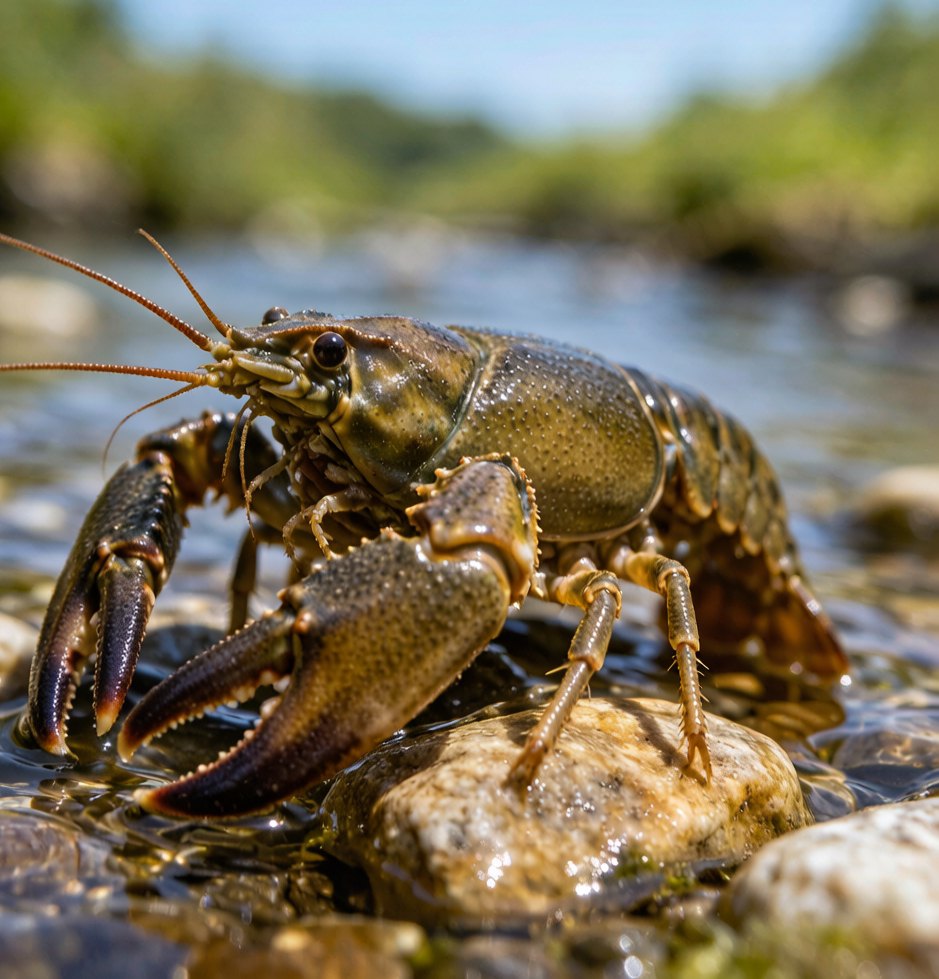
Introduction
The Noble Crayfish (Astacus astacus) is Europe’s largest and most economically important freshwater crayfish, prized for centuries as a gourmet delicacy across Scandinavia, Central Europe, and the Baltic states. In Sweden alone over 200 million crayfish are consumed annually during the traditional Kräftskiva crayfish party season. However, populations have crashed dramatically since the 1860s due to the fungal plague Aphanomyces astaci, introduced with North American crayfish, making it a species of high conservation concern throughout its range alongside the atlantic salmon and other freshwater species.
Taxonomy and Evolution
The Noble Crayfish belongs to the family Astacidae, the true crayfish of the Northern Hemisphere. It is one of roughly 650 described crayfish species worldwide and one of only three native European species, alongside the stone crayfish and the narrow-clawed crayfish. Within the genus Astacus, three species are recognized: A. astacus, A. leptodactylus, and A. pustulosus. Molecular studies suggest the genus diverged from the North American astacid lineage via trans-Atlantic dispersal some 50 to 75 million years ago, before the Atlantic opened fully and separated the continents.
Physical Characteristics
The noble crayfish is a large crustacean, adults typically measuring 10 to 16 cm in body length and weighing 50 to 200 g, with exceptional individuals reaching 20 cm and 300 g. Its coloration is typically olive-brown to reddish-brown, darkening to almost black on the carapace and claws. The body is divided into an anterior carapace, a fused head and thorax, and a segmented abdomen. The first three leg pairs bear pincers, the first pair being the largest. The distinctive feature separating it from invasive American species is a single post-orbital spine in front of and below the eye. Males have larger claws than females, used in combat and courtship.
Habitat and Distribution
Noble crayfish inhabit clean well-oxygenated freshwater: lakes, ponds, slow rivers, and streams with rocky or gravel substrates and abundant underwater cover such as submerged roots, fallen logs, and dense plant beds. They require calcium-rich water of at least 5 mg per liter for shell hardening after each molt. They are largely nocturnal, hiding in burrows, under stones, or in vegetation during the day. Their historical range spans from the British Isles across France, Germany, and Scandinavia to the Urals and from southern Finland to northern Italy and Greece. Range has contracted severely due to crayfish plague, with many populations now restricted to isolated lakes and streams free of the pathogen.
Diet and Feeding Behavior
Noble crayfish are omnivorous scavengers and detritivores. Their diet includes decaying plant matter, dead and dying fish, aquatic insect larvae, snails, freshwater mussels, tadpoles, and algae. They are important habitat engineers whose foraging breaks down leaf litter and recycles nutrients into freshwater systems. They locate food primarily by chemoreception using antennae and maxillipeds. In autumn they increase feeding to build energy reserves for winter, when activity decreases dramatically. During the vulnerable post-molt period, when the new shell is softening, they retreat to shelter and reduce activity for 1 to 2 weeks, avoiding the goldfish and other predators.
Reproduction and Life Cycle
Breeding occurs in autumn when water temperature drops below 15 degrees Celsius. Males become highly aggressive and court females with displays and pheromones. After mating, the female carries 20 to 200 fertilized eggs attached to the underside of her abdomen for 3 to 5 months over winter. The eggs hatch in spring and the juveniles remain attached to the mother’s swimmerets for several weeks before dispersing. Juveniles undergo 6 to 8 molts in their first year, each time shedding the rigid exoskeleton and expanding before the new shell hardens. Sexual maturity is reached in 3 to 4 years. Maximum lifespan is 20 to 30 years in pristine conditions, rivaling the Atlantic salmon in freshwater longevity.
Conservation Status
Listed as Vulnerable in the IUCN Red List, with populations declining across at least 50 percent of its historical range. The single greatest threat is crayfish plague, a waterborne oomycete fungus lethal to native European crayfish though carriers show no symptoms. The fungus was introduced in the 1860s with imported North American signal crayfish, now widespread and carrying the pathogen across Europe. Additional threats include water pollution, habitat degradation, drought, and competition with invasive signal crayfish. Conservation programs focus on protecting clean isolated water bodies, breeding and restocking, and controlling signal crayfish populations through targeted removal.
Fun Facts
The Swedish tradition of Kräftskiva, held every August, dates back to the 16th century when Queen Dorothea of Sweden officially opened the crayfish season. Today Sweden consumes more than 200 million noble crayfish annually, most imported from Turkey and China where signal crayfish are marketed as noble crayfish. Crayfish inspired the name of the constellation Cancer the Crab, the Latin words for crab and crayfish being used interchangeably in antiquity. Noble crayfish produce a loud noise by pressing their claws against the carapace, thought to be a defensive warning to predators. During the post-molt period they are extraordinarily vulnerable and hide for days while the shell hardens.