 By st20113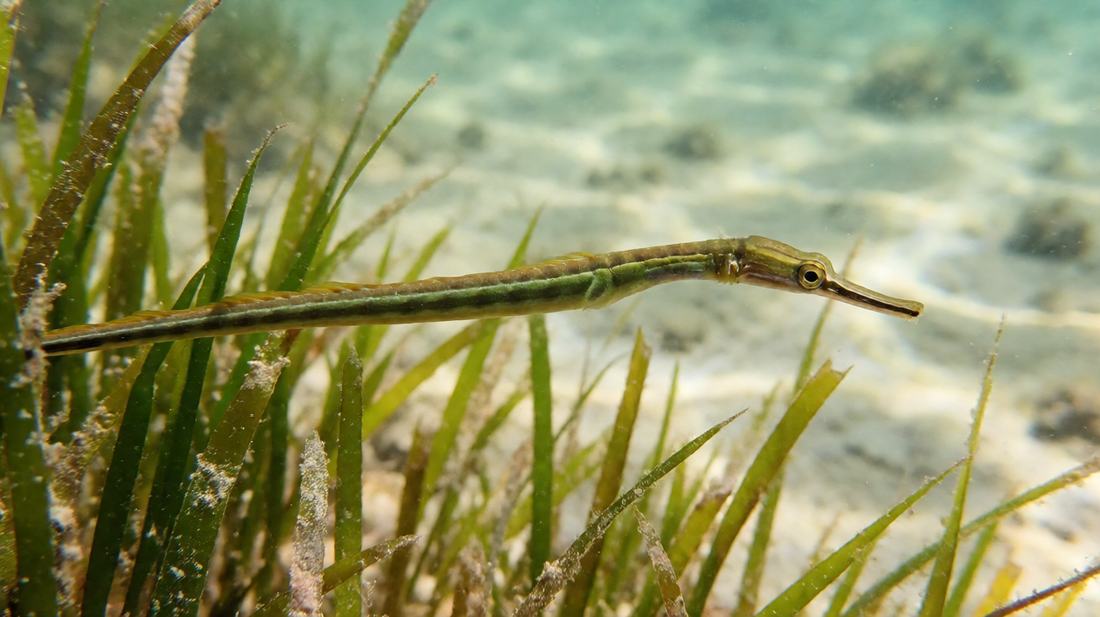
Nerophis ophidion | Straight-nosed Pipefish
Species Profile · Syngnathidae
Straight-nosed Pipefish
A thread thin fish of eelgrass beds that has no tail fin at all, and whose males glue the eggs to their own bellies.
A fish shaped like a thread
Length
Fins
Depth
Eggs
Life
The straight-nosed pipefish
A fish like a green thread
The Straight-nosed Pipefish is a fish that looks almost nothing like a fish. It has no wide body and no tail fin. Instead it is a thin ribbon shaped animal 15 to 30 cm long. It spends its life wound around the blades of eelgrass. The body is only a few millimetres wide.
It is coloured in shades of olive green and brown. So it blends into the weed like a stem of the plant itself. Fine blue white lines often run along its head and its back. The snout is straight and very slender, and it works like a small tube. The fish uses it to suck up tiny shrimps from among the leaves.
It has no tail fin, so it cannot grip a plant as a seahorse does. It holds on by wrapping its long body around the blades of eelgrass. The species lives in the north east Atlantic, the Baltic and the Mediterranean. It is best known for the way it raises its young. The male carries the eggs, and he does it without a pouch of any kind.
Family tree
Syngnathiformes, Syngnathidae
This fish belongs to the class Actinopterygii, the ray finned fishes. It sits in the order Syngnathiformes and in the family Syngnathidae. That family holds all of the pipefishes and all of the seahorses. It is one of the most unusual fish families in the sea. Every member has a body covered with bony plates instead of scales. Every member also has a long tubular snout and a small mouth at the tip.
The pipefishes form 1 group inside the family, and the seahorses form the other. Our fish is placed in the genus Nerophis. Its members are called snake pipefishes because of their thin bodies. Linnaeus named the species in 1758 as Syngnathus ophidion. The species name comes from the Greek word for a small snake. The genus holds only a handful of species.
Most of them live in the north east Atlantic. Three of them are found around the British Isles. Our fish shares its family with the Greater Pipefish, a much larger animal of the same weedy shallows. That species has a brood pouch under the tail of the male. The Straight-nosed Pipefish simply glues its eggs to the belly of the male.
No tail fin, no pouch
How to tell one
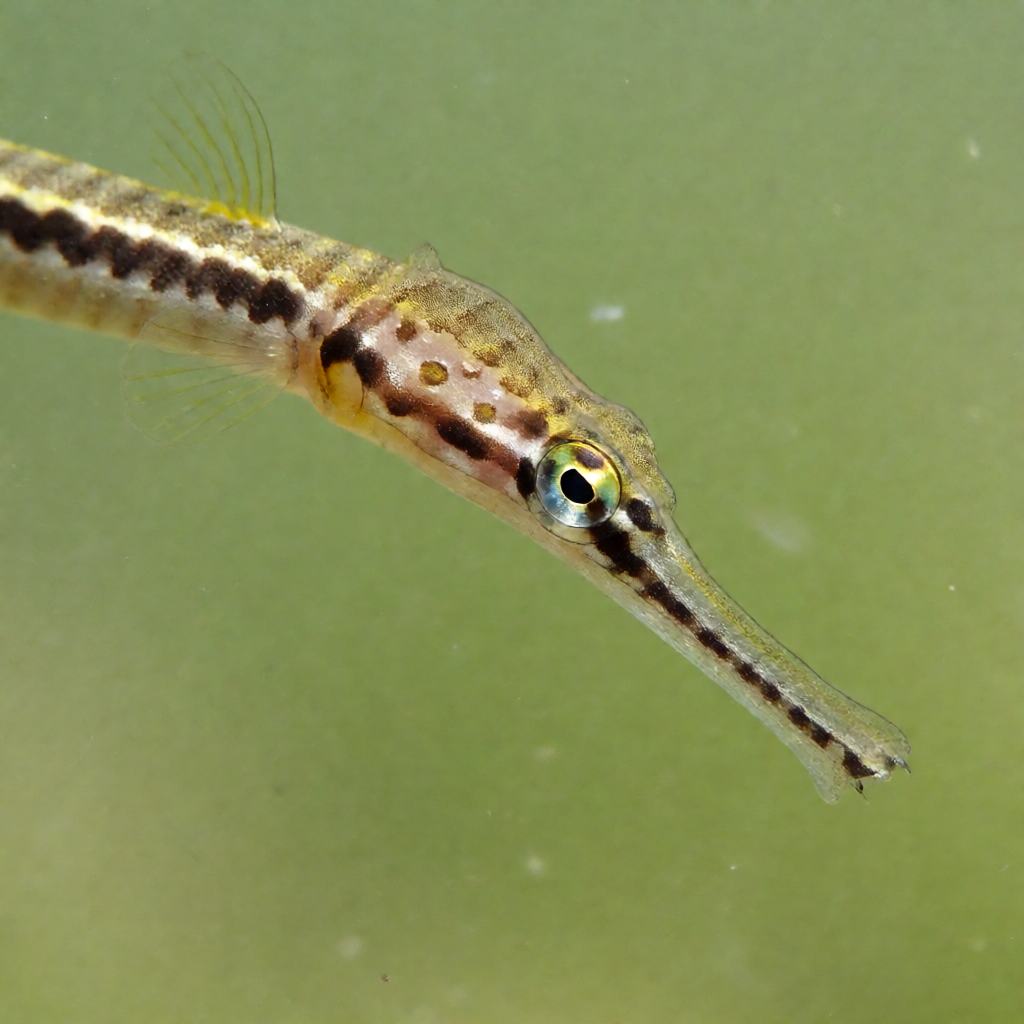
This fish has a very thin body 15 to 30 cm long. The female grows larger than the male. The body is round in section. It is covered with rings of bony plates instead of scales. That gives it a stiff, jointed feel. The head is long and narrow and ends in a straight slender snout.
A tiny mouth sits at the tip. The eyes are small and set high on the head. This species is unusual among pipefishes, because it has no pectoral fins at all. It also has no tail fin and no anal fin. Its only fins are a short dorsal fin with about 30 rays and a small fin under the tail. With no tail fin, the fish cannot use its tail as a seahorse does.
It cannot swim quickly for long. It moves by sending waves along its whole body, in the same way as an eel. The colour is olive green, olive brown or yellowish. Fine blue white lines often run along the head and the trunk. In the breeding season the female becomes brighter and develops blue markings.
1
2
3
Eelgrass and seaweed
Where it lives
This fish lives in shallow coastal water, from the low tide line down to about 15 m. It is found in 2 kinds of place. The first is a bed of eelgrass, the thin green plant of soft sand in sheltered bays. The second is a patch of seaweed on rocks. In some places the fish also enters the low salt water of the Baltic.
It needs good light and clean water with plenty of growth. It is rarely seen in bare or muddy places. The fish does not swim far, so it lives its whole adult life in a small patch of weed. It holds on to the blades with its body when the current is strong. It drifts between the plants when the water is calm.
The species is found from Norway and the Baltic south to Portugal. Around the British Isles it is most often seen on the south and west coasts. The fish is well hidden and easily missed. So records depend on careful searching rather than chance finds.
Sucking up tiny shrimps
What it eats
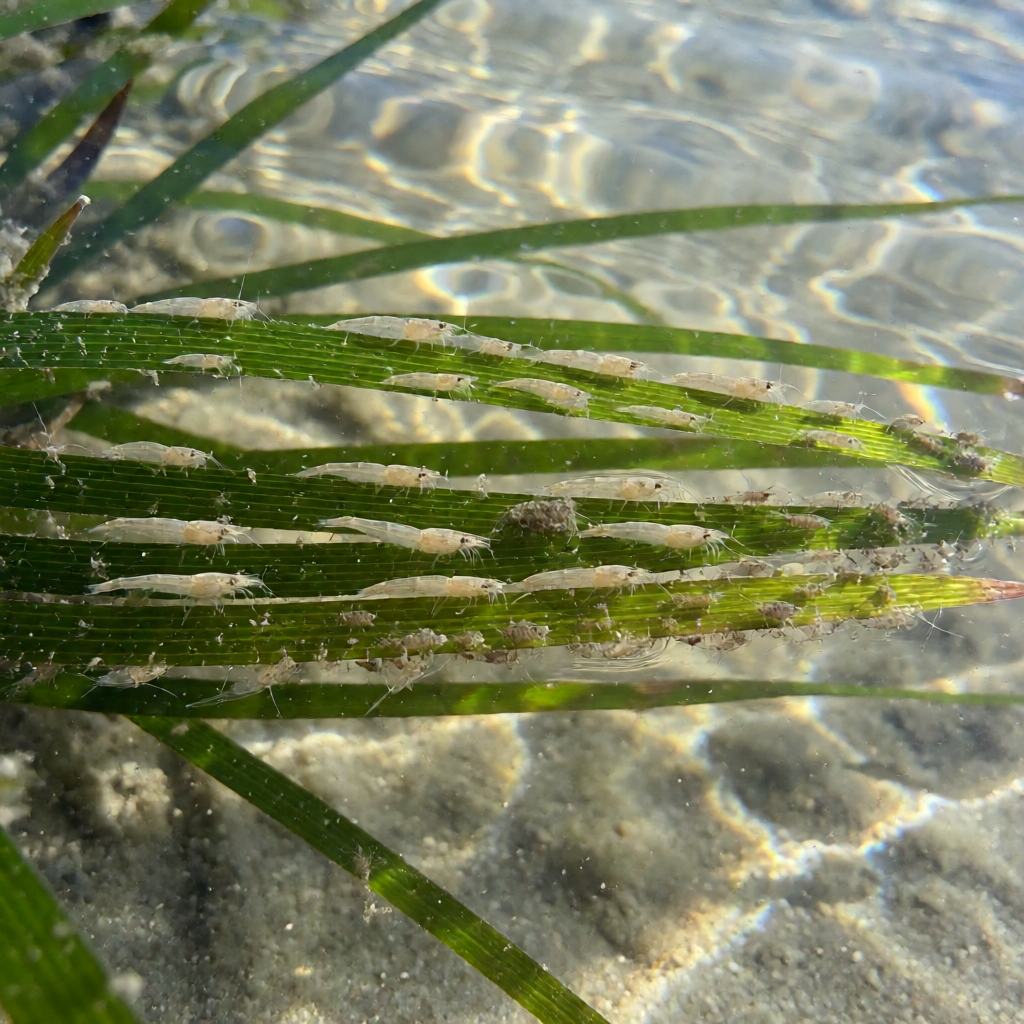
This fish feeds on very small animals, and it takes them one at a time. Its main food is the tiny crustaceans that live on and around the weed. Copepods, mysid shrimps and the young of larger shrimps are all eaten. It also takes small amphipods and the larvae of other animals. It finds its food by sight.
The fish hangs among the blades with its body almost upright. It watches for movement with its small high set eyes. When it sees a suitable animal, it bends its snout towards it. The tube then opens and closes very fast. That sucks the prey into the mouth with a small jet of water.
There is no chewing, because the mouth is only a narrow tube. The prey is swallowed whole, and its hard parts pass out later. Each meal is very small, so the fish must feed almost all the time in warm weather. One adult can take hundreds of tiny animals in a day.
Eggs glued to the male
The breeding cycle
The breeding season of this fish runs from April to August. It peaks in the warmest weeks of early summer. The male and the female meet among the weed and perform a short dance. They twine around each other and rise a little in the water. The female is the brighter of the 2 at this time. She also carries a deeper body and blue markings.
She then lays her eggs, and the male takes them on to his belly. This species has no brood pouch. So the eggs are simply glued to a shallow groove along the underside of the male. They are held there in 2 rows. The rows may hold a few hundred eggs. The male carries them for about 4 weeks.
He keeps them clean and supplied with air by bending and stretching his body. The female leaves after the eggs are placed. She may produce more eggs for another male. When the eggs hatch, the young swim away as tiny copies of the adults. The species lives for about 3 years and breeds in each of them. There is only 1 brood in the colder north.
A future tied to eelgrass
Conservation
This fish is not at risk, and it is still common in many parts of the north east Atlantic. Even so, its future depends almost entirely on 1 plant. Eelgrass beds have been lost on a huge scale around the coasts of Europe. Some of the loss comes from building work and dredging. Some comes from the dumping of waste at sea, and some from disease.
In the 1930s a wasting disease swept through the eelgrass of the North Atlantic. It removed most of the plant, and the beds have still not fully returned. Eelgrass is also damaged by pollution and by the anchors of boats. Whenever a bed of eelgrass goes, the pipefishes that live in it go too. They cannot move far and they cannot use bare sand.
Seaweed beds are at risk as well, and the loss of rocky habitat has the same result. The best protection for the species is protection for the plants. Keeping eelgrass free of anchors, dredging and waste will do more for this fish than any measure aimed at the fish itself.
Quick hits
Five things to remember
- This fish has no tail fin, no fins on its chest and no anal fin. Its only real fin has about 30 rays.
- It holds on to eelgrass by wrapping its long thin body around the blades, because it cannot grip with a tail.
- The male carries the eggs, but he has no pouch. The eggs are glued in 2 rows to a groove along his belly.
- The female is the brighter and larger of the 2 in the breeding season, which reverses the usual pattern.
- The loss of eelgrass in the 1930s, when a wasting disease swept the North Atlantic, took away much of the home of this fish.