 By st20113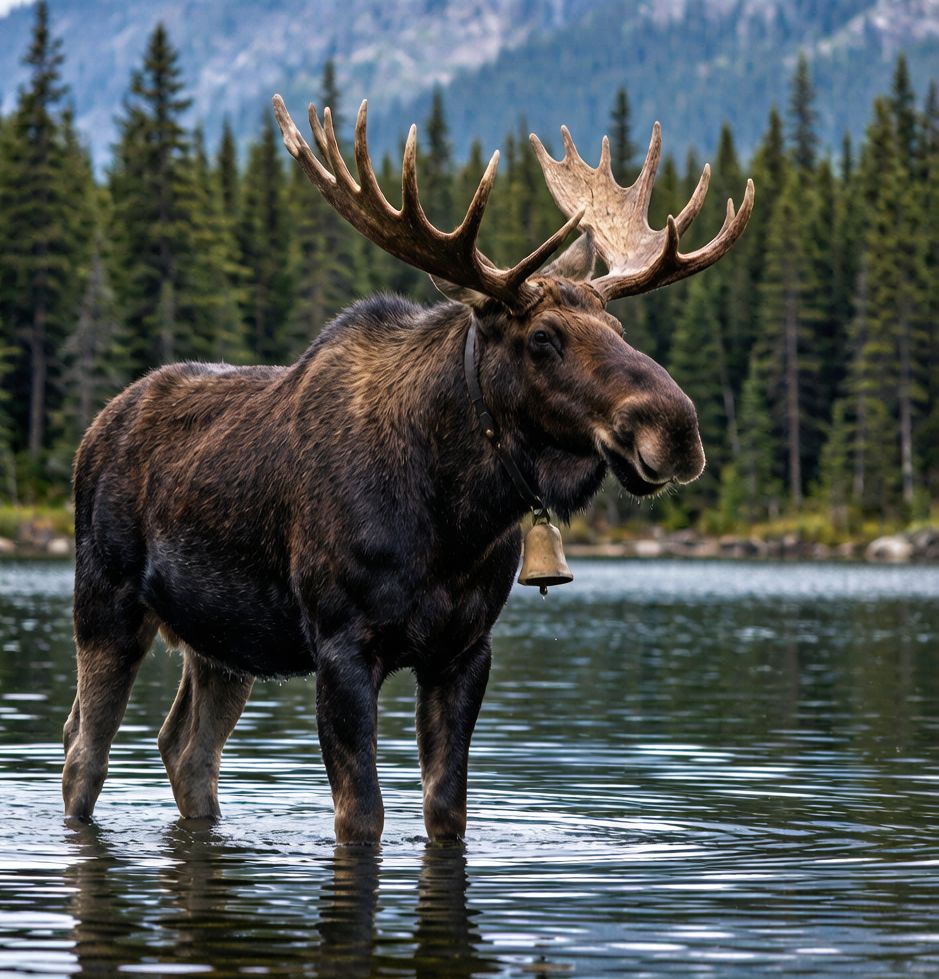
Introduction
The Moose is the largest member of the deer family and a striking emblem of the northern forests. Standing up to two meters at the shoulder and weighing as much as seven hundred kilograms, a bull moose dwarfs every other living deer. Long, overhanging snout, a dewlap called a bell, and immense palmate antlers set it apart from its relatives. These giants browse the shoots and leaves of trees and shrubs, wading into lakes and rivers to feed on aquatic plants. They range across the boreal forests of North America, Europe and Asia, where long winters and deep snow shape their lives and their movements through the year.
Taxonomy
Alces alces is the only living species of its genus and sits within the family Cervidae, the same family as the red deer and the elk. The name “moose” is used in North America, while in Europe the animal is called the elk. Ancient and isolated, the moose lineage diverged early from other deer and retains primitive features such as the sloping back and the bulbous nose. Fossil relatives once ranged farther south, but today the species is a creature of the cold north, well adapted to subarctic and temperate forest environments across the Northern Hemisphere.
Physical Characteristics
A bull moose stands 1.8 to 2.1 meters at the shoulder and may weigh 380 to 700 kilograms, while cows are smaller at 200 to 400 kilograms. The coat is dark brown to blackish, longer on the neck and legs, and the legs are long to lift the body over deep snow. The most remarkable feature is the set of palmate antlers grown by males each year, spanning up to two meters and bearing many points. The large, mobile nostrils warm frigid air before it reaches the lungs, an adaptation to extreme cold. Despite their bulk, moose are surprisingly agile swimmers and can trot for long distances through the forest.
Habitat
Moose favor boreal and mixed deciduous forests near lakes, marshes, rivers and young regrowth where food is abundant. They are closely tied to water, both for drinking and for the nutritious aquatic vegetation they eat in summer. In winter they move into denser coniferous stands that shelter them from wind and deep snow. The species ranges across Scandinavia, the Baltic states, Russia, and the northern United States and Canada, occupying the great circumpolar belt of northern forest that circles the globe in the high latitudes.
Diet
Moose are selective browsers rather than grazers, feeding on the leaves, twigs and bark of trees such as willow, aspen, birch and balsam fir. In summer they wade into ponds and streams to eat lilies, pondweeds and other aquatic plants rich in sodium and minerals. A single animal may consume more than twenty kilograms of vegetation a day during the growing season. Their browsing shapes forest structure, influencing the growth of young trees and the plants that grow beneath them across the northern landscape in measurable ways.
Reproduction
The rut occurs in autumn, when bulls bellow, thrash vegetation and fence with their antlers to win mates. After a gestation of about eight months, the cow gives birth in spring to one or sometimes two calves in a secluded spot. The spotted calf can stand within hours and grows rapidly on rich milk, learning to follow its mother through the forest. Young moose stay with the cow through their first winter before becoming independent. Bulls shed their antlers each winter and regrow a larger set the following spring as they mature and prepare for the next rut.
Conservation
The moose is listed as Least Concern globally and remains common across much of its range, though some southern populations have declined due to heat stress, parasites and habitat fragmentation. In parts of North America the winter tick and brainworm have reduced local numbers, while vehicle collisions are a growing concern as development expands. Sustainable hunting and the protection of calving habitat help maintain healthy populations, and the species continues to thrive in the vast intact forests of the north.
Fun Facts
A moose can dive several meters to graze on submerged plants on the lake bed. Its antlers can weigh more than thirty kilograms in total. Calves are born with a reddish, spotted coat that fades by autumn. Despite their size, moose can run at fifty kilometers per hour when alarmed. The species’ bulbous nose is so sensitive it can detect a single aquatic plant beneath the surface of a murky pond with ease.