 By st20113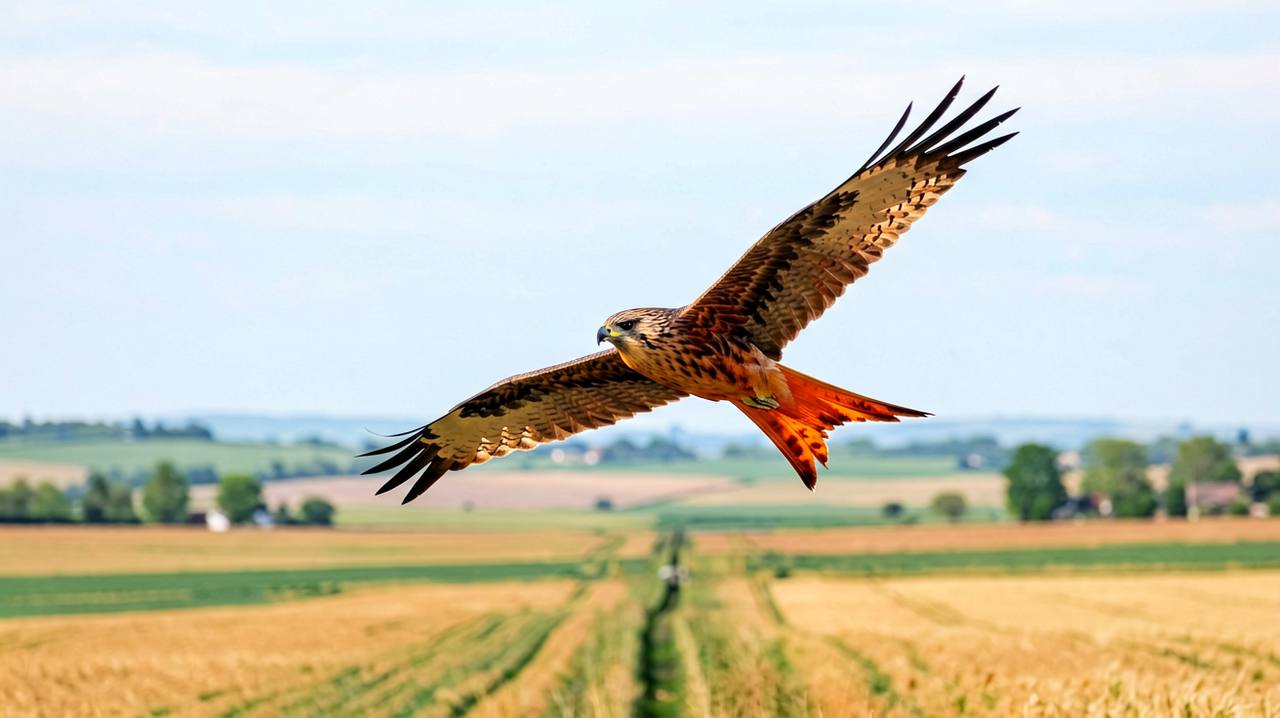
Milvus milvus | Red Kite
Species Profile · Accipitridae
Red Kite
A fork-tailed scavenger that was rescued from near-extinction and now soars over British gardens.
IUCN: Least Concern
Range
Size
Wingspan
Life
Status
The fork-tailed kite
A scavenger in the sky
The red kite is a large bird of prey with a deeply forked tail. That tail is the easiest way to recognise it. It looks like a long, rusty-orange arrow. The bird’s body is a warm reddish-brown. Its head is pale grey and white. Its wings are long and angled, with white patches near the tips.
A red kite has a wingspan of about 1.5 metres. It weighs between roughly 800 and 1,300 grams. That makes it lighter than it looks. It spends much of the day soaring on rising air. It rides the wind without flapping. It turns and slides on the breeze with little effort.
It is a scavenger as much as a hunter. It eats carrion, worms, and small animals. Its story in Britain is famous. The species was almost lost there, and then brought back. Today red kites fly over many towns and gardens.
Family tree
Kin of the eagles
The red kite sits in the genus Milvus. It belongs to the family Accipitridae. That family is the largest group of birds of prey. It includes eagles, hawks, and harriers. A powerful relative is the Golden Eagle. That bird is much heavier and hunts live prey on the wing. The red kite is lighter and slower. Both birds belong to the same large family. Both build big stick nests and defend a territory.
Both also suffered heavy persecution in the past. The eagle was shot and poisoned across the hills. The kite was cleared from almost all of England and Scotland. Each species survived only in a few remote strongholds. Each has since been helped back by protection and by reintroduction. The two are also separated by habitat. The eagle needs wild hills, while the kite thrives near farms and villages. It is an opportunist rather than a hunter. It takes whatever is easy to find.
The two share sharp vision and strong talons. They differ in almost everything else. The red kite often flies low over fields looking for dead animals. The golden eagle patrols mountain slopes for live prey. A second kite species, the black kite, lives in Africa and Asia. It once bred in Britain as well. The red kite is now the only kite species breeding there.
Rusty body, pale head
Built for slow soaring
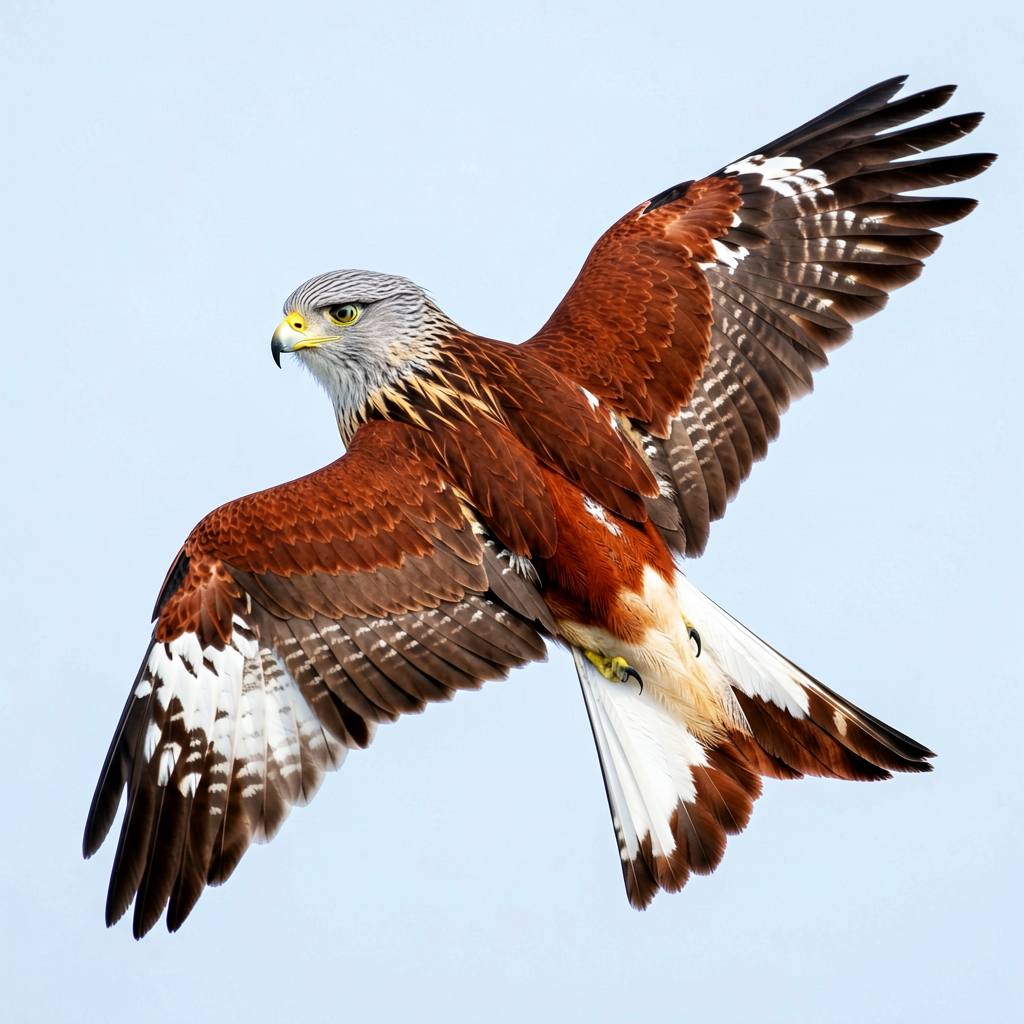
The red kite has a slim body and long wings. Its tail is deeply forked and slightly notched. The tail is why people once called it the fork-tailed kite. Adults have a reddish-brown back and chest. The head is pale grey and finely streaked. The underwing shows large white patches near the body.
The wingtips are dark. In flight from below, those markings are very clear. Its eyesight is sharp enough to spot a worm from high above. Its beak is hooked and yellow at the base. Its legs are yellow, and its talons are strong but short. It has one unusual habit in hot weather.
It mates and it also swims in shallow water. Its calls are a thin, whistling sound. When two birds meet, they often tumble together. Their calls carry a long way across open country.
1
2
3
Farms, woods, and towns
At home near people
The red kite lives in open woodland and mixed farmland. It needs tall trees to nest in and open ground to hunt. Villages and towns suit it surprisingly well. Many kites now nest close to houses. They feed in gardens and on playing fields. Its range is centred on Europe.
It is most common in Britain, France, Spain, and Germany. It also lives in parts of Sweden and Poland. Smaller populations survive in North Africa and Turkey. The species has recovered strongly in Britain. It was reintroduced from the late 1980s. Now thousands of pairs breed in England, Scotland, and Wales.
The birds are largely resident where food is reliable. Northern birds move south in autumn. Some cross to France or Spain for the winter. Others simply gather at winter roosts in lowland Britain. Those roosts can hold dozens of birds.
What it eats
Worms, carrion, and scraps
The red kite is a flexible feeder. Much of its food is already dead. It eats rabbits, birds, and other animals killed on roads. It also takes sheep afterbirth and livestock remains. Farmers and householders often put out scraps for it.
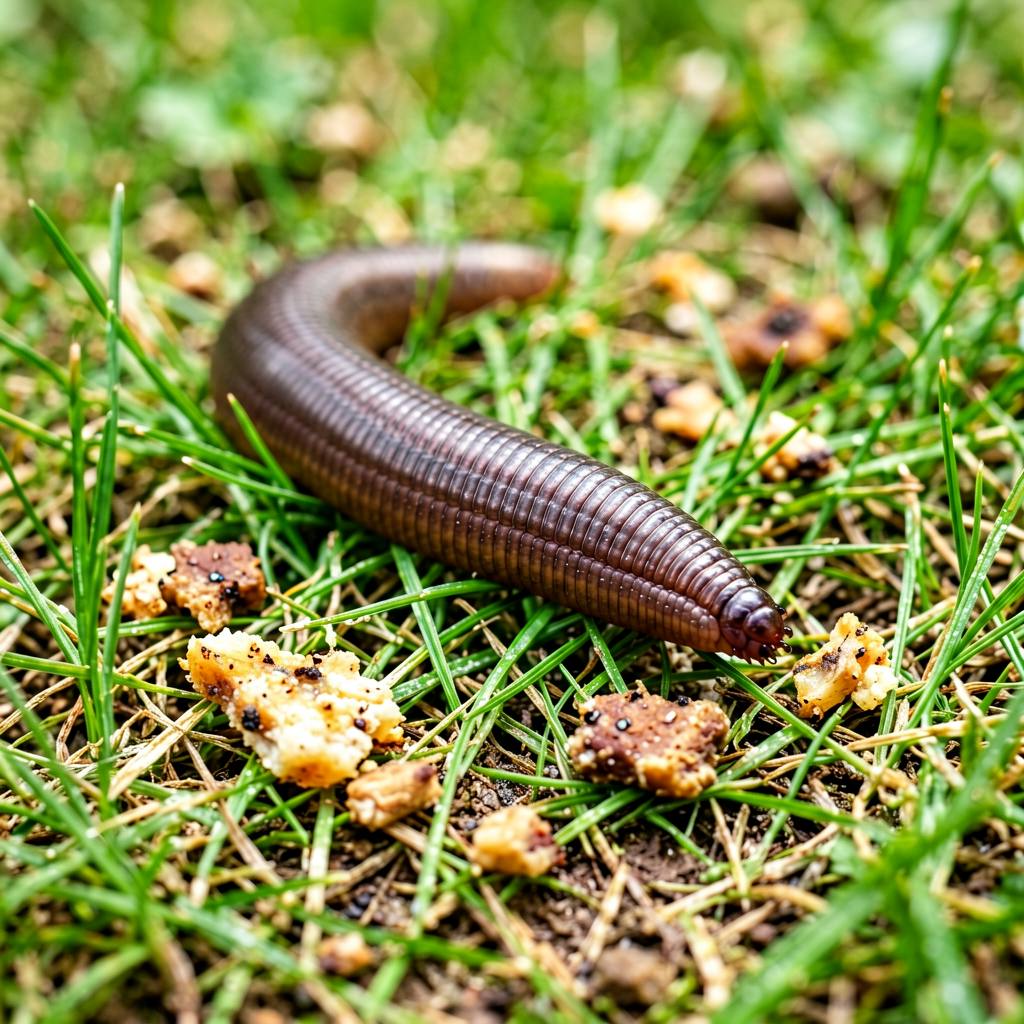
In some parts of Britain people throw meat into their gardens for kites. Worms and beetles make up a large part of the diet too. The kite can catch a worm without landing. It drops its feet and snatches it from a field in passing. It also takes small live prey when the chance comes.
Young birds, nestlings, mice, and voles are all eaten. It is not built to chase fast animals. Instead, it searches from the air and takes what it finds. It often follows ploughs to pick up disturbed worms. Kites may gather in large numbers where food is easy.
A big untidy nest
One to three eggs
Red kites build large, untidy nests of sticks. The nest usually sits high in a tree. The pair often reuses the same site for years. Sometimes they take over an old crow’s nest. They may also nest on pylons in some areas. Courtship involves spectacular tumbling flight and shrill calls.
The female lays a clutch of one to three eggs. Two or three is the usual number. Incubation takes about 31 to 32 days. The female stays on the nest for most of that time. The male brings her food. The chicks hatch covered in grey down.
They grow slowly and fledge at about 50 to 60 days. The parents keep feeding them after they leave the nest. Young birds may stay nearby for several weeks. Red kites first breed at two or three years old. They can live for about ten years, and a few reach 25.
Back from the brink
Persecution and reintroduction
The red kite is listed as Least Concern worldwide. Its history in Europe, though, is a warning. The birds were persecuted for centuries. Gamekeepers shot and trapped them as vermin. By the early twentieth century Britain held only a few pairs in Wales. Reintroduction began in 1989 in England and Scotland.
Young kites were brought from Spain and Sweden. The birds settled and bred successfully. More releases followed in Wales and Northern Ireland. Today more than 4,000 pairs may breed in Britain. Several European populations are declining, however. Spain holds the largest numbers, and they have fallen.
Illegal poisoning remains a serious problem. Kites are also killed by wind turbines and road traffic. The species is protected by law across Europe. Feeding stations have helped some populations grow.
Quick hits
Five things to remember
- Its deeply forked tail gives it the old name of fork-tailed kite.
- It often snatches worms from fields without landing, dropping its feet as it flies.
- Red kites sometimes bathe and tumble in shallow water during hot weather.
- British numbers crashed to a few Welsh pairs, then recovered through reintroduction.
- Kites gather at winter roosts that can hold dozens of birds together.
[…] It is the only member of its genus. A distant kin is the Red Kite. […]