 By st20113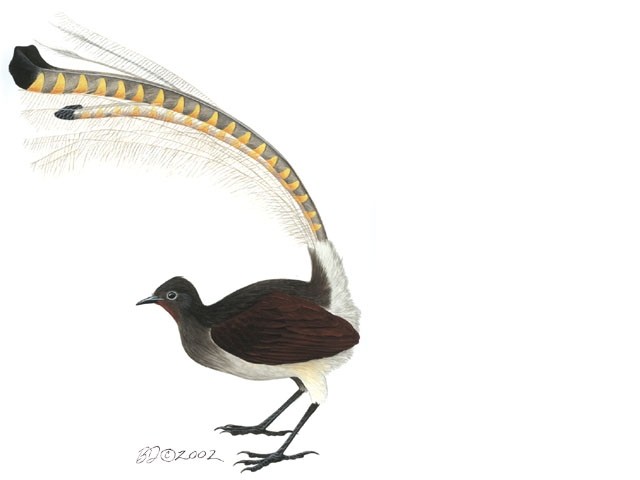
Introduction
The superb lyrebird (Menura novaehollandiae) is an Australian passerine renowned as one of the world’s most accomplished vocal mimics and elaborate display performers. Males construct and maintain display mounds on the forest floor, where they fan their spectacular lyre-shaped tail and reproduce an astonishing array of sounds, from other birds’ songs to camera shutters and chainsaws. Lyrebirds inhabit the wet forests of southeastern Australia and play a vital role in ecosystem health through their extensive foraging and soil disturbance. Their combination of acoustic virtuosity and elaborate plumage makes them a flagship for forest conservation. raven frigatebird
Taxonomy
The superb lyrebird is one of two lyrebird species in the family Menuridae, an ancient lineage of songbirds endemic to Australia. The genus Menura was established by Davies in 1802, with the superb lyrebird described as Menura novaehollandiae. The Albert’s lyrebird is its only congener. Molecular studies place Menuridae among the basal songbirds, diverging early in passerine evolution. Their large, complex syrinx and elongated tail feathers represent extraordinary specialisations absent in the broader songbird radiation.
Physical Characteristics
Superb lyrebirds are among the largest songbirds, measuring 80 to 100 centimetres including the tail and weighing up to 1.1 kilograms. Females are smaller and brown, while breeding males develop spectacular plumage: grey-brown above with a rufous undertail, and most distinctively, enormous tail feathers comprising fine, curved outer filaments and broad, scalloped central plumes resembling a lyre. Males use this tail in a vertical display fan during courtship. Both sexes possess strong legs and feet adapted for scratching through leaf litter, and a slender, slightly downcurved bill suited to probing soil and debris.
Habitat
Superb lyrebirds occupy wet and temperate rainforests, wet sclerophyll forests, and dense gullies from southern Victoria to southeastern Queensland. They require multilayered vegetation with a rich leaf-litter floor for foraging and dense understory for cover. Males establish and maintain several display mounds within their territory, cleared patches of soil where they perform. They are largely sedentary, though birds may descend to lower elevations in harsh weather. The integrity of intact forest with minimal disturbance is essential, as lyrebirds are highly sensitive to habitat fragmentation and increased predator exposure.
Diet
Lyrebirds are primarily terrestrial foragers that feed by raking through leaf litter with powerful feet, uncovering insects, spiders, worms, and other invertebrates. Their diet is dominated by ground-dwelling arthropods, supplemented seasonally by bulbs, fruits, and seeds. They rarely take food above ground, instead using their bill to probe and flick aside debris. Foraging activities turn over substantial amounts of forest floor litter, contributing to nutrient cycling and soil aeration. This ecological role links lyrebirds to the broader health of the forest communities they inhabit.
Reproduction
Female lyrebirds alone build the nest, incubate the single egg, and rear the chick, while males devote energy to courtship display and territory defence. The female constructs a large domed nest of sticks and moss in a tree fern, rock ledge, or branch fork, laying one egg that she incubates for around six weeks. The nestling fledges at roughly five to six weeks but remains dependent for several more months. Males begin displaying from about three to four years and may maintain multiple mounds across a territory used to attract females. Breeding success is closely tied to predator control and habitat quality.
Conservation
The superb lyrebird is listed as Least Concern, though local populations have declined where habitat has been cleared or fragmented. Introduced predators such as foxes and cats pose significant threats to ground-nesting females and chicks, and fires can devastate suitable forest. Conservation reserves protecting contiguous wet forest are crucial for the species’ persistence. Lyrebirds have also been introduced to areas outside their original range, including Tasmania, where they have established self-sustaining populations in suitable habitat.
Fun Facts
A single male lyrebird can mimic the songs of up to twenty or more other bird species, weaving them into its own complex song. Lyrebirds have been recorded imitating artificial sounds including camera shutters, car alarms, and chainsaws with startling accuracy. The male’s display involves flipping his tail forward over his head to form a silvery, shimmering canopy while he sings. Despite their elaborate appearance, lyrebirds are shy and more often heard than seen in dense forest. Their feet are so strong they can displace rocks and logs several times their own weight while foraging.
[…] family is the Menuridae, the lyrebirds. Our bird shares the family with the Superb Lyrebird. That bird is larger and far more […]