 By st20113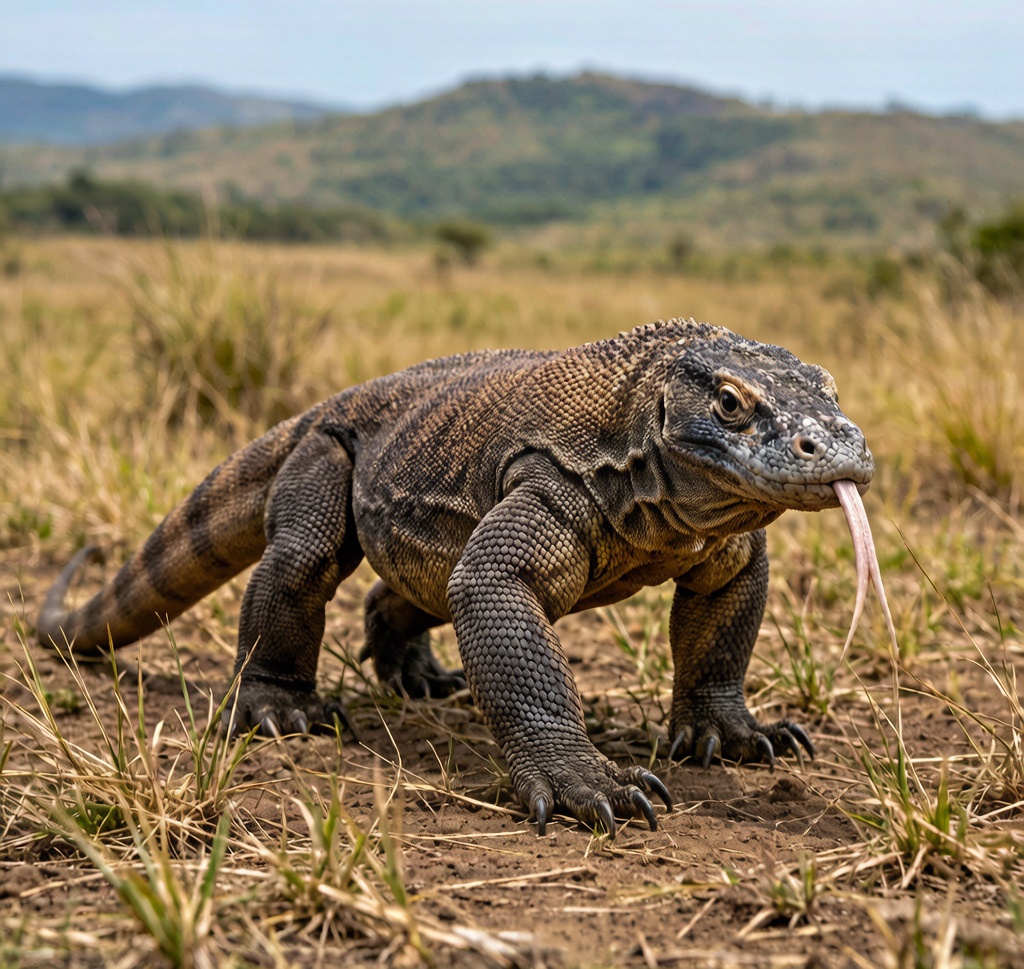
The Komodo dragon (Varanus komodoensis) is the world’s largest living lizard — a fearsome predator of the Indonesian islands that has inspired legends of fire-breathing dragons. Growing up to 3.1 meters in length and weighing up to 70 kilograms, the Komodo dragon is the apex predator of the small, remote islands it inhabits, capable of taking prey as large as water buffalo. For decades, scientists believed the dragon killed through blood poisoning from bacteria in its saliva, but research in 2009 revealed the true weapon: venom glands in the lower jaw that produce an anticoagulant cocktail, causing victims to hemorrhage to death over hours or even days. Found only on five Indonesian islands — Komodo, Rinca, Flores, Gili Motang, and Gili Dasami — the Komodo dragon is a flagship species for conservation and a powerful symbol of the unique biodiversity of Wallacea.
## Physical Characteristics
The Komodo dragon is the world’s largest living lizard, with adult males reaching lengths of 2.5 to 3.1 meters and weighing 40 to 70 kilograms. Females are smaller, typically 2.2 to 2.5 meters. The body is robust and powerful, covered in rough, bony, non-overlapping scales — each embedded in a bony plate called an osteoderm — that provide protection. The color is generally greyish-brown to reddish-brown. The head is large and elongated, with a relatively flat, triangular skull. The tongue is long, forked, and yellow — reminiscent of a snake’s tongue. Most remarkably, research has identified venom glands in the lower jaw that produce a complex cocktail of anticoagulants and other toxins that cause massive blood loss in prey.
## Habitat and Distribution
The Komodo dragon is found only on the Indonesian islands of Komodo, Rinca, Flores, Gili Motang, and Gili Dasami — a tiny area of approximately 1,900 square kilometers in the Lesser Sunda Islands east of Bali. It inhabits a variety of environments including tropical savanna forests, dry monsoon forests, and open grasslands. The species is most common in the dry, savanna-like terrain of the lower islands (Komodo and Rinca), where ungulate prey is most abundant. The Komodo National Park — established in 1980 and designated a UNESCO World Heritage Site in 1991 — provides the primary protection for Komodo dragon populations.
## Behavior and Diet
The Komodo dragon is an opportunistic apex predator with a varied diet that includes invertebrates, small mammals, birds, reptiles, eggs, and large ungulates such as deer, goats, and water buffalo. Adults are capable of taking prey up to the size of water buffalo — approximately 30 times their own body weight. The dragon’s venom causes anticoagulation and shock in prey animals, which may take hours or days to die. Komodo dragons are also cannibalistic — adults will prey on juveniles — and consume carcasses opportunistically. They are primarily solitary, with males defending territories through ritualized combat.
## Reproduction
Komodo dragons reach sexual maturity at approximately five to eight years of age. After mating between May and August, the female lays approximately 20 eggs in a deep nest burrow she excavates in the ground. The eggs incubate for approximately eight to nine months, hatching between April and July. Hatchlings are approximately 40 centimeters in length and are highly vulnerable to predation from adults, birds, and snakes. Young Komodo dragons spend significant time in trees, where they can escape cannibalistic adults. Remarkably, Komodo dragons are also capable of parthenogenesis — asexual reproduction — in which a female produces viable offspring without mating with a male.
## Conservation
The Komodo dragon is classified as Endangered on the IUCN Red List, with an estimated wild population of approximately 1,380 to 3,370 individuals. The species faces significant threats including habitat loss on Flores, human persecution, natural disasters, and climate change. The creation of the Komodo National Park has been the cornerstone of conservation efforts and has enabled a gradual recovery of dragon populations on Komodo and Rinca. Ecotourism centered on Komodo dragons generates significant revenue for local communities and provides a powerful economic incentive for conservation.