 By Iris
Hyas araneus | Great Spider Crab
Species Profile · Majidae
Great Spider Crab
The slow spiny crab that gardens its own back — a cold-water spider crab that plants living weed and sponge on its shell until the disguise is almost perfect.
IUCN: Not Evaluated
Range
Shell
Legs
Depth
Eggs
The crab that wears a garden
Slow, spiny, and disguised
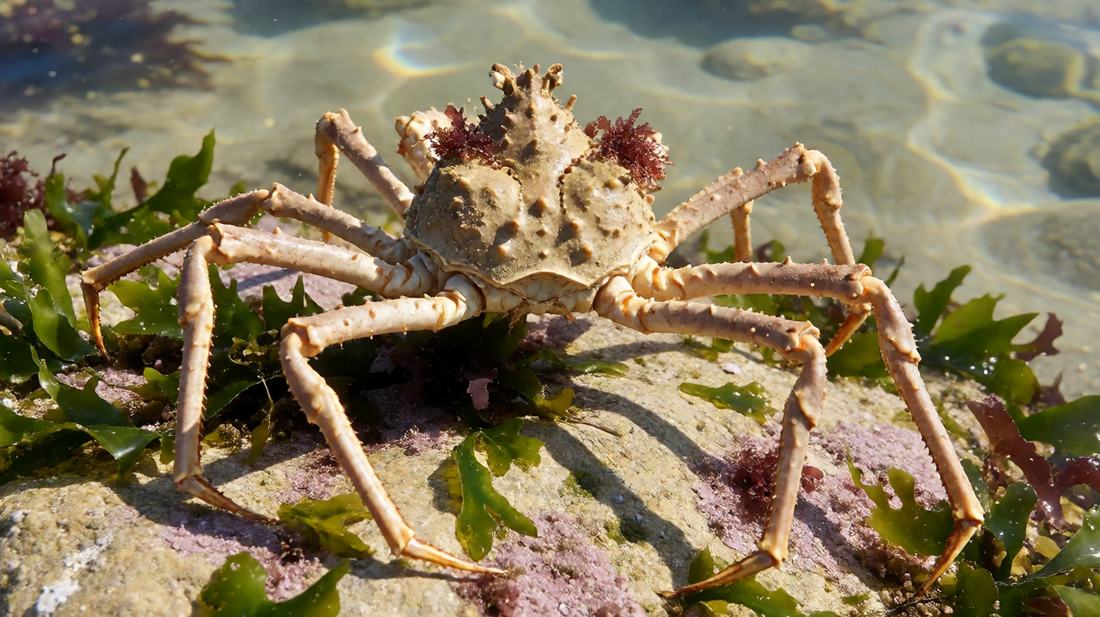
The Great Spider Crab is a slow, spiny animal. It lives in the cold rocky shallows of the north Atlantic. It is one of the best examples of camouflage in European waters. Its shell is a rough triangle covered in bumps and small spines. The colour is usually a dull red-brown or yellow-brown. But the colour is often hidden under a thick growth of red seaweed and small sponges.
This covering is not an accident. The crab collects the growths with its small front pincers. It hooks them onto fine bristles that cover its shell. So the animal ends up wearing a small garden of living plants and animals. The disguise is almost perfect. The legs are extremely long and thin, like those of a spider.
They give the crab a leg span far wider than its body. A large male can carry a shell 10 cm long. The females are smaller. The species lives from the shore down to about 100 metres on rocky ground. It is common all round the British Isles, Norway and Iceland.
Family tree
Majidae, the spider crabs
The Great Spider Crab sits in the family Majidae, the spider crabs. It belongs to the genus Hyas. Linnaeus described it in 1758. He placed it in the genus Cancer before the modern system was worked out. The family Majidae is a large group of crabs spread throughout the world’s seas. It is defined by a set of features that give the group its name. The shell is triangular or pear-shaped. The legs are very long and slender.
The crab covers its shell with living material. Almost every member of the family decorates itself. Some carry this so far that the crab becomes almost impossible to see. Within the family the genus Hyas holds a small number of cold-water species. The Great Spider Crab is the largest and most familiar of them. The genus name comes from classical myth. The species name araneus is Latin for spider. This is a direct reference to the long, thin legs.
The family has an excellent fossil record. Spider crabs very like the modern forms are known from rocks over 100 million years old. The Great Spider Crab shares its family with the spiny spider crab. That is the big southern species that supports a large fishery. The 2 are set apart by size and by the shape of the shell. But they sit in the same family and both decorate their shells.
Bumpy shell, long thin legs
How to tell one
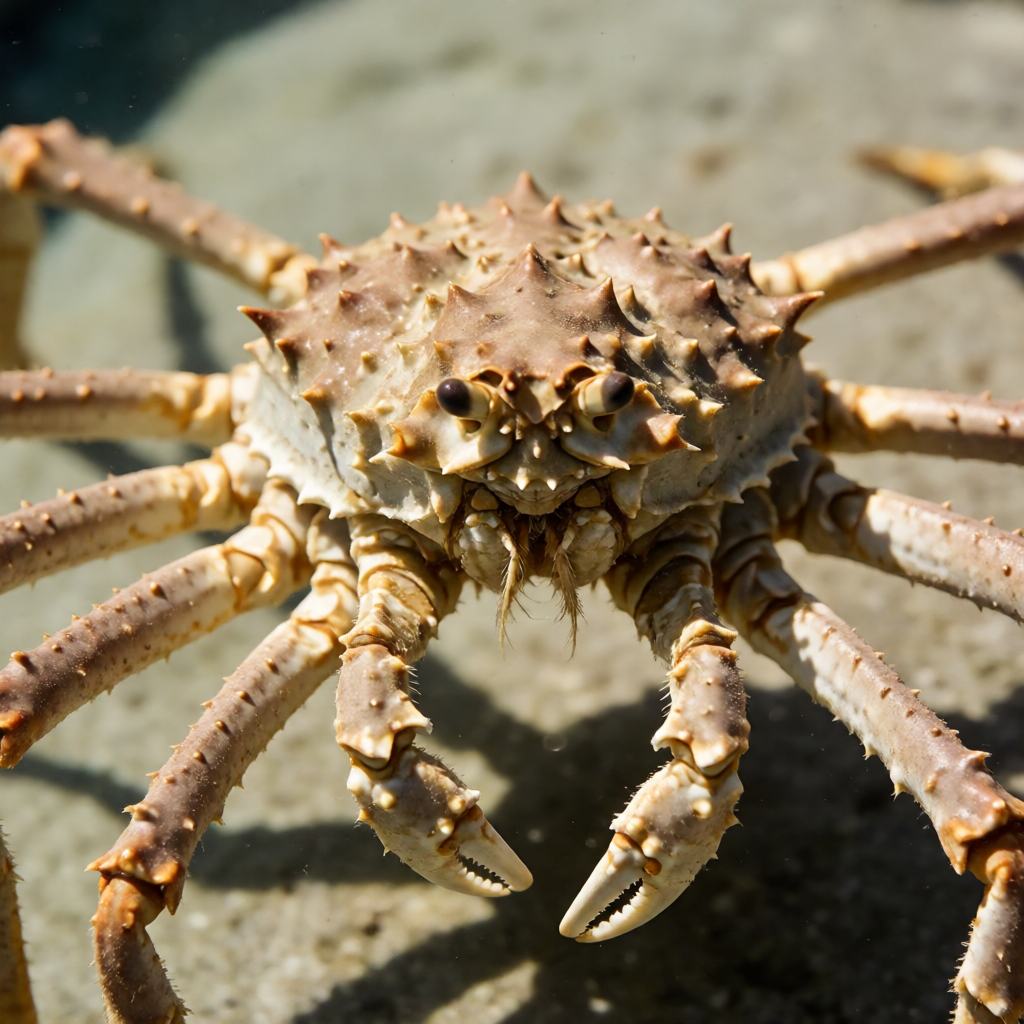
The shell of the Great Spider Crab is roughly triangular. It can reach 10 cm in length, though most adults are 6 to 8 cm. The surface is covered in small bumps and short spines. Two longer spines stick forward at the front of the shell. They sit on either side of the beak-like rostrum. The colour is usually red-brown or yellow-brown.
It is often buried under a dense growth of red algae, small hydroids and sponges. The pincers at the front are small and delicate. They are used for collecting material and for feeding rather than for fighting. The walking legs are the most striking feature. They are very long, thin and jointed. When fully stretched they span 3 times the length of the shell or more.
The legs are covered in fine bristles and small hooked hairs. These hairs are what hold the decorating material in place. The eyes are small and sit on short stalks at the front of the shell. The crab is not a fast mover. But the long legs let it pick its way over rough ground and hold on in strong water movement. Males are larger than females.
1
2
3
Cold rocky shallows
Where it lives
The Great Spider Crab lives in cold, shallow, rocky water throughout the north Atlantic. Its range runs from the Arctic coasts of Norway and Russia south to the British Isles and the Netherlands. It is also found around Iceland and on the eastern coast of North America. It has been recorded from the shoreline down to about 500 metres. It is most common between 5 and 100 metres.
It is a species of hard ground. It lives on rock faces, boulders, stone and gravel. It also lives in beds of kelp and among the holdfasts where the weeds grip the stone. It turns up on muddy ground with a scattering of stones near the shore. The crab hides in crevices and under stones by day.
It walks slowly over the open rock at night in search of food. Because it lives in cold water it grows slowly and lives for several years. This is unusual among crabs of its size. The species is very sensitive to the amount of cover available. It does poorly on bare, smooth rock or on ground cleared of seaweed.
Barnacles, mussels and weed
What it eats
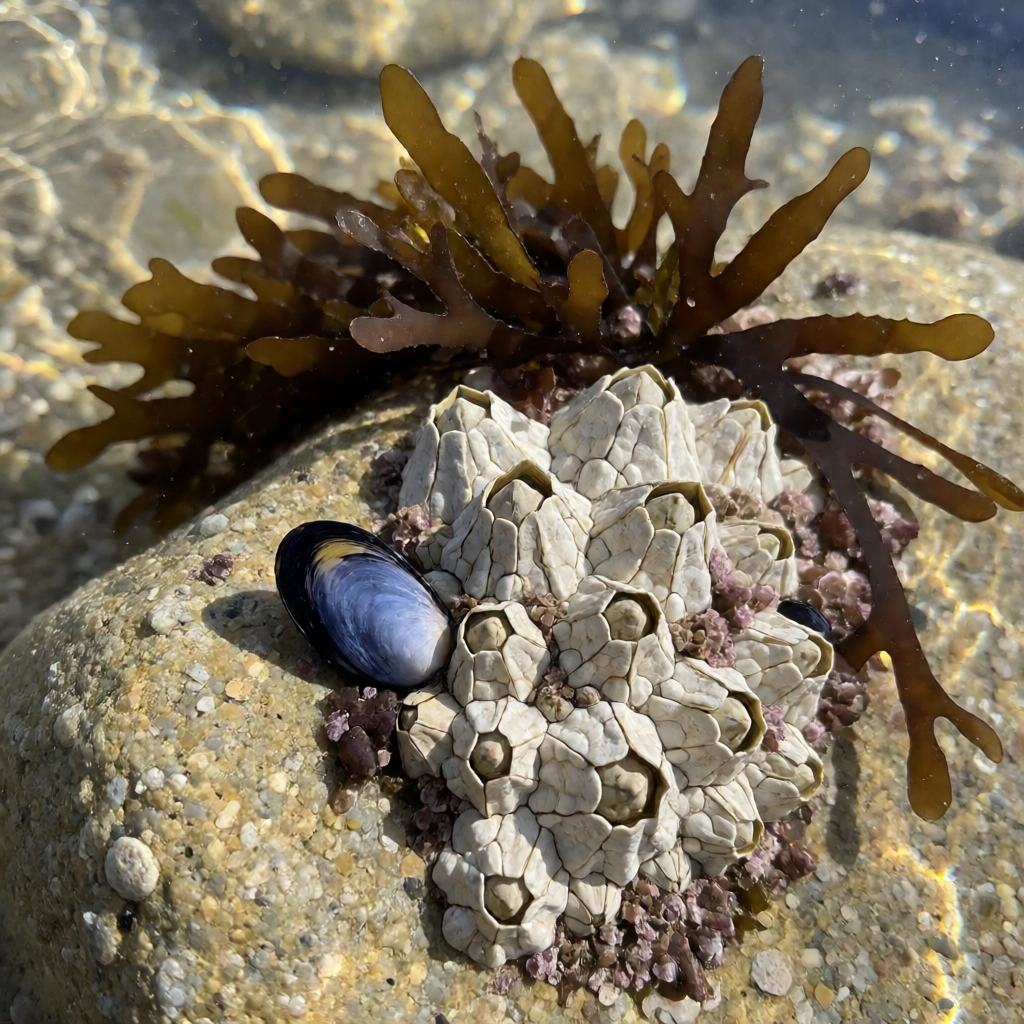
The Great Spider Crab is an omnivore and a scavenger. It eats a very wide range of food. The main items are small crustaceans, barnacles, mussels and other bivalves. It also takes worms, small snails and large amounts of seaweed. It will feed on dead animals whenever it finds them. Crab traps baited with fish attract it readily.
The crab is slow, so it cannot chase active prey. Instead it feeds on animals that are fixed in place, such as barnacles and mussels. It breaks their shells with its pincers. It also uses its pincers to scrape algae and small animals off rock surfaces. It can turn over small stones to reach the animals underneath. The decorating habit is closely tied to feeding.
The crab collects seaweed and small fixed animals with its front pincers. It passes them to the mouth to taste them. Then it either eats them or fixes them to its own shell. In this way the disguise is built out of the food supply itself. The crab feeds mostly at night. It can go for several days without food.
40,000 eggs, nine months
The breeding cycle
The Great Spider Crab mates mainly in the autumn and early winter. This happens after the female has moulted, while her shell is still soft. The male guards the female for several days before and after mating. He holds her with his larger pincers and legs. After mating, the female carries the fertilised eggs under her folded abdomen. She broods them for about 9 months, through the winter and until the following spring.
A large female can carry 40,000 eggs or more. The mass of eggs turns from orange to dark brown as the young develop. When the eggs hatch, the young are released into the open water. They drift for several weeks as small, spiny larvae. Then they change into a second larval form. Later they settle on the bottom as tiny crabs.
Only a very small share of the young survive to settle. This is why the species produces so many eggs. Growth is slow in cold water. A crab may take 2 or 3 years to reach full size. Like all crabs, the animal must moult its shell to grow. It hides away while the new shell hardens.
No assessment, cold water at risk
Conservation
The Great Spider Crab has not been assessed on the global Red List. There is no evidence that the species is in decline across its wide northern range. It is caught in some places for food and for bait, especially in Norway and on the Atlantic coast of Canada. But there is no large fishery of its own. The main risks come from changes to its habitat rather than from direct fishing.
The crab needs rocky ground with good seaweed cover and plenty of crevices. It is vulnerable to the removal of kelp and to the smothering of rock surfaces by silt. It also suffers from the damage caused by dredging and trawling on shallow rocky ground. The warming of the sea is a further concern. The species is a cold-water animal, and it sits at the southern edge of its range around the British Isles.
A slow shift north has already been recorded in some areas. There is no special management for the Great Spider Crab. The most useful step would be the protection of kelp beds and shallow rocky reef.
Quick hits
Five things to remember
- The crab plants living seaweed and small animals on its own shell with fine hooked bristles, and the disguise can be almost perfect.
- The legs are so long and thin that a fully stretched animal spans more than 3 times the length of its own shell.
- A large female carries up to 40,000 eggs under her body and broods them for about 9 months through the winter.
- The species grows very slowly in cold water and may take 2 or 3 years to reach full size, which is odd for a crab this large.
- Every crab of this kind must moult its whole shell to grow, and it hides in a crevice while the new shell hardens.