 By Iris
Maja squinado | Spiny Spider Crab
Species Profile · Majidae
Spiny Spider Crab
A long-legged spider crab that grows a garden of seaweed on its own back, hides among weedy rock and supports valuable fisheries in western Europe.
Not assessed by IUCN
Range
Carapace
Camouflage
Colour
Mating
The crab that wears a garden
The spiny spider crab
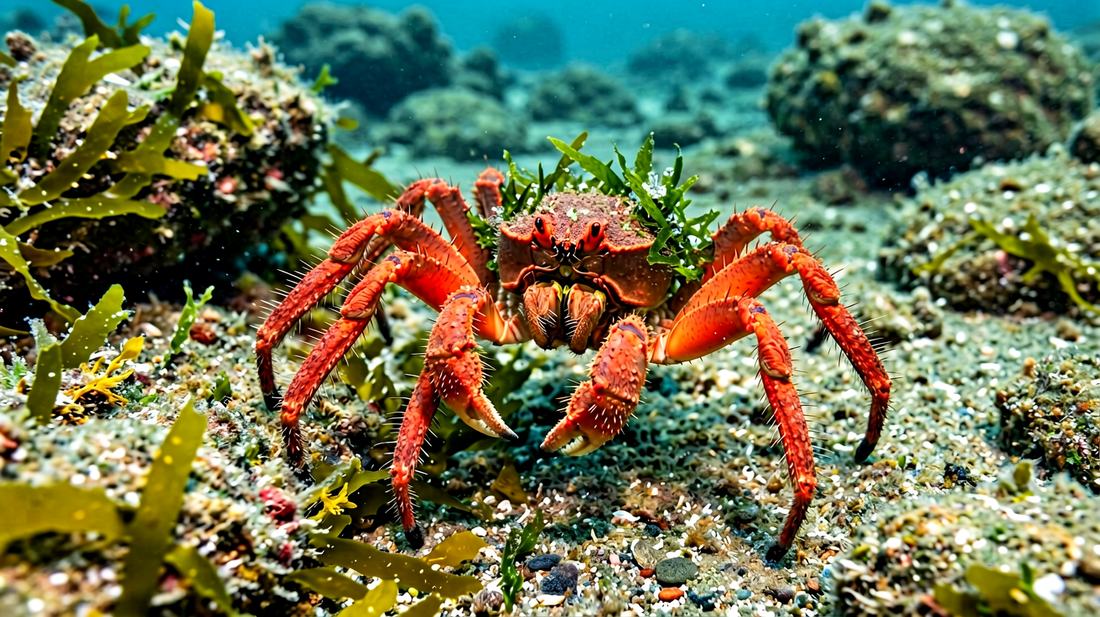
The spiny spider crab is the largest crab in European waters. Its body reaches twenty centimetres across. Its legs span nearly a metre. Hooked hairs on its shell catch bits of seaweed.
Older crabs hide under a mat of algae. It eats seaweed, shellfish, sea urchins and carrion. In autumn and winter the crabs gather in huge groups. They march into deeper water for the cold months.
In spring they return to the shore. It is now one of the most valuable crabs landed. This holds for the English Channel and the Irish Sea.
Family tree
Within the spider crabs
The spiny spider crab belongs to the phylum Arthropoda. Its class is Malacostraca. Its order is Decapoda. Its family is Majidae, the spider crabs. Its best-known British relative is the Edible Crab. The edible crab is heavier and rounder. It has a smooth, brick-red shell. It lives in the same rocky habitats.
Yet it hunts in a different way. The edible crab is a strong shell-crusher. It can open large mussels with ease. The spider crab is slower and more delicate. It picks at seaweed and scavenges. Its claws tear soft food well. They are weak at cracking hard shells. The family Majidae holds several hundred species worldwide.
It includes the decorator crabs of the Pacific. It also includes the long-legged spider crabs of the Atlantic. Many of them cover themselves with seaweed. Some use sponges or anemones as camouflage. The species was described by Johan Christian Fabricius in 1788. Its scientific name joins a classical word for a crab-like beast. It adds the Latin word squinado. That word is thought to mean the spines on its body.
Spines, hairs and long legs
How to identify one
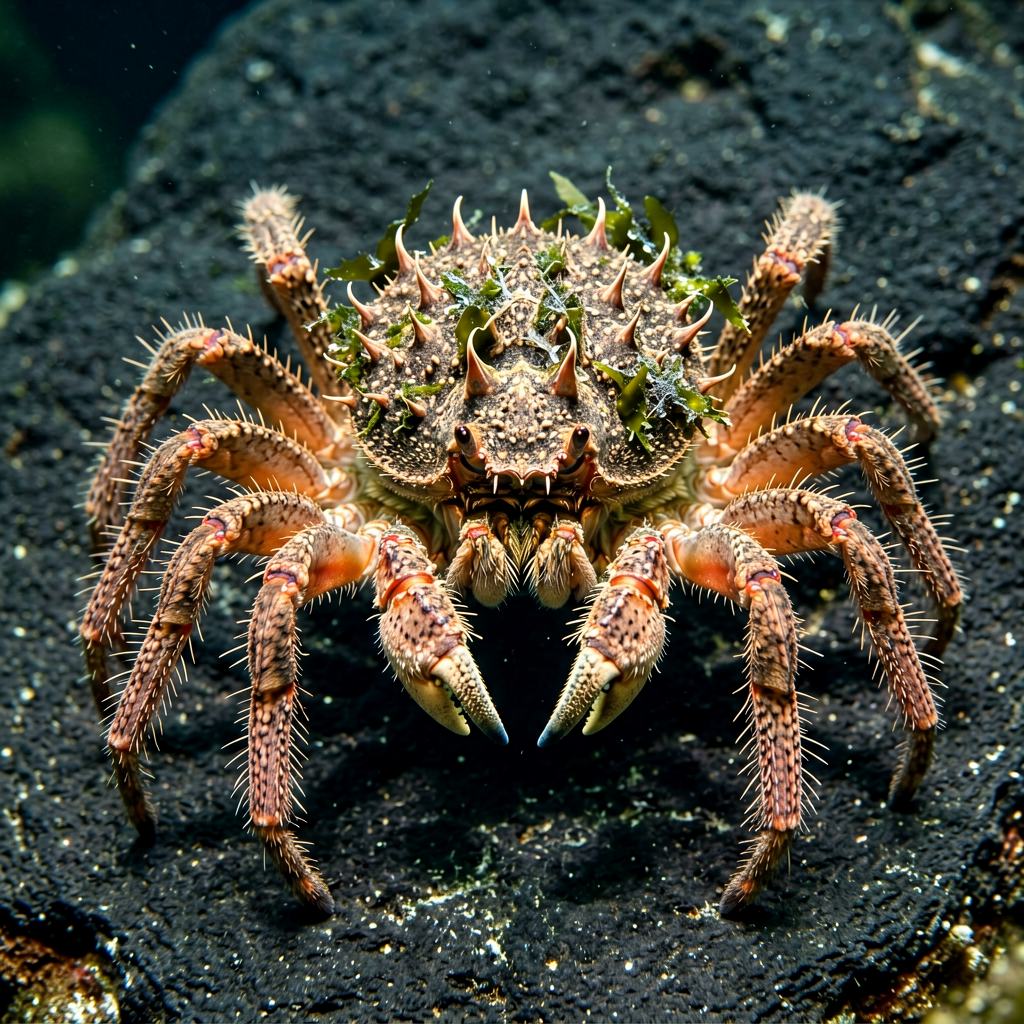
An adult has a carapace about twenty centimetres long. Its leg span can approach one metre. Most adults are somewhat smaller. Egg-bearing females have shorter legs. The shell is roughly pear-shaped. It is wider at the back than at the front. Sharp spines cover the shell. They vary in size. Stiff, hooked hairs grow there too. The hairs catch pieces of seaweed.
The crab lets the weed grow on its back. The camouflage is very effective. A large crab is hard to see on weedy rock. The colour runs from warm reddish-orange to brownish-red. Younger crabs are cleaner and brighter than old ones. The claws are slender. They are slimmer than an edible crab’s claws. They tear and pick rather than crush. The legs are long, jointed and spiny. The crab walks slowly over rock and gravel.
It can swim weakly when it must. The last pair of legs is reduced. These legs sit high on the body. Like all crabs it must moult to grow. After moulting it is soft and vulnerable for days. Females moult before they mate. Males guard them until the new shell hardens. It grows slowly and may live eight years or more.
1
2
3
Weedy rock and cobble
Where it lives
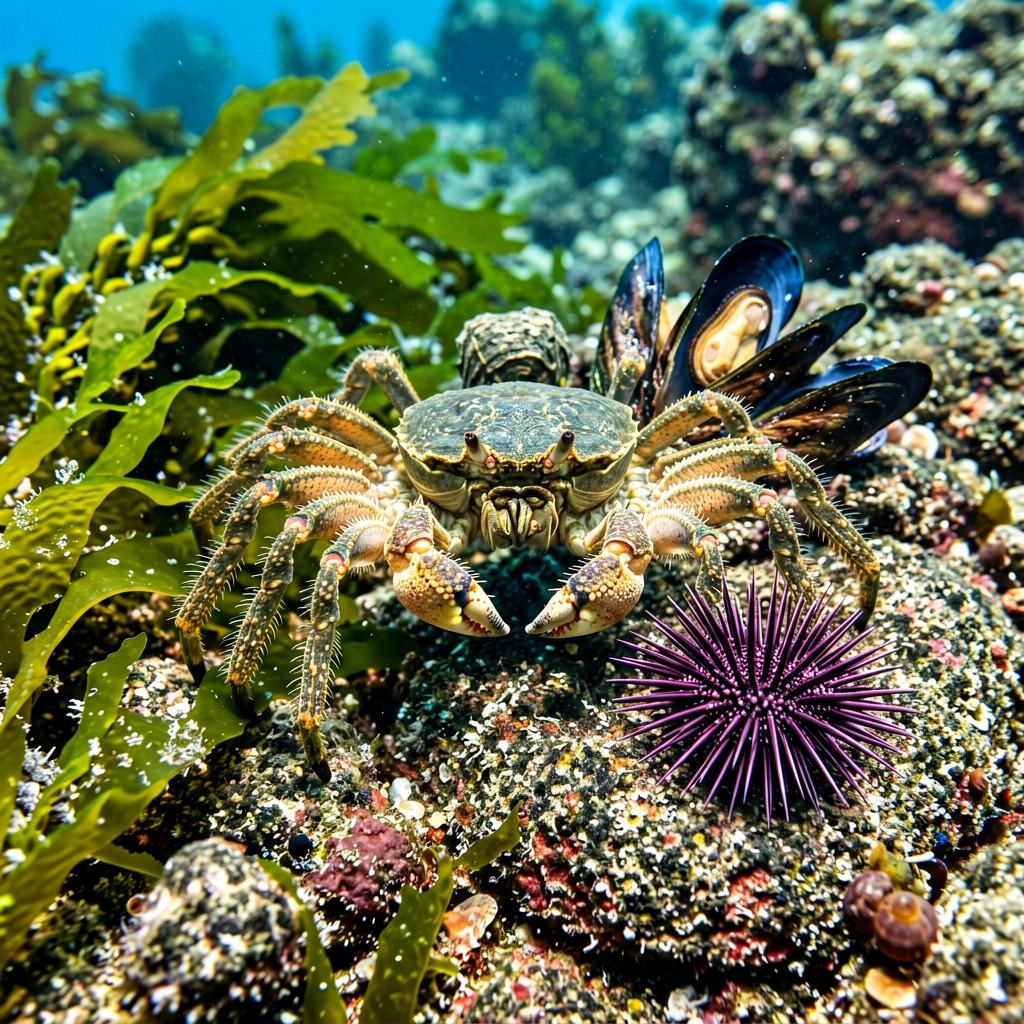
The spiny spider crab lives along the Atlantic coast of Europe. Its range starts at the British Isles and Ireland. It runs south through France, Spain and Portugal to Morocco. It is found throughout the Mediterranean. This includes the Adriatic and the Aegean seas. It lives on rocky, stony and gravelly bottom. It favours the edges of kelp beds. It lives among maerl as well. It is found on coarse sand now and then.
It lives from the low water mark down to about one hundred and twenty metres. In Britain and Ireland it is commonest in the south and west. It is a regular catch in crab pots. These are set around Cornwall, Devon and south Wales. They are also set around the Isle of Man and west Ireland. Around the Channel Islands and the French coast the fishery is old. It has been documented since the nineteenth century. Young crabs settle in shallow water in late summer. They stay in weedy inshore areas.
They move to deeper ground when large enough. They decorate themselves heavily at that stage. The species makes a clear seasonal migration. In autumn the crabs gather in large aggregations. The groups help them move offshore together. This shields them from cold and from disturbance. In spring they return to the shore. The females moult, mate and spawn there. They use the warmer water among the seaweed beds.
What it eats
A slow-moving scavenger
The spiny spider crab is an omnivore and a scavenger. Seaweed forms a large part of the diet. It favours the softer red and green species. It also grazes the fine film on rock surfaces. Animal food includes mussels, limpets and small snails. It eats barnacles, sea urchins and brittlestars. It eats other crabs and any carrion. The crabs gather on dead fish and dead seabirds.
They take the discarded remains of fishing bait. Prey is picked apart with the slender claws. It is not crushed. Hard-shelled prey is attacked at a gap or weak point. Feeding is mainly nocturnal. By day the crab sits still in a crevice. It hides among weed and trusts its camouflage. It grows slowly and eats a mixed diet.
It can live on food that would not suit a specialist. It can go long periods without feeding. This happens while it is soft after moulting. Spider crabs are eaten in turn by others. Their enemies include octopus and conger eels. Large fish, gulls and otters eat them too. The autumn aggregations are the only time when many are caught with ease.
Waiting for the moult
Mating and egg masses
Spiny spider crabs mate in autumn or in spring. The timing depends on the region. The sequence always depends on moulting. A female can mate only just after she sheds her shell. A male carries her beneath his body with his claws. He guards her against rivals for several days. Right after her moult he transfers sperm. She stores it inside her body until her eggs are ready.
She then produces a mass of eggs. The number may be well over a hundred thousand. She glues them to the hairs on her abdomen. She carries them for several months through the winter. The larvae are called zoeae. They drift in the plankton through several stages. They settle in shallow inshore water in late summer. Females breed only once or twice in their lives.
They do not moult again after the final moult. That moult sets their final size and breeding ability. Growth is slow and maturity comes late. The larvae are carried by currents for weeks. Local populations recover slowly from heavy fishing. Populations in different regions are less connected. Their larvae do not live as long as those of some species.
A crab worth catching
Fishing the spider crab
The spiny spider crab has no formal conservation status. Its management is left to national and European fisheries rules. It supports valuable fisheries in France, Spain, Portugal, Ireland and Britain. In some areas it has replaced the edible crab. It is now the most important crab landed there. It is caught in pots and in tangle nets. It is also bycatch in trawls and dredges. It grows slowly and matures late.
It breeds only a few times. Heavy fishing can cut both the number and size of crabs. Minimum landing sizes vary between countries. Some areas have a closed season in the spawning period. The rules are not consistent across its range. Females carrying eggs are protected in some places. They are returned to the sea. There are growing calls for a coordinated minimum size.
There are calls to protect the autumn aggregation sites. These are the places where the crab is easiest to catch. Climate change is expected to shift its range northwards. Warming seas may alter the timing of its migrations. Marine protected areas help it indirectly. They exclude bottom fishing and preserve its rocky and maerl habitats.
Quick hits
Five things to remember
- It is the largest crab in European waters. Its leg span reaches nearly a metre.
- Hooked hairs on its shell catch seaweed. The weed grows and hides the crab.
- In autumn the crabs gather by the thousand. They migrate together into deeper water.
- A female carries well over a hundred thousand eggs. She glues them under her body all winter.
- It is a slow, delicate feeder. It tears food with slender claws, not heavy crushing ones.