 By Iris
Cucumaria frondosa | Sea Apple
Species Profile · Cucumariidae
Sea Apple
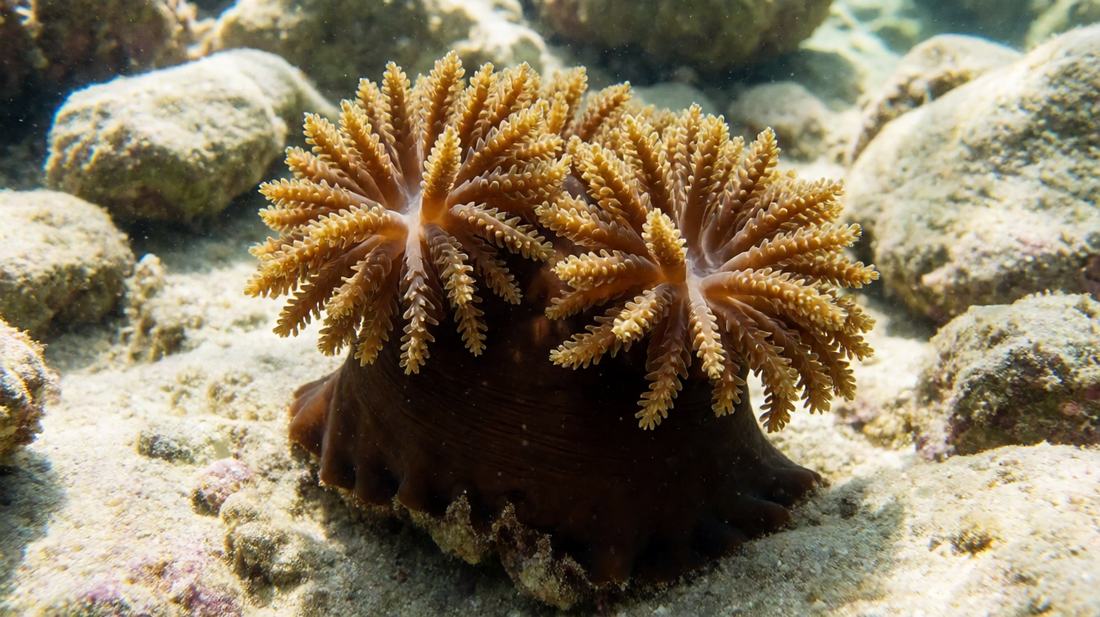
The dark leathery sea cucumber of the cold Atlantic — a filter feeder that opens a crown of ten branched tentacles into the current and pushes each one into its mouth in turn.
IUCN: Not Evaluated
Range
Length
Tentacles
Depth
Life
The crown of the cold seabed
A leathery filter feeder
The Sea Apple is a big, dark sea cucumber. It lives in the cold north Atlantic. It is one of the oddest animals on the northern seabed. Its body is thick, soft and shaped like a sausage. It can reach 50 cm in length. Most animals are 15 to 25 cm. The skin is dark brown, purple-black or dark red.
Fine wrinkles and small soft bumps sit on the skin. The body is firm and bendy at the same time. It feels rather like a thick piece of wet leather. The most striking part is the ring of tentacles around its mouth. There are 10 of them. They are large and branched like tiny trees. They are usually a bright yellow-brown or orange.
This stands out against the dark body. The animal holds them open in the current. It uses them to catch tiny bits of food. Then it pushes each tentacle into its mouth in turn. The Sea Apple lives on hard rock in places with strong currents.
Family tree
Cucumariidae, the sea cucumbers
The Sea Apple sits in the family Cucumariidae and the order Dendrochirotida. It belongs to the phylum Echinodermata. The starfish and the sea urchin are its relatives. It was named by Gunnerus in 1767. The members of this phylum share a set of features. The body is built on 5-part symmetry. The skeleton is made of plates of chalk.
The animal has a set of water-filled tubes. It uses them to move and to feed. The class Holothuroidea, the sea cucumbers, has taken a very different road. The animal has become long and soft. The plates are now tiny pieces in the skin. The 5-part symmetry shows only in the rows of small tube feet. The order Dendrochirotida holds sea cucumbers that feed with branched tentacles.
The family Cucumariidae is the largest family in that order. The genus name refers to the cucumber shape of the body. The species name frondosa means leafy. The Sea Apple shares its phylum with the common starfish. That is the well-known 5-armed hunter of the same cold seas. The 2 look nothing alike. But they share the same water tube system and the same chalk plates in the skin.
Dark body, branched crown
How to tell one
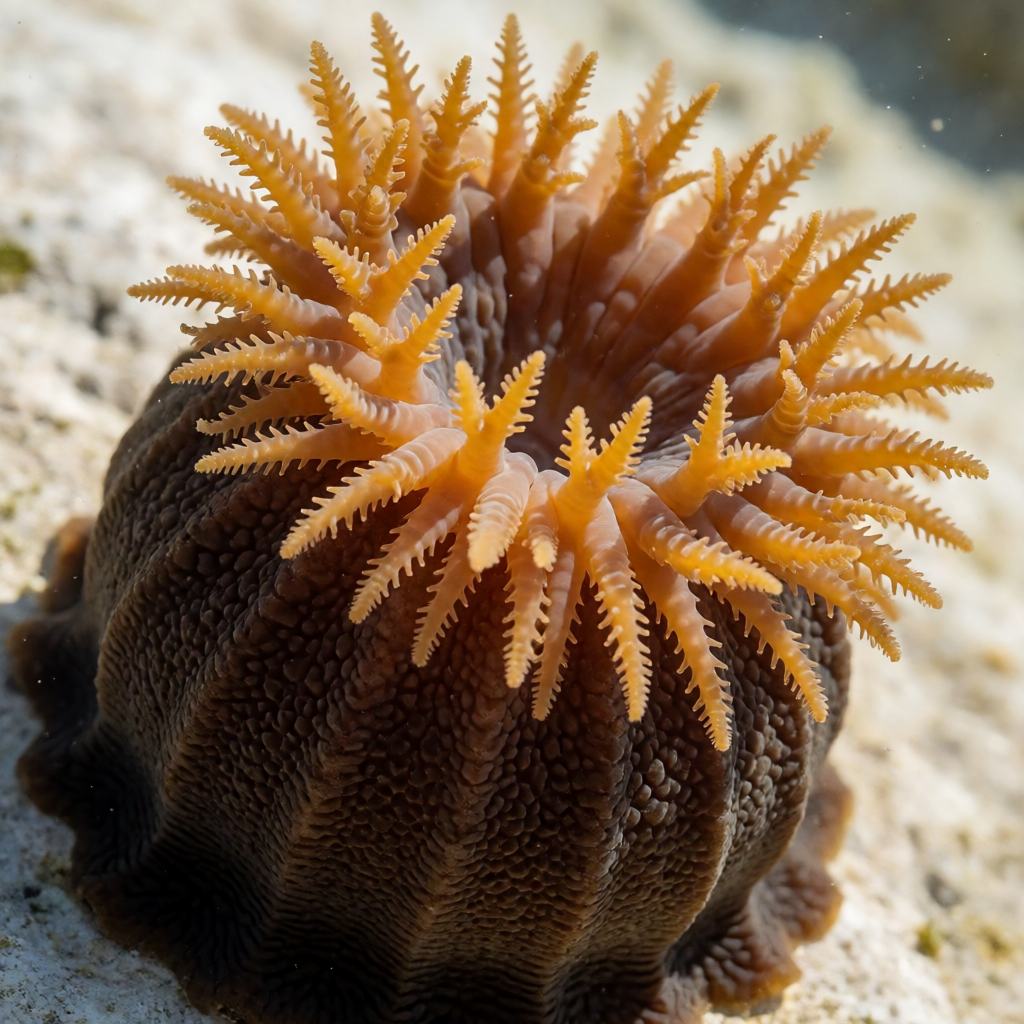
The Sea Apple reaches 50 cm in length. Most adults are 15 to 25 cm. The body is round like a tube and rounded at both ends. The skin is thick, tough and leathery. Its colour is deep brown, purple-black or dark red. The underside is often lighter.
Fine wrinkles and small soft bumps cover the surface. It feels a little slimy to the touch. The skeleton is now only tiny plates buried in the skin. These plates give the body a gritty feel. The body wall holds 5 bands of muscle from end to end. A set of muscles can pull the front end back inside itself when the animal is alarmed.
The tube feet sit in 3 to 5 rows along the lower surface. The animal uses them to hold on to rock and to creep along the seabed. The mouth sits at the front end. Around it are 10 large branched tentacles. They are bright yellow-brown or orange and can be up to 5 cm long. Each one is covered in tiny sticky knobs.
1
2
3
Hard rock and strong current
Where it lives
The Sea Apple lives in the cold waters of the north Atlantic and the Arctic. Its range covers both sides of that ocean. On the American side it runs from Maine north to Labrador and Newfoundland. On the European side it runs from Iceland and north Norway to the north of Britain. It lives on hard ground.
It needs a firm surface to hold on to and a strong flow of water to bring it food. It is found on rock, on boulders and on gravel. It is most common where the tide and the currents keep the water moving. Such places include narrow channels and the mouths of bays. The species often gathers in very dense groups.
In the Gulf of Maine and off Newfoundland there are beds that hold hundreds of thousands of animals on one patch of seabed. These beds are the reason the fishery grew. The animal lives from the shoreline down to about 300 metres. It is most common between 10 and 100 metres.
A filter of the drifting plankton
What it eats
The Sea Apple is a filter feeder. It takes its food from the water and not from the seabed. The 10 branched tentacles are held open in the current. Every one is fringed with tiny sticky knobs. They catch whatever floats past. The animal catches plankton, small algae, tiny larvae and fine flakes of waste.
It also takes the small particles that form marine snow. When a tentacle is covered in food, the animal bends it down. It pushes it into its mouth and wipes the food off. A special set of small lips inside does the wiping. The tentacles work one after another. So the animal feeds almost all the time while the current runs.
This way of feeding needs moving water. It also needs water that carries plenty of small particles. This is why the species lives where the current sweeps the seabed. The animal is more active at some times of day and year than at others. The amount of food in the water changes with the tide, the season and the light.
Eggs freed to the water
The breeding cycle
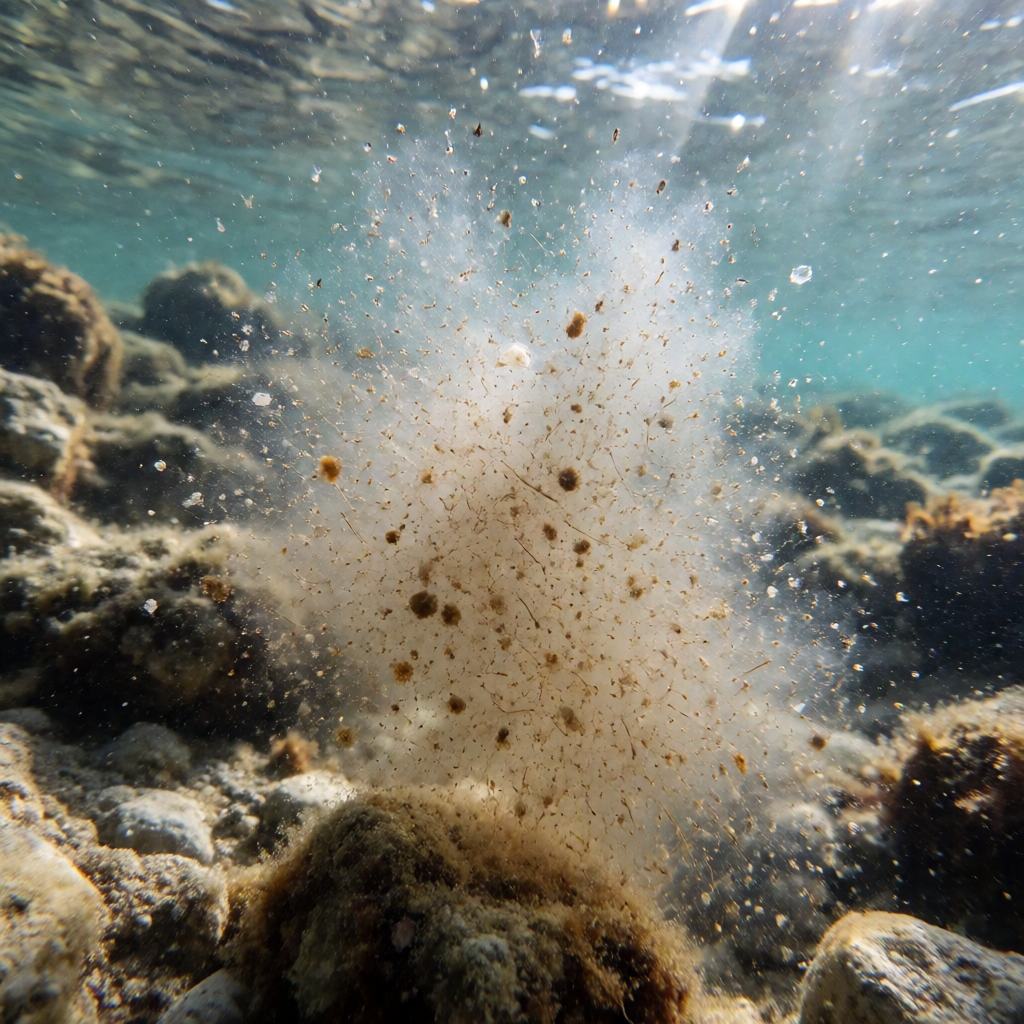
The Sea Apple has separate sexes. Every group holds both males and females. There is no courtship and no contact between the animals. Instead, the males and the females let their eggs and sperm go into the open water. Fertilisation happens in the current. Spawning is tied closely to the season and to the food supply. The animals spawn in the spring and summer.
The water begins to warm then. The spring bloom of plankton also feeds the young. In many groups the whole bed spawns at almost the same time. So the water above it turns cloudy with eggs and sperm. A large female can release several million eggs in one season. The young are a special type called a vitellaria larva. They carry their own store of yolk.
So they need no food while they drift. They stay in the open water for several weeks. Then they settle on the seabed as small sea cucumbers. Growth is slow and the animals mature late. A Sea Apple does not breed until it is 3 or 4 years old. It can live for 8 to 12 years.
No assessment, a growing fishery
Conservation
The Sea Apple has not been assessed on the global Red List. But there is real concern about its future where it is fished. The animal is taken for the Asian food market, where dried sea cucumber is a valuable product. The fishery has grown fast in Newfoundland, Maine and Iceland since the 1990s. The species grows slowly and matures late. It also gathers in dense beds that are easy to find.
So it is very open to overfishing. There is evidence that some beds have already been thinned. In some areas the animals landed have become smaller over time. There is very little management of the fishery. Only a few places set quotas or close areas. No one has a reliable count of how many animals live on the seabed.
A further problem is the damage that dragging gear does to the rocky ground. These animals cannot move away. They also cannot recolonise a stripped area quickly. The most useful steps would be catch limits based on real counts, the protection of some beds from all fishing, and a longer study of growth and breeding.
Quick hits
Five things to remember
- The animal feeds with 10 branched tentacles that look like tiny trees, and it pushes each one into its mouth to wipe off the food.
- Sea Apples often gather in beds that hold hundreds of thousands of animals on one patch of rocky seabed.
- The animal has no eyes and no brain, only a simple ring of nerve tissue around its mouth.
- Males and females never meet, and they let their eggs and sperm go into the open water at almost the same moment.
- The young carry their own yolk and need no food while they drift, and they do not breed until they are 3 or 4 years old.