 By st20113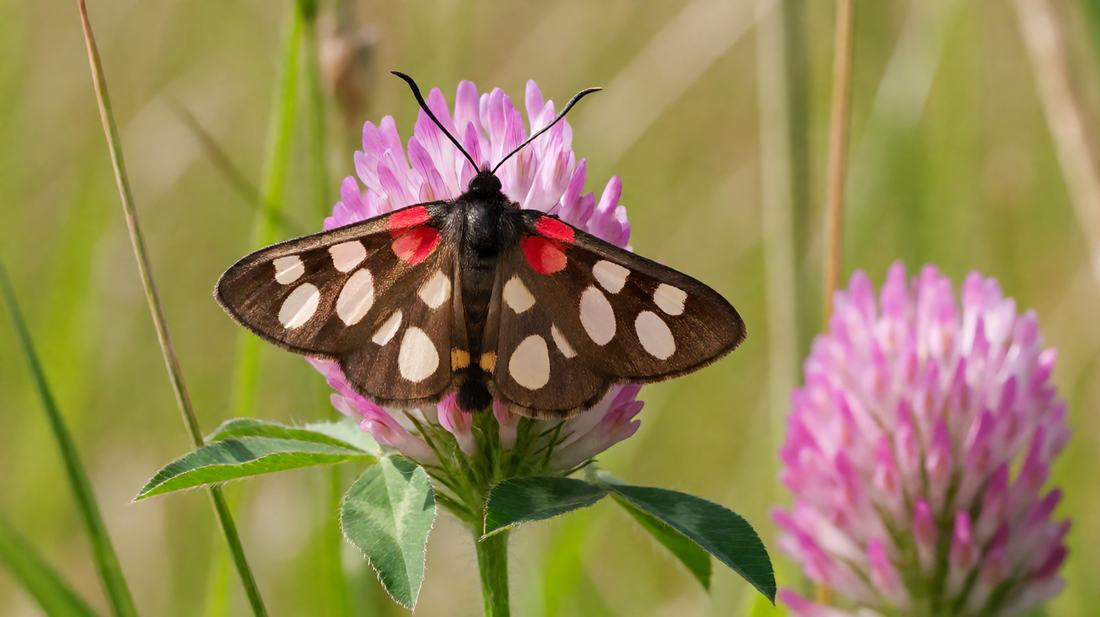
Hippodamea esther | Six-spot Burnet
Species Profile · Nymphalidae
Six-spot Burnet
The boldly marked moth of sunlit meadows — a butterfly in the technical sense that basks by day, feeds only on clover, and is now one of the most threatened moths in Britain.
Scarce in Britain
Range
Wingspan
Spots
Broods
Larval food
The boldly marked meadow moth
A burnet you actually see by day
The six-spot burnet is a large, boldly marked moth. It flies in the sunlit meadows of the Old World. It is one of the few night-flying insects that people learn to know. It is a butterfly in the technical sense. It sits in the order that holds both butterflies and moths. It is the only species in its genus that lives outside the Americas. The adult is small but hard to miss. It has a sooty brown, furred body.
It holds its forewings flat. Each forewing carries 6 large pale spots. It basks with the wings spread flat on the ground or on flowers. It does this in the middle of the day. Most moths hide by day. This one is often out in the open. Its spots tell the birds that hunt it that it is protected to some degree. It lives in a narrow band of grassland.
That band runs from Europe across much of Asia. It is a classic animal of warm, rich meadowland. Such meadows are cut only once a year. In much of western Europe its numbers have fallen. Hay meadows are now mown twice. They are also treated with fertilizer and spray. The six-spot burnet is now one of the most threatened moths in Britain.
Family tree
Nymphalidae, the brush-footed ones
The six-spot burnet is in the family Nymphalidae. That is the brush-footed group. It sits in the genus Hippodamea. The Swedish entomologist Fabricius described it in 1775. The genus name is Greek for ‘of the blessed’. It points to the mythological wife of Hector. Later workers added the name esther to mark this form. The family Nymphalidae is one of the largest in the whole group.
It is named for the way the adult holds its forelegs. Those legs are folded away. Only 4 of the 6 legs are used for gripping. That is why the family is called the brush-footed ones. The six-spot burnet sits among the small, fast, day-flying members. It lives in the subfamily Heliconiinae and its close neighbours. Its living relatives across the Atlantic are the 4 and 6 spot species of North America. The genus is one of the few that spans both continents.
The six-spot burnet shares the family with the cinnabar moth. That moth is larger and bolder. It lives on heather and ragwort. Its young feed on a single plant family. The two differ in the size of the adult. They also differ in the plant the young will accept. Both share the family and the day-active habit.
Sooty body, six pale spots
How to tell one
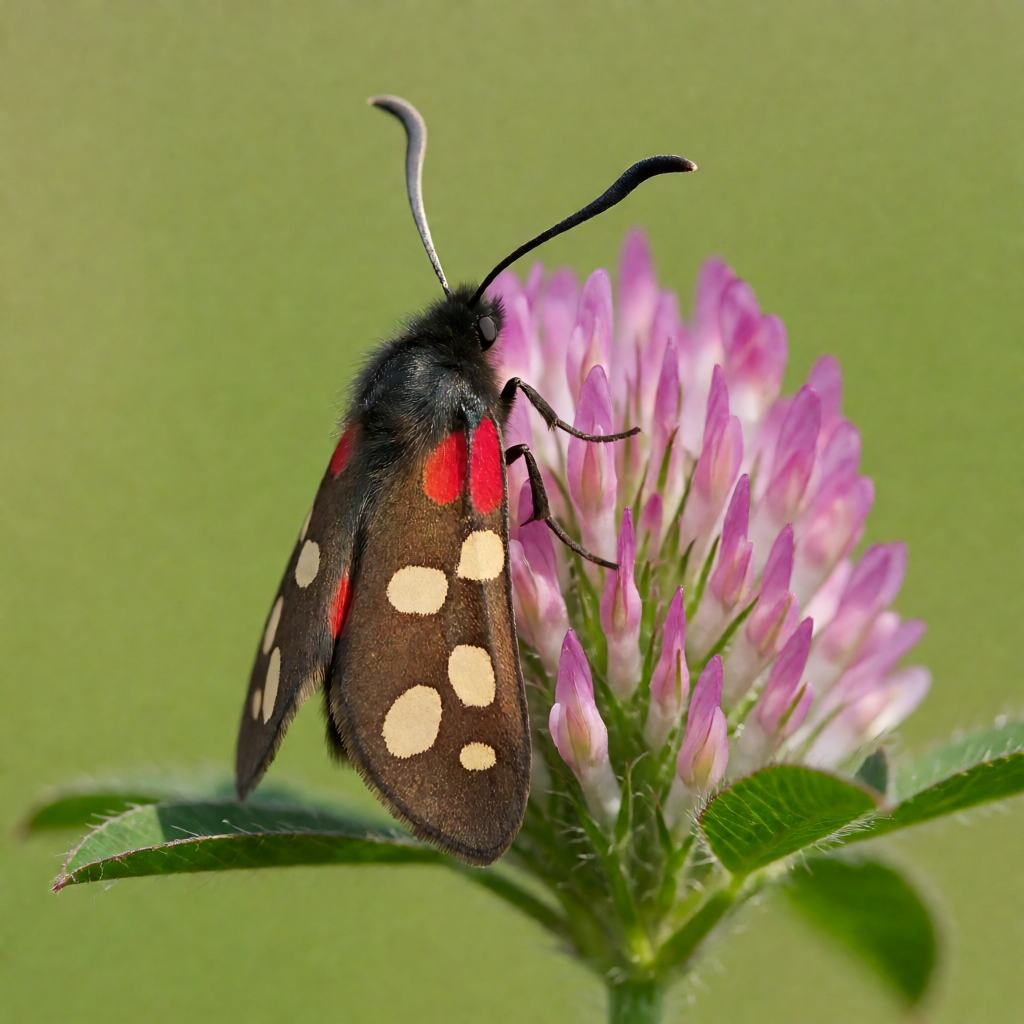
The adult has a wingspan of 35 to 40 mm. That is large for a European burnet. Its body is thickly covered in sooty brown fur. The forewings are the same sooty brown. A broad, darker band crosses the middle. Each forewing holds a row of large, pale, oval spots. The 6 spots that name the species sit in two columns of three. A small row of dark spots sits on the pale hindwings.
The antennae are dark with pale tips. The legs are banded. The larvae are short, thick and grey-green. They have a dark head and a pale line on the back. In the Old World they feed only on red clover. The species shows a sharp difference in the timing of each brood. The early moth is called the spring form. It comes out in May.
It is smaller and darker. The later moth is called the summer form. It comes out in July and August. It is larger and more orange-brown. This split, called polyphenism, is why the species has been studied for so long. The eggs are small and orange. They are laid in rows along the veins of the clover leaves. The larvae hatch there and begin to feed.
1
2
3
Warm meadow, cut once a year
Where it lives
The six-spot burnet lives in warm, rich meadowland. Its range runs from the Atlantic coast of Europe. It goes east across the continent to the edges of Central Asia. In the north it is a summer visitor of lowland meadows. In the south it reaches the open maquis. It also takes the dry, stony slopes of the Mediterranean. It is most at home in grassland that is cut once a year.
The quality of that grassland decides how many it will hold. A meadow cut early in spring is then left for the whole summer. By the time the summer brood needs it, it is short, open and sunlit. That open, short grass is exactly where the moth lays its eggs on the clover. A meadow cut twice will be dense and shaded. One heavily fertilized will be poor in the wild clover and the nectar flowers it needs. Such ground holds almost no six-spot burnets.
The species is also tied to red clover. Where fertilizer and seed mix have driven that plant out of a field, the moth disappears with it. In much of lowland Britain the once-common meadows are lost. The strongholds that remain are the unimproved, hay-cut downlands. They sit in the southern and western counties.
Clover only, and the nectar too
What it eats
The life of the six-spot burnet is built around two plants. It also turns on two life stages. The larvae are strict eaters. In the Old World the young take only red clover. The larvae of the American relatives feed on white and other clovers. A young larva cuts into a clover flower head. It sits there in the flower.
The petals protect it as it eats. It works its way through the buds and the seeds. The adult is a nectar drinker. It takes the sugar from many meadow flowers. It drinks from the very clover it has just left. It also takes the purple of the vetches. It takes the white of the bramble and the orange of the butterfly bush.
It drinks at dusk, in the middle of the day and at dawn. It is one of the later of the day-active burnets to show itself. The moth flies hard but short. It moves only a short way from the meadow where it hatched. It reaches the nearest suitable meadow where it can feed. It is not the kind of insect that crosses long open country. The gaps between meadows matter as much as the meadows themselves.

Spring and summer broods
The breeding cycle
The six-spot burnet breeds twice a year in the south. In the north it breeds once. The two broods look so different that early workers named them as separate species. The spring moth comes out in May. It lays a small clutch of eggs on the clover. It disappears by the end of June. The summer moth comes later, in July and August.
Its eggs hatch and feed through the autumn. The larvae of the summer brood overwinter in the clover. They wrap in the flower head. They feed again in the spring. Then they pupate and emerge as the spring moth of the next year. The pupa is a small, brown, leathery case. It rests on the ground or in the clover.
The larvae are slow to grow. A full generation takes a whole year. That runs from the eggs of one spring moth to the eggs of the next. This two-year rhythm is tied to the flowering of clover. It is what makes the species so fragile when the meadows are cut at the wrong time.
Scarce: a grassland flagship
Conservation
The six-spot burnet is not tracked on the global Red List. It is still one of the flagship species of European grassland. Its local declines have been severe. In Britain it is classed as a Species of Conservation Concern. It is far rarer than it was in the 19th century. The cause is the loss of the unimproved, once-cut hay meadows it needs.
Two-fold cutting has also taken the clover out of its fields. The main threats are farming that works harder. They also include the use of fertilizer. Mowing at the wrong time of year is the last of the three. All of these shorten the window the summer brood has to finish its life cycle. The fix is to protect the last strongholds.
Cut the meadows only once a year. Leave the clover in place. The species is a useful marker. It will not return to a field until the clover is there. It will not return until the grass is cut only once. It is one of the insects that tells a manager a meadow has recovered well.
Quick hits
Five things to remember
- The 6 large pale spots on the forewing are the only reason it is called the six-spot burnet. They sit in two neat columns of three.
- The early spring moth and the later summer moth are so different in colour that early workers called them two separate species.
- The larvae live inside the clover flower head. They cut into it with their own jaws. They will eat nothing else.
- A full life cycle takes two years. The summer larvae overwinter inside the clover flower before they pupate.
- The species is one of the strongest markers of an unimproved, once-cut hay meadow. It will not return to a field that has lost its clover.