 By st20113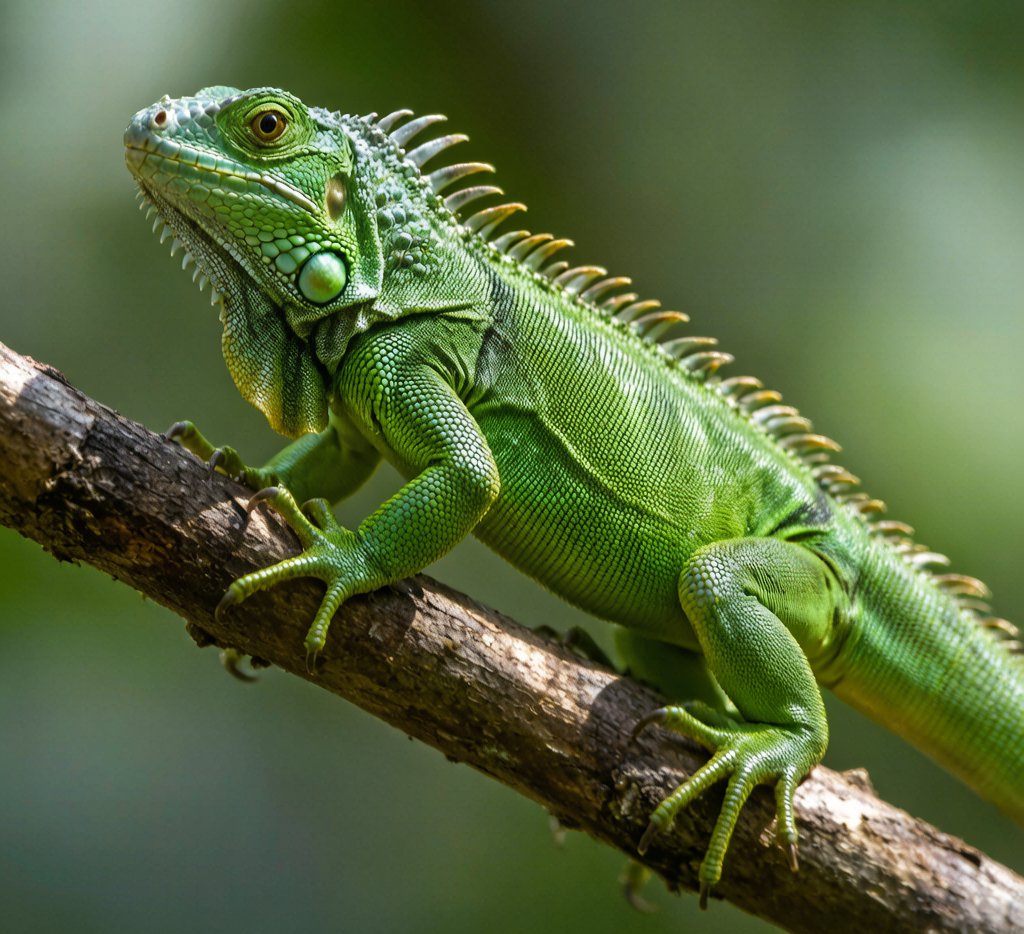
Introduction
The green iguana (Iguana iguana), often called the common iguana, is a large arboreal lizard native to the forests, riverbanks, and coastlines of Central and South America and the Caribbean. Despite the name, adults display a wide range of colors from brilliant green to blue, orange, and even reddish brown depending on mood, region, and age. Popular in the international pet trade, this reptile is also an important cultural food source across parts of Latin America, where it is sometimes called “chicken of the trees.” Capable of living more than twenty years in captivity, it demands careful husbandry that many casual owners underestimate.
Taxonomy
The green iguana belongs to the family Iguanidae, within the genus Iguana. Its scientific name, Iguana iguana, reflects its status as the type species of the genus. Closely related reptiles include the Komodo dragon only in the broad sense of being squamates, while true iguanids are mostly herbivorous New World lizards. Several subspecies have been proposed across its broad range, though classification remains debated among herpetologists. Genetic studies suggest that populations formerly lumped together may represent distinct lineages, complicating both taxonomy and conservation planning for the pet trade.
Physical Characteristics
Adult green iguanas commonly reach 1.2 to 1.7 meters in length, much of it tail, and can weigh up to 9 kilograms. A row of elongated scales runs along the spine from the neck to the tail, and a large dewlap hangs beneath the throat, used for thermoregulation and display. Males are larger than females and develop taller dorsal crest scales and larger femoral pores on the underside of the hind legs, which release scent during the breeding season. Excellent vision includes a third eye, the parietal eye, on the top of the head that detects changes in light and movement. Powerful jaws and sharp teeth allow them to crop tough leaves, and a long whip-like tail serves as a defensive whip against threats.
Habitat
Green iguanas favor tropical and subtropical forests near water. They are strong climbers, spending most of their time in the canopy where they bask on exposed branches and leap between trees when disturbed. They also inhabit mangrove swamps, savanna edges, and increasingly urban parks and gardens, where ornamental plants provide both food and shelter. Because they are ectothermic, they depend on sunlit perches to raise their body temperature and retreat into water to escape predators, swimming with confident dog-paddle strokes. In cooler highland areas their activity is sharply reduced during the dry season.
Diet
Although young iguanas occasionally eat insects, adults are primarily herbivorous, feeding on leaves, flowers, fruits, and shoots. This plant-based diet makes them important seed dispersers in their ecosystems, carrying seeds far from parent trees. In captivity, an unbalanced diet high in protein or oxalates can cause severe health problems such as kidney disease and metabolic bone disease, which is why proper nutrition is emphasized for pet animals such as the leopard gecko and other captive lizards. Fresh water must always be available, and UVB lighting is essential for calcium metabolism in enclosed enclosures.
Reproduction
Breeding typically occurs in the dry season, when males establish territories and perform head-bobbing and dewlap displays to court females and deter rivals. Females dig nesting burrows in sunny, well-drained soil and lay clutches of 20 to 70 eggs, though smaller females lay fewer. The eggs incubate for roughly 90 to 120 days before hatching, with temperature influencing the sex of the offspring. Hatchlings are independent from birth, emerging with a yolk reserve and immediately climbing into vegetation to avoid predation by birds, snakes, and mammals that readily take young iguanas.
Conservation
The green iguana is currently listed as Least Concern by the IUCN because of its wide range and large populations. However, local pressures from hunting, habitat loss, and the pet trade affect some regions, and overexploitation for meat has depleted populations in places such as Colombia and Nicaragua. In areas such as Florida, Hawaii, and Puerto Rico, introduced populations have become invasive, damaging landscaping, burrowing into infrastructure, and undermining native species. Managed harvest programs aim to balance cultural use with long-term sustainability.
Fun Facts
Green iguanas can drop and regrow their tails as a defense against predators, though the new tail is supported by cartilage rather than bone. They are strong swimmers and can remain submerged for long periods, using the water as an escape route. Their dewlap and crest are used in elaborate head-bobbing displays to signal dominance or readiness to mate, making them one of the most behaviorally expressive lizards in the Americas, and their color can shift subtly with temperature and stress.