 By Iris
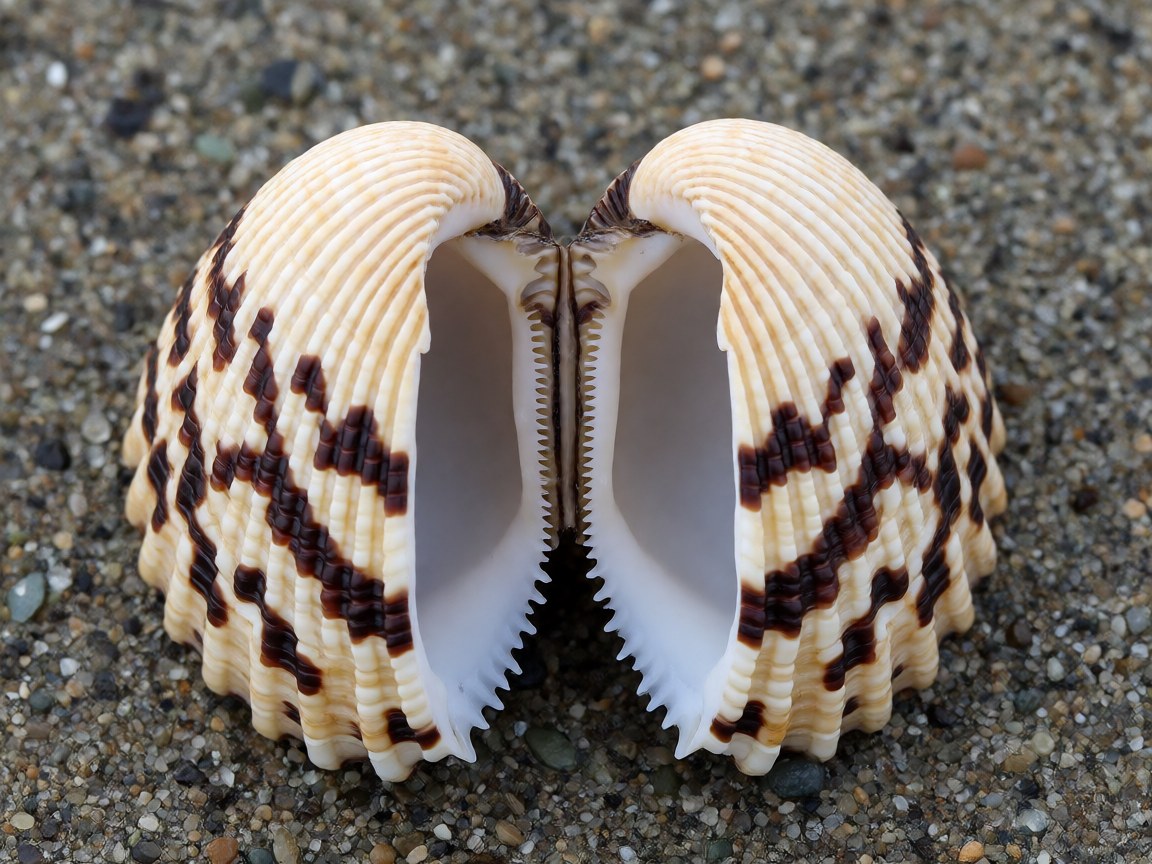
Glycymeris glycymeris | Dog Cockle
Introduction
The dog cockle (Glycymeris glycymeris) is a thick, almost circular bivalve of clean gravelly seabeds, common around the coasts of Britain and Ireland and familiar to most shore-walkers as the heavy cream shell, painted with zigzag brown markings, that turns up in the strandline. It is not a cockle in the true sense, and not close to the edible cockle of sandy beaches, but it is the same general idea: a stout, symmetrical shellfish that lives just under the sediment and feeds by filtering the water above it. What sets it apart is its shell, which is unusually massive for its size, and its age: these animals grow slowly and live for decades, laying down annual growth lines that have made them useful both to archaeologists working out when shells were gathered and to scientists reconstructing past sea temperatures. Live animals are much less often seen than their shells, because they live in coarse offshore gravels that are rarely disturbed.
Taxonomy
Glycymeris glycymeris is a bivalve mollusc in the family Glycymerididae, the bittersweet clams, which belongs to the order Arcida alongside the ark shells. It is therefore a member of the same broad lineage as the ark clams rather than of the true cockles, which belong to a different order; the English name simply reflects a vague resemblance. The genus Glycymeris is a widespread group of heavy, equivalve, semi-infaunal clams, and the species name glycymeris was applied to some edible shellfish in classical antiquity and was reused by Linnaeus. Its hinge structure is diagnostic: instead of the few large interlocking teeth seen in clams and cockles, the hinge line is straight and long and carries a row of many small, similar teeth, an arrangement known as taxodont dentition, which is a primitive feature shared with the ark shells. Like other suspension-feeding bivalves such as Mytilus edulis, it feeds by pumping water over its gills, though the mussel attaches to rock with byssal threads while the dog cockle is a free-living burrower in sediment.
Physical Characteristics
The shell is thick, heavy, and almost circular in outline, usually four to six centimetres across but occasionally larger, and the two valves are equal in size and shape, closing tightly all round. The outside is smooth to the touch despite a sculpture of fine radiating ribs crossed by concentric growth lines, and it is covered with a thin, brownish periostracum, or skin, which wears off to reveal the underlying shell. The colouring is one of its most recognisable features: a background of cream, buff, or pale grey overlaid with darker brown or reddish-brown zigzag, chevron, or blotched markings arranged in bands, giving the shell a distinctly patterned, almost painted appearance. The hinge is straight, with the characteristic row of numerous small teeth, and the ligament is external and sits in grooves on the hinge plate. Inside, the shell is smooth and porcellaneous, white or faintly flushed, with two roughly circular muscle scars of similar size. The animal has a large, powerful foot used for burrowing, and unlike many bivalves it has no siphons or only very short ones, which restricts it to living just below the sediment surface. Adults do not attach themselves with byssal threads.
Habitat
It lives buried just beneath the surface of coarse, clean sediment — shell gravel, coarse sand, gravel with sand, and shelly mud — from the lower shore and shallow sublittoral down to depths of around a hundred metres, and it is characteristic of the stable, current-swept gravelly grounds that many softer-bodied animals avoid. It needs clean, well-oxygenated water with enough movement to keep the sediment free of silt, and it is absent from fine mud and from heavily silted ground where its short siphons would clog. The species is distributed in the eastern Atlantic from Norway and the North Sea south to Iberia, the Mediterranean, and north-west Africa, and it is common around Britain and Ireland, especially in the south and west. Empty shells are abundant on beaches after storms, and because the shell is dense and durable it survives in the strandline long after most other species have been smashed to fragments.
Diet
It is a suspension feeder. Water is drawn in through a gap between the valves, passed over the gills, where cilia and mucus trap suspended particles, and expelled again. The gills sort the trapped material by size and weight and pass the edible fraction to the labial palps and then to the mouth; rejected material is bundled into mucus and ejected as pseudofaeces. The diet is dominated by phytoplankton — diatoms, flagellates, and other microscopic algae — together with bacteria, organic detritus, and the larvae and other small particles suspended in the water column. Because it has no long siphons, it must sit close to the sediment surface in order to reach clean water, and it is therefore more exposed to shifting gravel and to being uncovered by storms than a deep-burrowing clam would be. Feeding continues year-round but slows in winter when plankton is scarce and water temperature falls.
Reproduction
The sexes are separate, and reproduction is by broadcast spawning: males and females release sperm and eggs into open water, usually in spring and summer, often in response to rising sea temperature, and fertilisation takes place in the plankton. Development passes through the standard bivalve sequence of trochophore and veliger larvae, with the veliger feeding and swimming in the plankton for several weeks before it settles onto suitable gravel and metamorphoses into a tiny clam. Settlement is the critical stage, since the larvae need coarse, clean substrate and will not survive on silted ground. Growth is slow and, crucially, continues throughout life in the form of annual growth increments laid down in the shell, and individuals commonly reach several decades of age. Sexual maturity is reached at a few years old, and although fecundity is high, recruitment is irregular and depends heavily on favourable conditions during the long larval phase.
Conservation
The species is widespread and locally abundant and is not considered globally threatened. Its chief vulnerability is its biology: it is slow-growing, long-lived, and lives in a habitat — stable offshore gravel — that is easily damaged by scallop dredging, bottom trawling, and aggregate extraction, all of which disturb or remove the surface layer it depends on and can destroy animals that took decades to grow. Recovery of a dredged gravel bed is correspondingly slow. There is also some local collection for food and for craft uses, and the attractive shells are sold widely. Because the shell records growth in annual bands, dog cockles have attracted scientific attention as archives of past environmental conditions, and shells from archaeological middens have been used to determine the season in which prehistoric people gathered them; this dual value as both a long-lived animal and a natural recorder makes the protection of stable gravel habitat a genuine conservation priority.
Fun Facts
- Despite the name, it is not a true cockle; it is more closely related to the ark shells.
- The hinge carries a long row of many small teeth, a primitive feature called taxodont dentition.
- It grows slowly and lives for decades, recording each year as a growth band in the shell.
- Scientists read those bands to reconstruct past sea temperatures, and archaeologists use them to tell what season shells were collected in.
- The heavy cream shell with brown zigzag markings is one of the most familiar shells on British beaches.