 By st20113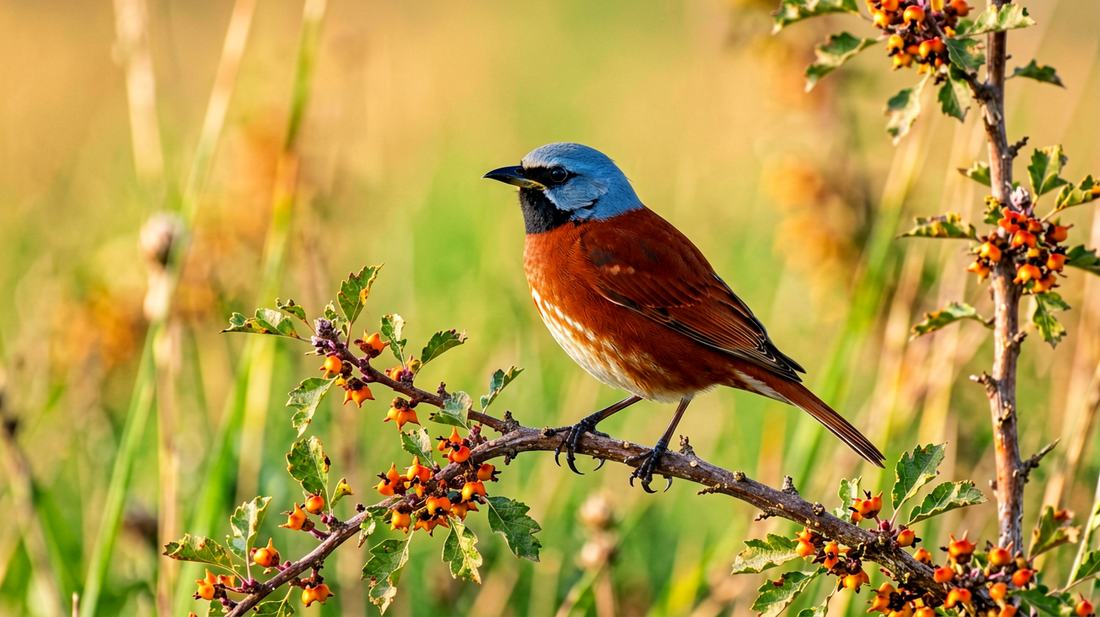
Lanius collurio | Red-backed Shrike
Species Profile · Laniidae
Red-backed Shrike
A small masked hunter that impales surplus prey on thorns — once a common bird of the British countryside, and now barely a breeder there.
IUCN: Least Concern
Range
Length
Weight
Larder
Migration
The butcher bird
A songbird that hunts
The red-backed shrike is a small, compact, boldly marked hunting songbird. It belongs to the shrike family. It is one of the few European songbirds that kills other vertebrates. That habit has given it a place in country folklore far beyond its size. A bird no bigger than a sparrow will take lizards and frogs. It takes young voles and the nestlings of other birds. It stores the surplus by spiking it on thorns. Hawthorn, blackthorn, sloe and barbed wire all serve. The male is a handsome bird. His crown and nape are a pale blue-grey. A black mask runs through the eye.
His back and mantle are a rich chestnut-red. His breast and belly are a pale pink. His long black tail carries white outer feathers. That tail flicks and turns as the bird sits on an open perch. It watches for movement on the ground below. The female and the young birds are sober brown, buff and grey. They carry a barred, wavy pattern and a fainter mask. The whole look of the species is that of a small hawk rather than a songbird. Its hunting method is shared with the other shrikes. The bird uses an open vantage point. From there it launches a direct, low, gliding attack on prey.
It has spotted that prey on the ground. It also spikes its victims on thorns in what is called a larder. That larder stores food for a period when hunting is poor. It also holds a noxious insect or a struggling lizard in place. Then the bird tears it apart. The species is a long-distance migrant that winters in Africa. It has retreated from Britain over the last 60 years. It has also retreated from the western edge of its range. Few birds of the European countryside have declined so clearly.
Family tree
Lanius, the true shrikes
The red-backed shrike sits in the genus Lanius. This is a group of about 30 species of hunting songbirds. They range from small to medium in size. They occur through Europe, Asia, Africa and North America. They share a hooked bill with a notch near the tip. They also share a habit of storing prey on thorns or barbed wire. They have a fierce and lonely temper. The bird belongs with the wood shrikes, the bush shrikes and the helmet shrikes. Together they make up the shrike family. Its place in the group has been argued over for more than a century.
The shrikes look like small falcons in their hunting and in their hooked bills. But they are now known to belong to the crow line of the songbirds. They are not close relatives of the true insect-eating flycatchers. They were once grouped with those birds. That history is worth recalling. The red-backed shrike shares its hunting method with the spotted flycatcher, Muscicapa striata. It also shares much of its habitat taste. The spotted flycatcher belongs to a different family altogether. It dashes from an open perch to take flying insects. The 2 birds sit and wait in the same hedgerows in parts of eastern Europe.
The comparison between them makes a useful point. One line has merely taken up the sit-and-wait habit. The other has evolved the hooked bill and the strong feet. It has also evolved the storing habits of a true hunter. The species is polytypic. Between 2 and 5 subspecies are named across its range. That range runs from Iberia and Scandinavia to western Siberia and the Caucasus. The birds that once bred in Britain are placed in the nominate form, collurio.
Mask, chestnut back and hooked bill
How to identify one
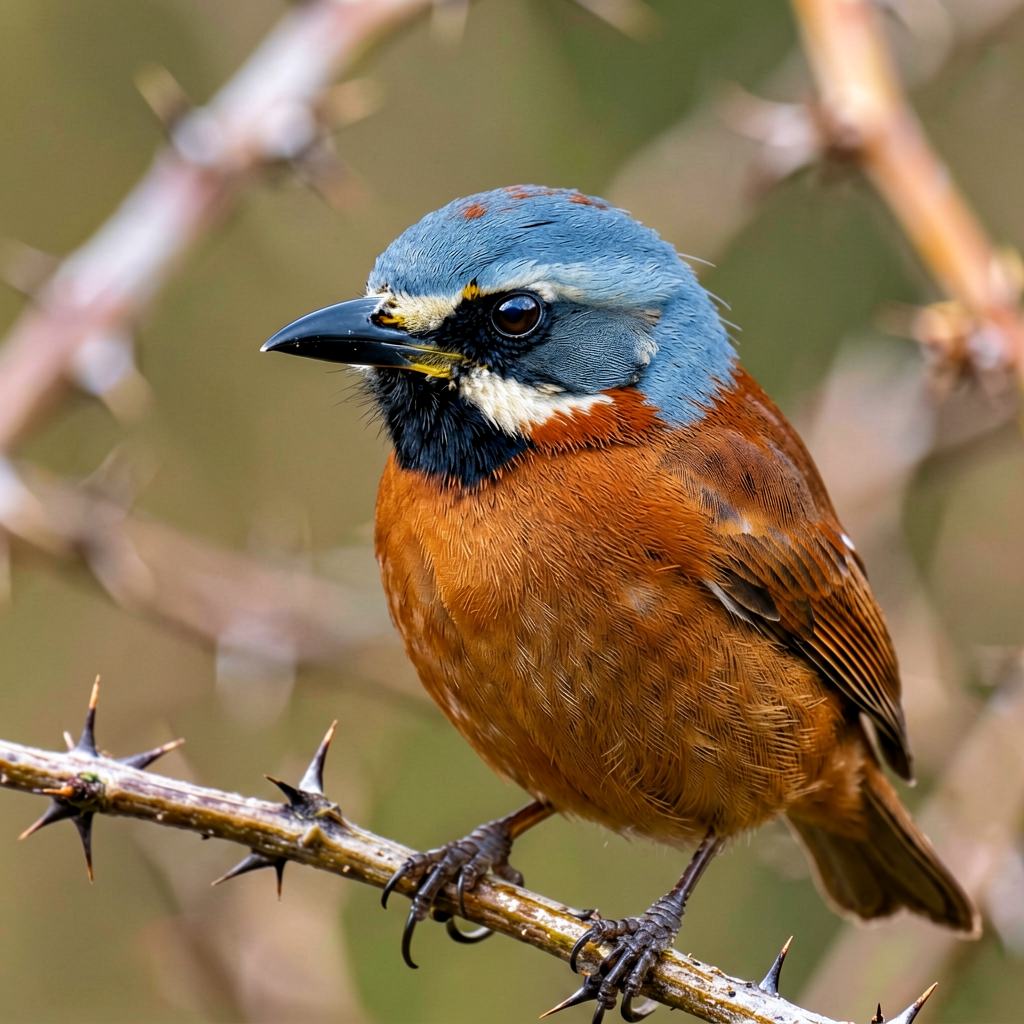
The red-backed shrike is a medium-sized shrike. It measures between 16 and 18 centimetres in length. Its wingspan is between 24 and 27 centimetres. Its body mass is between about 22 and 35 grams. Its strong, slightly hooked bill is a little over 20 millimetres long. The bill carries a sharp tooth near the tip. Its long, graduated tail accounts for nearly half of the total length. That tail works as a balance and a rudder in flight. The flight itself is low and undulating. The adult male in spring is unmistakable in good light. His crown and nape are pale blue-grey. A broad black band runs through the eye and onto the lores.
It separates the grey of the crown from the whitish throat. His mantle and back are warm chestnut or brick red. A white patch at the base of the primaries shows clearly in flight. His underparts are a pale, slightly rose-tinted pink. That fades to whitish on the belly. His long black tail has a white base and white outer feathers. The bill and the legs are dark. The female looks quite unlike the male. She is brown above with a warm rufous tinge on the rump and shoulders. She is buff-grey below with a fine crescent barring. That barring is most obvious on the breast and the flanks. She carries a dark brown mask.
It is narrower and less sharply defined than that of the male. She also has a pale eyebrow. The first-year male closely resembles the female. It may be 2 or 3 years before he acquires the full adult plumage. The tail of the adult male is flicked and turned in a slow, mechanical way. He does this when he is excited or searching for prey. The species also sits upright and level on a wire, a stem or a fence post. It uses the dead top of a bush as well. From there it drops to the ground in a short glide. The bird at rest looks like a small, heavy-headed hunter rather than a songbird.
1
2
3
Scrub, heath and rough pasture
Where it lives
The red-backed shrike is a bird of open country with scattered bushes. The exact make-up of its habitat matters a great deal to its conservation. The species needs low, open grassland that is rich in invertebrates for hunting. It needs thorny bushes for nesting sites and spiking points. And it needs a supply of larger prey such as lizards, frogs and voles. That supply is itself a product of rough and varied land. In Europe the bird breeds in dry scrub and heathland. It uses rough pasture with bramble and hawthorn. It also uses the edges of woodland and of clearings. It uses the lightly grazed fringes of old farmland, orchards, vineyards and young plantations.
It uses the mosaic of grass and thorn that traditional pastoral farming produced. It avoids the closed canopy of the wood. It also avoids the uniform bare fields of modern arable farming. In Britain the species was formerly a regular breeding bird. It was fairly common on heathland, commons, scrub and field edges. That was true through much of England and Wales. Its decline through the 20th century was tied to several changes. Rough pasture was lost. Hedgerows and thorn scrub were removed. Grazing was intensified and farm chemicals were sprayed.
And the rough corners of farmland were cleaned up. Those corners had supported the large insects on which the bird depends. The species is a long-distance migrant. It leaves its breeding grounds in August and September. It crosses the Mediterranean and the Sahara. It winters in the savannas and open woodland of eastern and southern Africa. Most of that area lies south of the Equator. It returns to Europe in May. So the yearly cycle involves a journey of 8,000 kilometres. That happens in each direction.
Insects and lizards
What it eats
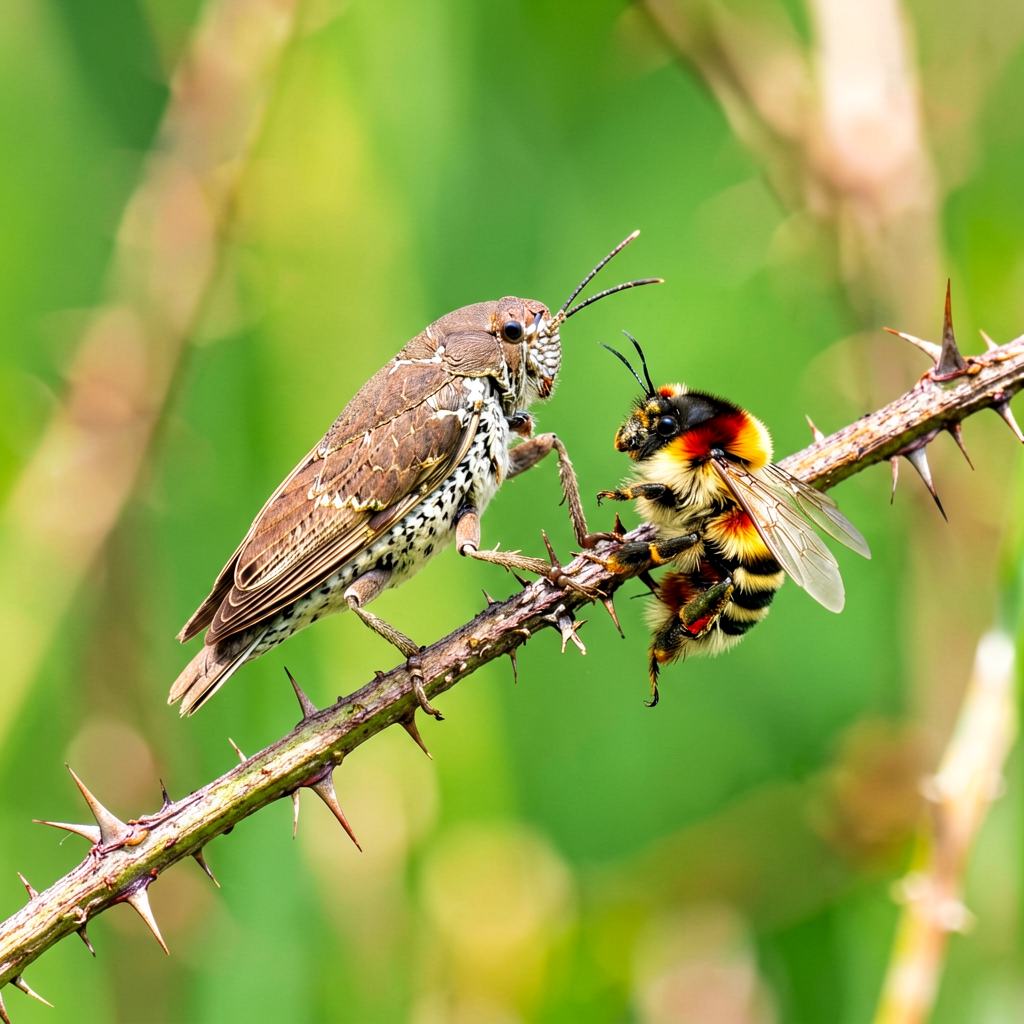
The red-backed shrike is a generalist hunter. It takes whatever suitably sized animal it can catch. Its diet is made up very largely of large insects. Beetles of many families, grasshoppers and bush crickets all feature strongly. So do crickets, flies and dragonflies. So do bees, wasps, bumblebees, ants, butterflies and moths and their caterpillars. The bird is one of the few European songbirds that will tackle a stinging insect. To this invertebrate diet the species adds a wide range of small vertebrates. Lizards are probably the most important of these. The common wall lizard and the viviparous lizard are both taken.
The bird also takes small snakes, young frogs and toads. It takes the nestlings and young of other small birds. It eats small mammals such as voles and shrews, and earthworms after rain. The taking of vertebrates peaks when the shrikes feed their own fast-growing young. The male may then provision a nest with mostly lizards and nestling birds. The hunting method is a low, direct glide or a short run and pounce. It is not a long chase. The bird will also hover. It takes insects from the air in a flycatcher-like dash. It picks prey from the surface of leaves and stems.
The typical habit of the family, though, is the spiking of prey. Thorns, the barbs of a fence and the broken ends of twigs all serve. The larders that result may hold a dozen or more items. Those items include noxious insects, held for 1 or 2 days before they are eaten. They may lose their unpleasant taste in the interval. The species depends on a rich community of large insects and small land vertebrates. So it is tied to land that is structurally diverse and untreated by chemicals. It also needs land that is only lightly grazed. The collapse of that kind of land is the chief cause of its decline.
A thorn bush for a nest
The breeding cycle
The red-backed shrike is monogamous. In most of its range it raises a single brood in the year. The male arrives on the breeding grounds in May, a few days before the female. He sets up a territory and advertises it by singing from the tops of bushes. He also gives a slow, fluttering display flight. He holds his wings high and spreads his tail. The song itself is a quiet, rambling mix of squeaks and trills. It also contains fragments of the songs of other birds. The nest is a bulky, untidy cup of grass, stems, rootlets and moss.
It is lined with wool, hair and feathers. It is placed low down in a thorny bush. That is usually between 1 and 2 metres above the ground. Hawthorn, blackthorn, bramble, gorse, rose and young conifer are all used. Both birds take part in building it. The clutch holds between 5 and 6 eggs, occasionally 7. They are laid in the second half of May or in June. The female incubates them for between 14 and 16 days, and the male brings her food. The male also defends the nest with vigour and force.
He may attack people, cats, magpies and jays that come too close. The young are fed by both parents. The food is insects and the vertebrate prey that the male collects. The young leave the nest at between 14 and 16 days of age. They can look after themselves a further 3 or 4 weeks later. The family parties break up in August. The birds begin their migration within a few weeks of the young having left the nest. Ringing data show that the species may live for 5 years or more. The hazards of the Saharan crossing mean that deaths among first-year birds are high.
Lost from Britain
Conservation
The red-backed shrike is listed as Least Concern on the global Red List. Its world range is huge and the total population is still counted in millions of pairs. Yet it is one of the most striking examples of a safe bird. It is in deep trouble at the western edge of its range. The numbers of western and central Europe have fallen sharply since the 1970s. The bird no longer breeds often in Britain. It has also been lost from the Netherlands and from parts of Germany. Much of France has lost it too. In Britain the red-backed shrike bred in most counties of England and Wales in the 19th century. It declined steadily through the 20th century.
It has not bred often since the 1980s. The birds still seen in the country are chiefly migrants and overshooting individuals. They appear in late spring and autumn. The species is treated in Britain as a rare and casual visitor. It is no longer a regular breeder. The causes of the decline are many and connected. They include the loss of the scrub and rough pasture that the bird needs. The intensification of farming is another cause. It brings chemical inputs and the loss of hedgerows. So is the tidying of the rough corners of farmland.
And so are the pressures on its African wintering grounds. The savanna and open woodland it uses there are being converted. The bird depends on large insects and on small vertebrates. So any fall in the insect life it feeds on hits the bird as well. Conservation steps have therefore focused on a few things. They apply in the countries where the bird still breeds in numbers. Low scrub and thorn are kept open by light grazing or by cutting. Chemical inputs on farmland are reduced. Habitat mosaics of grass and bush are created. And nest sites are protected from disturbance.
Quick hits
Five things to remember
- The red-backed shrike stores surplus prey by spiking it on the thorns of hawthorn and blackthorn, or on barbed wire. A well-used larder may hold a dozen beetles, grasshoppers and lizards at once.
- It is one of the very few European songbirds that hunts other birds. A male feeding young may bring more lizards and nestling birds to the nest than insects.
- Its closest kin in the group are the crows and their allies. They are not the flycatchers, which it resembles in its habit of sitting on an open perch and waiting for prey.
- The female is so different from the male in plumage that the 2 were once thought to belong to different species.
- The last regular breeding of the red-backed shrike in Britain took place in the 1980s. The birds that appear in the country now are mostly migrants that have overshot their nesting grounds.