 By st20113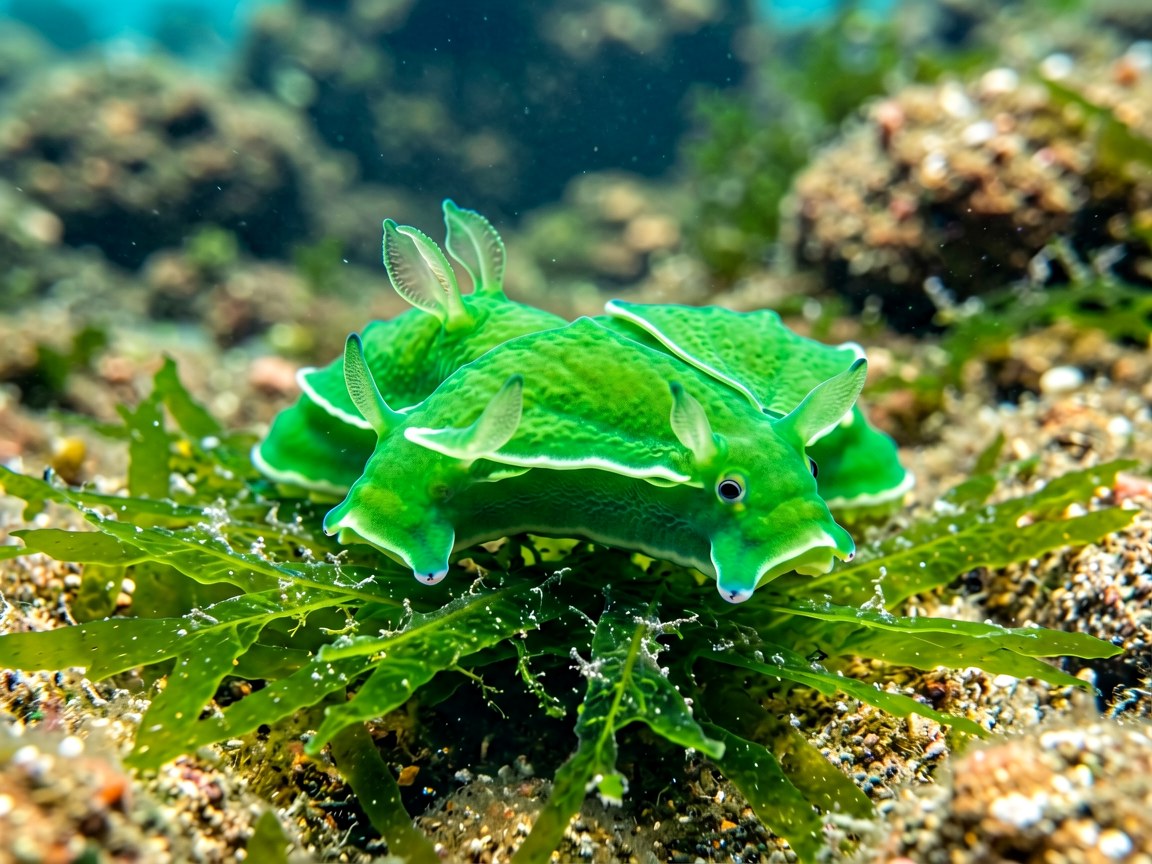
Elysia viridis | Green Sea Slug
Introduction
The green sea slug (Elysia viridis) is a small, vividly emerald sea slug that lives on green algae and does something almost plant-like: it keeps the algae’s chloroplasts alive inside its own body and lets them feed it. A few centimetres long, with folded wing-like flaps along its sides, it is one of the best-known examples of “solar-powered” animals and a common sight in shallow, weedy pools on European coasts.
Taxonomy
Elysia viridis is a sacoglossan sea slug in the family Plakobranchidae. It belongs to the molluscs, sharing the basic plan of a muscular foot and a radula with far more active relatives such as Octopus vulgaris, the common octopus, but it has taken the molluscan body in a very different direction: instead of a shell and a hunting life, it has a soft, leaf-like body, no adult shell at all, and a diet of nothing but algae.
Physical Characteristics
The body is soft, elongate, and flattened, usually two to five centimetres long, and bright emerald to mid-green, sometimes with small white, red, or blue spots. Along each side run two large, thin, folded flaps—the parapodia—which can be held out flat like wings to spread the body into a leaf shape, or folded up over the back. The head bears two rolled, ear-like rhinophores. The green colour comes from the living chloroplasts inside the tissue, not from pigment alone.
Habitat
It lives on the lower shore and in shallow subtidal water, on rocky coasts, in rock pools, and among seaweed, especially where the green alga it feeds on grows. It is found around the coasts of Britain, Ireland, and north-west Europe and into the Mediterranean. It favours sheltered, weedy, sunlit water and is most often found by examining clumps of green seaweed in pools.
Diet
The slug feeds by piercing the cells of green algae—particularly the filamentous seaweed Codium—with a specialised radula tooth and sucking out the contents. Remarkably, it does not digest the chloroplasts: it keeps them living in the cells lining its gut, where they continue to photosynthesise and pass sugars to the slug. This theft, called kleptoplasty, means an animal can survive for weeks with little or no additional food, living partly on sunlight.
Reproduction
Like most sea slugs it is a hermaphrodite, and two animals mate to exchange sperm. It lays small, coiled, sausage-shaped masses of eggs, usually on the seaweed it feeds on, each containing many tiny eggs. Development is direct in this species: there is no long-lived swimming larval stage, so the young crawl away as miniature slugs and stay in the same habitat as their parents.
Conservation
The species is common, widespread, and not threatened. Because it depends on particular green seaweeds and on clean, sheltered shallow water, it disappears from shores that are heavily polluted, silted, or scoured, but it remains abundant across most of its range. It is widely studied by scientists because of the remarkable way it keeps stolen chloroplasts alive and working inside its own cells.
Fun Facts
- It steals working chloroplasts from the algae it eats and keeps them alive inside its body.
- The stolen chloroplasts keep photosynthesising, so the slug lives partly on sunlight.
- Its green colour is the algae’s own chlorophyll inside its tissues, not just pigment.
- It can survive for weeks without food thanks to its internal “gardens”.
- It has no adult shell at all, and its side flaps open out like a leaf to catch the light.