 By st20113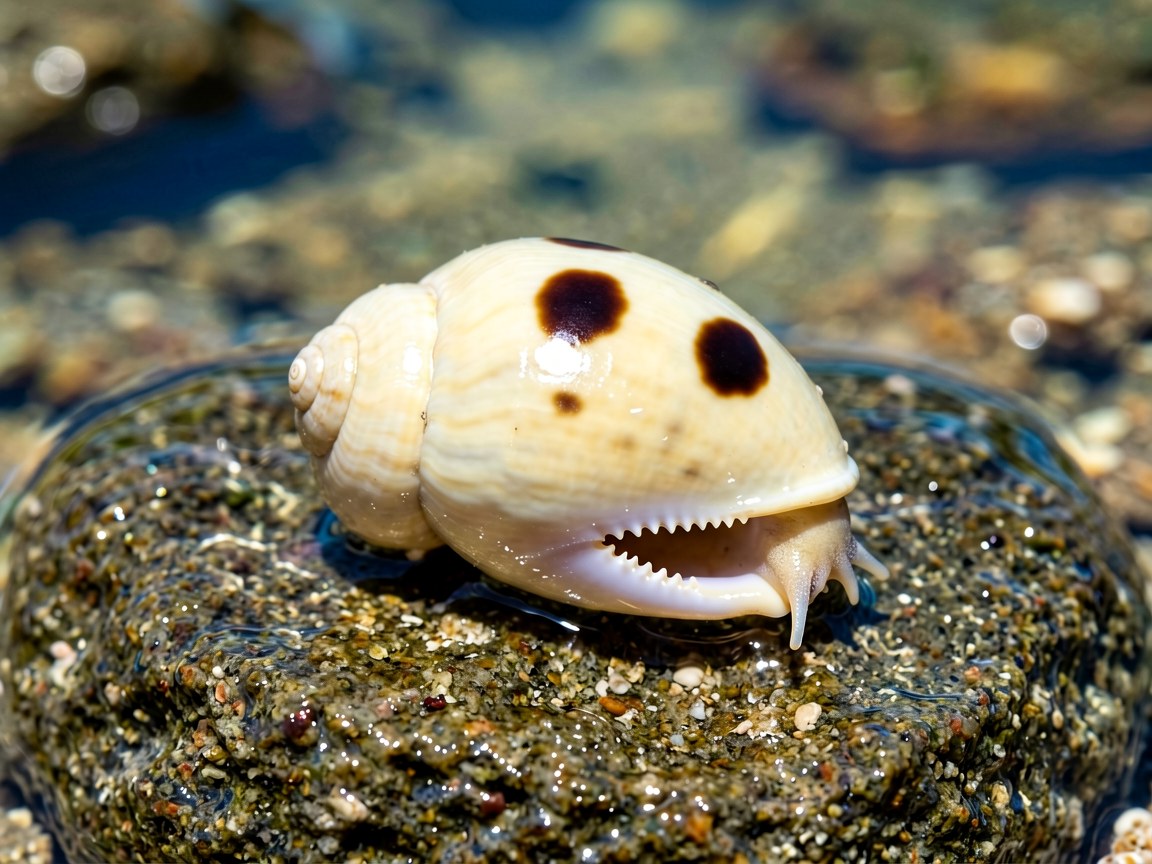
Trivia monacha | European Cowrie
Introduction
The European cowrie (Trivia monacha) is a tiny, glossy sea snail whose shell looks more like a piece of porcelain than a mollusc: a smooth, rounded, pale oval strongly marked with three dark spots, which is exactly what “monacha”—nun—refers to. Barely a centimetre long, it lives under stones and among sea squirts on the lower shore, and its shell is far more likely to be found washed on the strandline than the living animal itself.
Taxonomy
Trivia monacha is a small gastropod mollusc in the family Triviidae, the trivias, which are related to the tropical cowries but are much smaller and live in cooler water. It shares the fundamental molluscan body plan—muscular foot, mantle, and a rasping radula—with far larger and more mobile relatives such as Octopus vulgaris, the common octopus, though where the octopus hunts actively across open ground, the cowrie spends its life creeping slowly beneath stones.
Physical Characteristics
The shell is small, nine to twelve millimetres long, oval and strongly inflated, very smooth and glossy, and pale—creamy, greyish, or pinkish—with three conspicuous dark brown or reddish spots: one near the spire and one on each side. The underside is flat with a long, narrow, toothed aperture running its length, and the surface is crossed by fine ridges that are more obvious at the ends. The living animal is brightly coloured and patterned, and its mantle folds up over the outside of the shell, keeping it polished and clean.
Habitat
It lives on the lower shore and in shallow subtidal water, on rocky coasts, under stones, in crevices, and among sea squirts and compound ascidians, which are its food. It is found around the coasts of Britain, Ireland, and north-west Europe, from the Mediterranean north to Norway. It needs clean, sheltered-to-moderate rock with plenty of cover, and it is seldom seen because it hides by day and comes out at night.
Diet
European cowries are carnivorous grazers that feed mainly on sea squirts and other colonial animals. They rasp at the tough outer tunic of the colony with the radula, biting out small pieces of tissue and gradually hollowing out an area in which they live. They do not hunt moving prey and are not scavengers: their whole diet is made up of the sessile colonial animals that encrust rocks and seaweed.
Reproduction
The sexes are separate, and mating and egg-laying take place mainly in spring and summer. The female lays flask-shaped egg capsules, often glued to the sea squirt colony she has been feeding on, each containing many eggs that develop within the capsule. The young hatch as crawling juveniles rather than as swimming larvae in most populations, so they settle close to where they were laid—which is why cowries are often strongly local in their distribution.
Conservation
The species is not considered threatened and remains widespread around north-west European coasts. Like other small animals of the lower shore, it is vulnerable to local habitat damage: turning and not replacing stones, trampling, pollution, and the loss of the sea squirt colonies it feeds on all reduce numbers. It is much more frequently encountered as an empty shell on the strandline than as a living animal.
Fun Facts
- Its name means “nun”, after the three dark spots that were said to resemble a hooded figure.
- The living animal wraps its brightly coloured mantle over the shell, keeping it polished.
- Empty shells are far more often found on the strandline than living animals on the shore.
- It feeds by rasping pieces out of sea squirt colonies and often lives inside them.
- Unlike most sea snails, its young hatch as tiny crawlers rather than swimming larvae.