 By st20113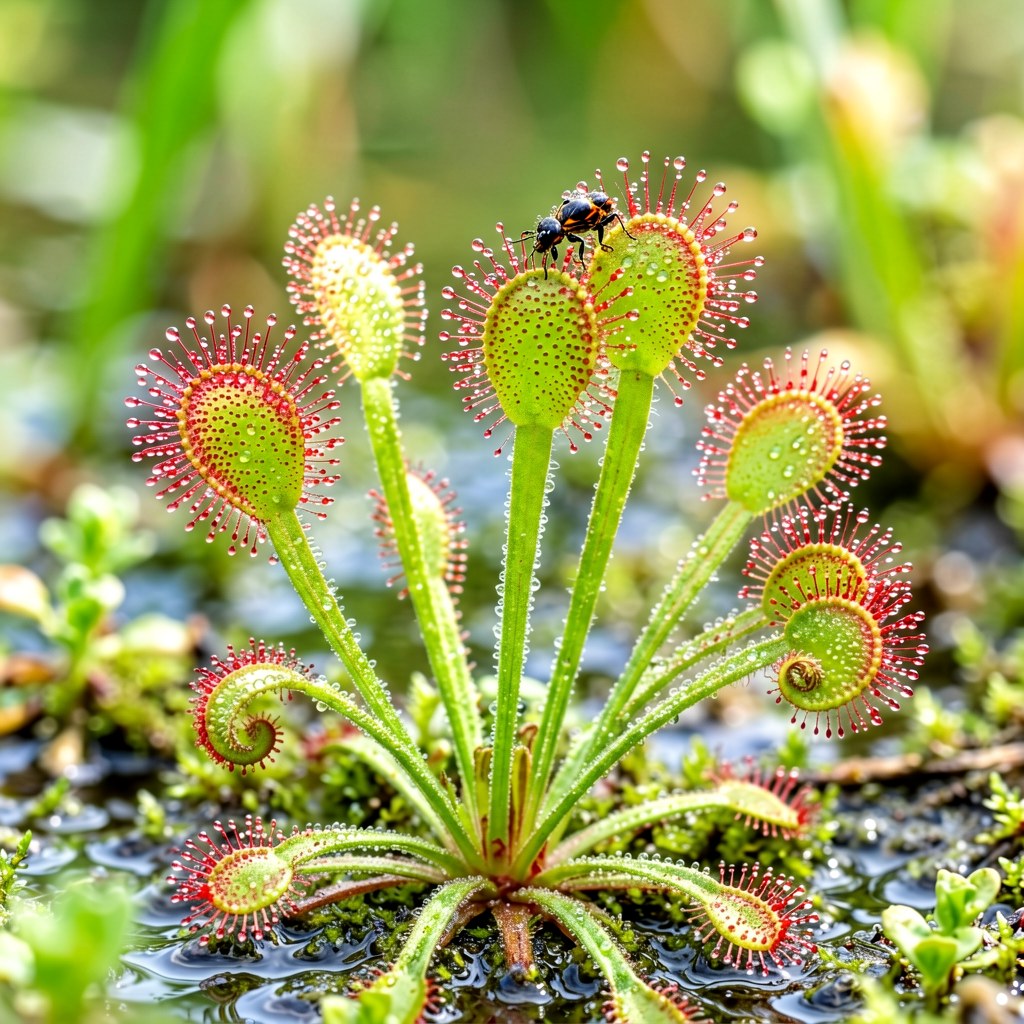
Drosera capensis | Cape Sundew
Introduction
The Cape sundew, Drosera capensis, is a small but visually striking carnivorous plant native to the Cape Provinces of South Africa. Growing in a flattened rosette rarely more than fifteen centimetres across, it is best known for the glistening drops of sticky mucilage that bead along the red-tinted tentacles covering every leaf. To the unaided eye the plant looks as though it is permanently wet with morning dew, a illusion created by glands that secrete a glittering adhesive. Insects attracted by the sparkle become trapped, and the leaf slowly curls around the struggling prey, beginning a digestive process that supplements the poor, acidic soils in which the plant lives. Because it is both beautiful and exceptionally easy to cultivate, D. capensis is arguably the most widely grown sundew in the world, found on windowsills and in greenhouse collections from Tokyo to Toronto. Its predictable, observable trapping behaviour has also made it a favourite subject for classroom demonstrations of plant movement and carnivory.
Taxonomy
Drosera capensis belongs to the genus Drosera, the sundews, the largest genus within the family Droseraceae and the order Caryophyllales. The species was formally described by Carl Linnaeus in 1753, and its specific epithet capensis simply refers to the Cape of Good Hope, the region from which the type specimen originated. Within the genus it sits among the rosette-forming African sundews, sharing the characteristic tentacle-based trap with hundreds of close relatives worldwide. Like every green plant, D. capensis ultimately powers its growth through [Photosynthesis](https://www.gloencyc.com/photosynthesis-plant-energy-process/), capturing sunlight to build sugars; carnivory is an added strategy that lets it thrive where the soil alone cannot supply enough nitrogen and phosphorus. Several naturally occurring forms are recognised, including the broad-leaved typical form and the narrow-leaved “typical” variant, both of which are treated as a single variable species rather than separate taxa.
Physical Characteristics
The most distinctive feature of the Cape sundew is its leaves. Each leaf is a slender, spatulate blade, green to deep red in colour, and armed along both margins and the upper surface with dozens of moving tentacles. At the tip of every tentacle sits a stalked gland that exudes a clear, glistening droplet of mucilage rich in sugars, polysaccharides, and digestive enzymes. In bright light the leaf surface glows with these droplets, producing the dew-like appearance that gives the genus its common name. When an insect touches a tentacle, the stimulus triggers thigmotropic and chemotropic movement: nearby tentacles bend toward the prey within minutes, and over the course of several hours the entire leaf may fold inward to form a digestive pouch. The trapping hairs themselves are extraordinarily sensitive, responding to contact as light as a single footfall of a fruit fly. Flowering stems rise above the rosette and bear small, five-petalled pink or white flowers that open sequentially, reducing the chance that a pollinator will be caught by its own prey’s trap.
Habitat
In the wild the Cape sundew occupies the fynbos and associated wetland margins of South Africa’s Western and Eastern Cape, including the Cape Peninsula and regions around Knysna and Port Elizabeth. It favours permanently damp, nutrient-poor substrates: the acidic peat of seepage bogs, the edges of seasonal streams, and the wet shoulders of dirt roads where groundwater keeps the soil saturated. The plant demands full sun to develop its characteristic red pigmentation and vigorous tentacles, and it tolerates the cool, misty winters and hot, dry summers of the Mediterranean-like Cape climate better than many tropical sundews. Crucially, it requires low-mineral water; in nature it grows where rain and seepage keep the root zone flushed of salts. This precise ecological niche explains why, outside its native range, growers must replicate acidic, nutrient-free conditions using rainwater or distilled water rather than tap water.
Diet
Drosera capensis is an obligate carnivore that feeds principally on small flying and crawling invertebrates: gnats, mosquitos, fruit flies, small ants, and the occasional tiny beetle. Prey is lured by the reflective shine and presumably by sweet or volatile scents of the mucilage. Once stuck, the insect’s struggles stimulate the surrounding tentacles to converge, immobilising it and preventing escape. The glandular heads then release a cocktail of enzymes—acid phosphatases, proteases, and nucleases—that liquefies the soft tissues of the victim over several days. The resulting nutrient-rich soup is absorbed directly through the leaf surface, supplying the nitrogen, phosphorus, and potassium the plant cannot obtain from its barren substrate. A single leaf can process repeated meals, and a healthy plant may trap dozens of insects across a growing season, effectively fertilising itself in environments where competing plants would simply starve.
Reproduction
Reproduction is primarily sexual. The Cape sundew produces numerous small flowers on upright scapes, and although individual flowers last only a day, the plant blooms over many weeks during the warm season. Flowers are self-compatible and are pollinated by small generalist insects; in cultivation they are often hand-pollinated to ensure seed set. Each fertilised flower develops into a curling capsule containing hundreds of minute, dust-like seeds that are dispersed on the wind. The species is also remarkably easy to propagate vegetatively: a single detached leaf laid on moist substrate will frequently sprout plantlets along its margin, a trait that has made it a staple for beginners. In its native habitat, populations persist year to year from seed banks as well as from resilient rosettes that survive the cooler months and resume active growth when conditions warm.
Conservation
At the global scale Drosera capensis is listed as Least Concern, and it remains abundant across its South African range as well as ubiquitous in horticulture. The principal threat is localized habitat loss: the fynbos ecosystems of the Cape are under pressure from urban expansion around Cape Town, from agricultural conversion, and from drainage of the seasonal wetlands that the plant depends upon. Because the species is so widely cultivated, ex-situ conservation is effectively assured, and seed banks and amateur growers preserve enormous genetic diversity. Responsible collection from the wild is discouraged, and most plants in trade derive from cultivated stock. Continued protection of the Cape’s unique wetland and fynbos habitats remains the most important measure for safeguarding the species’ natural populations and the many other endemic organisms that share its specialized environment.
Beyond its ecological role, the Cape sundew has quietly become a small but globally significant horticultural crop; millions of plants are propagated annually by specialist nurseries and traded among enthusiasts, generating livelihoods for growers and feeding the demand of an enthusiastic carnivorous-plant community. Its mucilage and digestive enzymes have attracted biomedical and materials researchers interested in the glue’s reversible adhesion and in compounds with antimicrobial properties. In parts of southern Africa the plant has a place in traditional remedy lore, though such uses are local and unregulated. Botanical gardens and seed banks maintain living collections that preserve the species’ genetic breadth outside its native fynbos, an insurance policy against the continued loss of Cape wetland habitat.
Fun Facts
- The tentacles of a Cape sundew can bend toward trapped prey in as little as thirty minutes, a movement slow enough to film but fast enough to astonish first-time observers.
- A single plant can digest prey totalling up to roughly a third of its own dry weight over a season, effectively fertilising itself.
- It is widely considered the easiest carnivorous plant to grow from seed or leaf, making it the standard “gateway” sundew for new growers.
- The glistening droplets are not water but a living glue containing enzymes, sugars, and compounds still studied for potential biomedical uses.
- Its sticky, colourless mucilage has inspired biomimetic research into reversible adhesives that could one day replace surgical glues.
[…] plant shares the family with the Cape Sundew. That family holds about 200 species. All of them catch small animals with sticky […]