 By st20113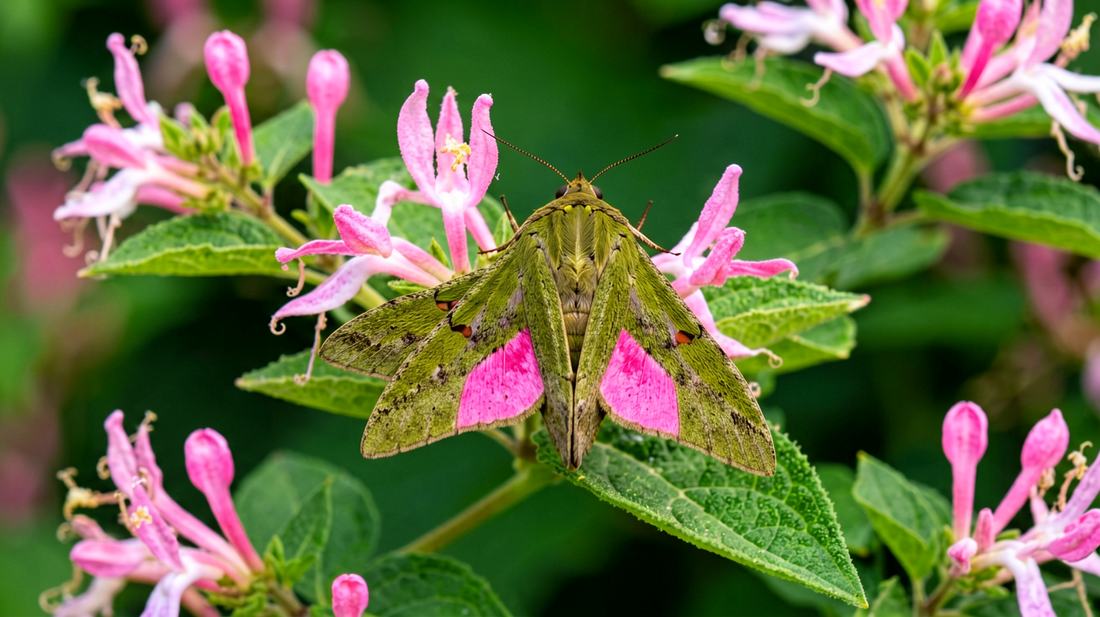
Deilephila elpenor | Elephant Hawkmoth
Species Profile · Sphingidae
Elephant Hawkmoth
An olive-green and shocking-pink moth that hovers at flowers like a hummingbird and is seen by day as often as by night.
Not assessed by IUCN
Range
Wingspan
Flight
Proboscis
Eggs
Pink and olive in the dusk
The elephant hawkmoth
The elephant hawkmoth is one of the most spectacular insects of the European summer. It is a large moth in olive-green and shocking pink. It flies at dusk around honeysuckle and other garden flowers. It hovers in front of each bloom like a tiny hummingbird. It drinks through a long rolled-up tube.
It is unusual among moths in being seen by day as often as by night. Its bright colours also hide it among pink and green stems. Its common name comes from the caterpillar. That larva is one of the best known in Europe. It is fat and grey-brown.
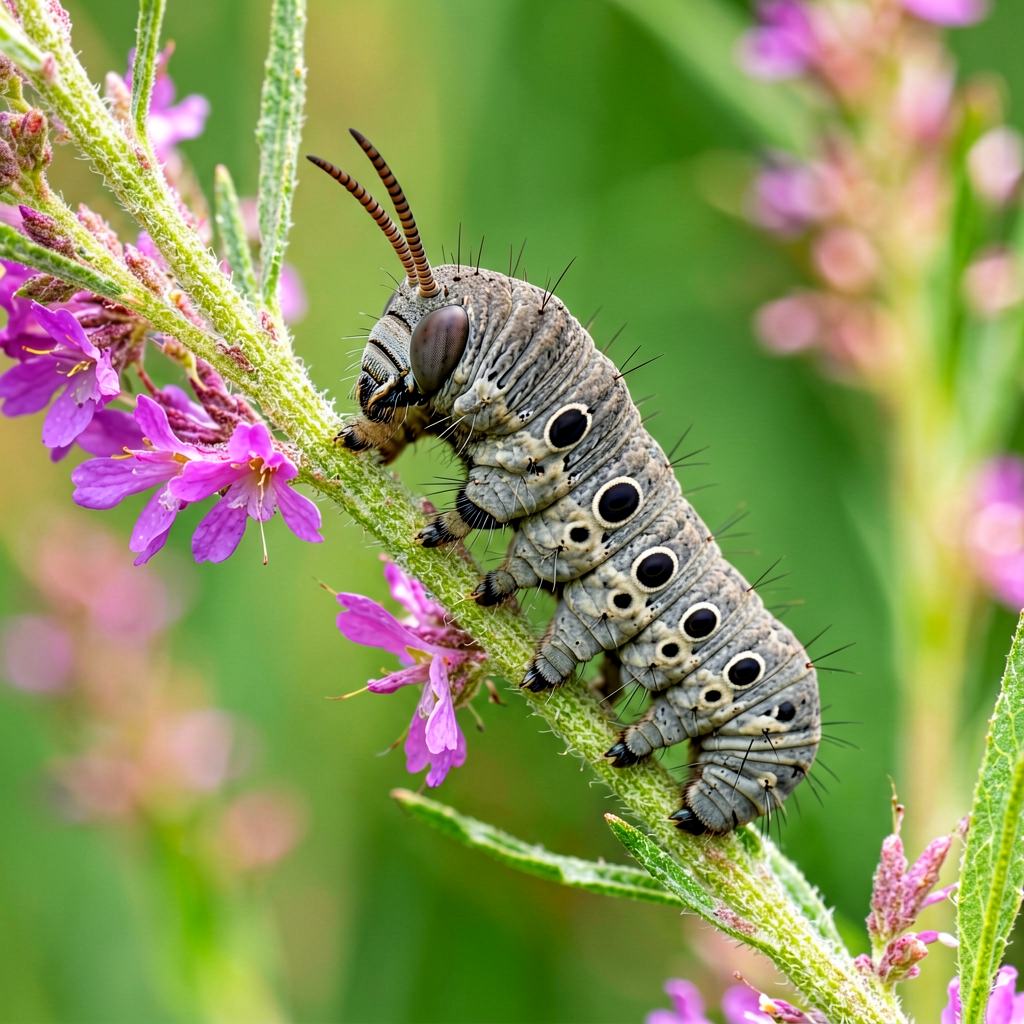
It carries four huge eye-spots along its back. It also has a trunk-like snout it can pull in and push out. When disturbed it pulls in its head and swells its front end. The eye-spots appear and the animal looks like a small snake. Work on this moth showed it can see colour in very dim light.
Family tree
A hawk moth of the genus Deilephila
The elephant hawkmoth is in the family Sphingidae, the hawk moths. Those moths are heavy-bodied with narrow wings. The species sits in the subfamily Macroglossinae and in the genus Deilephila. That genus holds a few species in Europe and Asia. A Swedish naturalist described it in 1758. Its scientific name links a Greek word for evening with a mythical figure. Its English name refers to the caterpillar and its trunk.
Its closest relative in Europe is the small elephant hawkmoth. That insect is smaller and yellower. It feeds on bedstraws. It hovers at flowers in the same way. The two are sometimes found in the same garden. But they use different food plants and fly at slightly different times. The hawkmoths are among the fastest and strongest flying moths.
They are closer to the silkworms than to the butterflies, despite their size and colour. One insect of the same order shares its meadows. That is the Monarch Butterfly. It flies by day and warns birds with bright orange and black. It is in a different family.
Bands, wings and colour
How to identify one
An adult elephant hawkmoth has a wingspan of 45 to 60 mm, sometimes more. It is a bulky, powerful insect. The body is thickest across the thorax. The forewings are long, narrow and sharply pointed. They are olive-green or khaki. A broad band of pink or magenta crosses each one. The band runs from the leading edge towards the trailing edge. Darker lines border it. The hind wings are black at the base. They carry a broad pink band and a dark outer edge.
A moth with its wings spread is a mix of green, pink and black. The body is olive-green above. A pinkish band crosses the abdomen. Its antennae are short, thin and thread-like. That is unusual in a moth. Most moths have feathered antennae. This species finds its mate by scent at dusk over short distances. It does not track a long-distance plume at night. Its proboscis is very long. It is sometimes almost as long as the body.
It stays rolled under the head when not in use. The moth unrolls it to reach into deep flowers. Its eyes are large. Their make-up allows colour sight at very low light. The caterpillar grows to about 70 or 75 mm. It is grey-brown, sometimes green. It has four large eye-spots on the first four abdominal segments. Dark lines run along its back. The front of the body can be withdrawn.
1
2
3
Rough damp ground
Where it lives
The elephant hawkmoth is found throughout Europe. Its range runs from the Mediterranean to southern Scandinavia and the Baltic. It continues east across Asia as far as Japan. It also reaches North Africa. It has been recorded as a rare vagrant in other regions. It is commonest where its food plants grow thickly. That means damp rough ground, waste land and woodland edges. It also uses riverbanks, railway embankments and sand dunes.
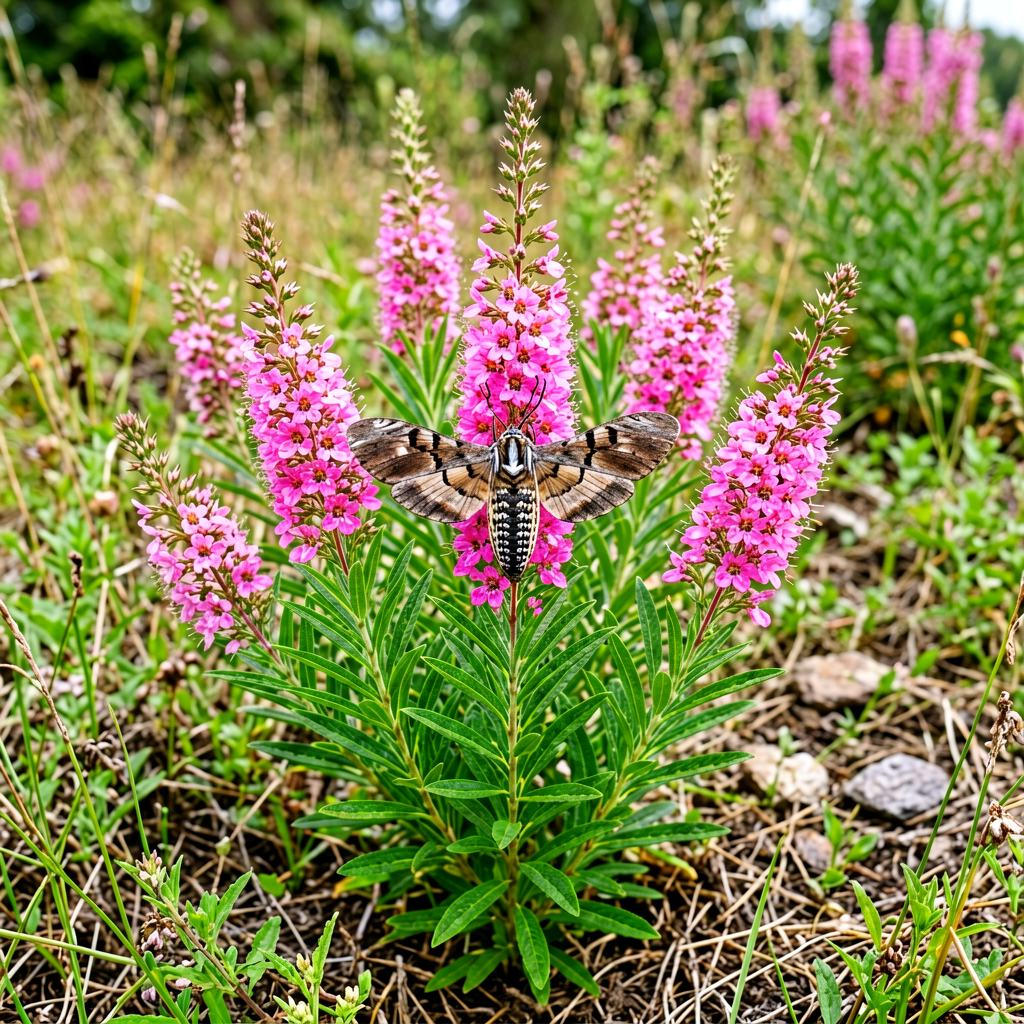
Hedgerows, gravel pits and gardens all suit it. Many of its food plants are garden ornamentals as well as wild plants. The caterpillars feed on rosebay willowherb and other willowherbs. They also eat bedstraws, fuchsia and enchanter’s nightshade. Females lay eggs singly on the leaves. They choose plants growing in the open rather than in deep shade. In the north there is one generation a year. Adults fly in late May, June and July.
In the south there may be two or three broods. The species spends winter as a pupa in the soil. It also pupates among leaf litter at the base of the food plant. It stays there for up to 10 months. The adults rest by day on walls, fences and tree trunks. The green and pink pattern hides them well there.
What it eats
Hovering for nectar
The adult moth feeds on nectar. It hovers in front of a flower. It unrolls its long proboscis into the tube. Its body stays almost motionless in the air. Few European insects feed this way. It visits honeysuckle, rhododendron and buddleia. Valerian, soapwort, petunia and lilac are used too. All have deep tubes that open at dusk. The moth flies in low light and still sees colour.
So it can choose flowers by hue at dusk. Most other insects simply follow scent at that hour. The caterpillar is the bigger eater of the two stages. It feeds on rosebay willowherb and other willowherbs. It also eats bedstraws, fuchsia and enchanter’s nightshade. In some areas it takes grapevine. A large caterpillar can strip a willowherb stem in a night or two. That rarely matters where the plants grow thickly. It shows in a small garden.
The caterpillars feed mainly at night and hide by day. They rest along the stem with the head raised. The body is held in a curve that looks like a dead shoot. Their grey-brown colour hides them among dead plants. When disturbed, the caterpillar pulls in its head. It swells its front segments so the eye-spots show. It may lunge sideways. Tests show this cuts further attacks.
A few weeks as an adult
Mating and single eggs
The elephant hawkmoth leaves its pupa in late spring. The adults live for only a few weeks. In that time they must find a mate and lay eggs. Males and females find each other mainly by scent. The female releases a pheromone. The male detects it with his antennae at close range. The pair mate at dusk, often on the food plant itself. The female lays her eggs singly on leaves and stems. She may lay several hundred over a week or two.
She chooses plants growing in the open. She avoids plants in deep shade. The eggs are small, pale green and almost round. They hatch in about 7 to 10 days. The caterpillars feed for 3 or 4 weeks. They pass through five growth stages. They become very large and conspicuous by the end. When fully grown they leave the plant. They burrow into the soil or into leaf litter at its base.
There they form a chamber and change into a pupa. In northern Europe the pupa overwinters. The moth stays in the ground for about 10 months. It emerges the following late spring. In the south some pupae produce a second generation. The species has one brood over most of Europe. So the whole local population depends on pupae living through winter.
Lost rough ground
Fading at the north-west edge
The elephant hawkmoth has no formal conservation status. It is not protected. Over most of Europe it is still common and widespread. But long-term moth recording shows a clear contraction at the north-western edge of its range. In Britain and Ireland it has gone from many of its old northern and western sites. The main cause is the loss of rough, wet, broken ground. Rosebay willowherb and the other food plants grow in such places.
Waste land, verges, railway cuttings, gravel pits and rough field corners have been built on. They have been planted with trees, sprayed or mown. The plants themselves are often cleared as weeds. Farming has also intensified. Wet ground has been drained. Weed killers are used along roads and railways. The general tidying of the countryside has cut the food plant back.
Outdoor lights are a further pressure. The moth flies at dusk. Lights draw it away from flowers and expose it to bats and other predators. The species is large, colourful and easy to name. So its fortunes are among the best documented of any European moth. Its decline is part of a wider loss of moth variety over the past 50 years.
Quick hits
Five things to remember
- The caterpillar has four huge eye-spots and a trunk-like snout, and when disturbed it retracts its head, swells its front segments and lunges like a small snake.
- Research on this species showed that it can see colour at light levels far too dim for human beings to distinguish any colour at all.
- The adult hovers in front of honeysuckle and other deep-tubed flowers, unrolling a proboscis that can be almost as long as its body.
- Its green and pink wings look gaudy in the hand but work as excellent camouflage against the leaves and stems of its food plants.
- In northern Europe it spends about 10 months of the year underground as a pupa, and the adult lives for only a few weeks.