 By Iris
Cyclopes didactylus | Silky Anteater
Species Profile · Cyclopedidae
Silky Anteater
A ball of golden fur that lives in the canopy and eats ants.
Least Concern
Length
Weight
Claws
Food
Range
Rating
Twenty centimetres of golden fur
A pocket sized anteater
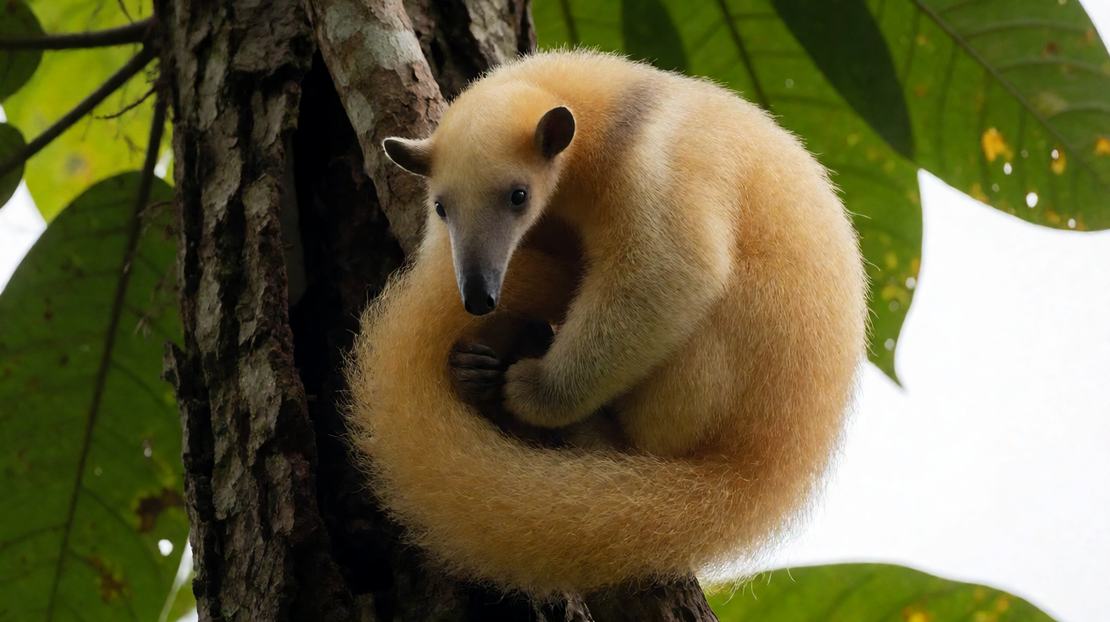
A silky anteater looks like a ball of golden fur on a branch. It curls around a trunk and holds on with a bare tail pad. Eyes are small, and the snout is short.
Lowland forest from Mexico to Brazil holds the species, and the range crosses a dozen national borders. Most people never notice one, since it stays high and still. At night it moves slowly, feeling along the bark.
Two long claws open an ant nest. A long tongue then licks up the insects. Fur is the softest known.
Family tree
Cyclopedidae, the silky anteaters
Cyclopes didactylus sits in Cyclopedidae, a family of its own. Its nearest relative on this site is the Giant Anteater, a ground dwelling species of open country. Both belong to Vermilingua, the anteaters, and neither has teeth.
Yet one weighs 400 grams, while the other reaches 40 kg. Genus once held a single species, and that view has changed. Recent work recognises seven species across the range.
Scientists described the species in 1758, and the name refers to the two claws. Family split from other anteaters more than 30 million years ago.
A family of its own
How to tell one
Body length runs 15 cm to 20 cm, and the tail adds 18 cm to 25 cm. Weight stays between 250 grams and 400 grams. Fur is golden yellow, with a pale stripe along the back in some animals.
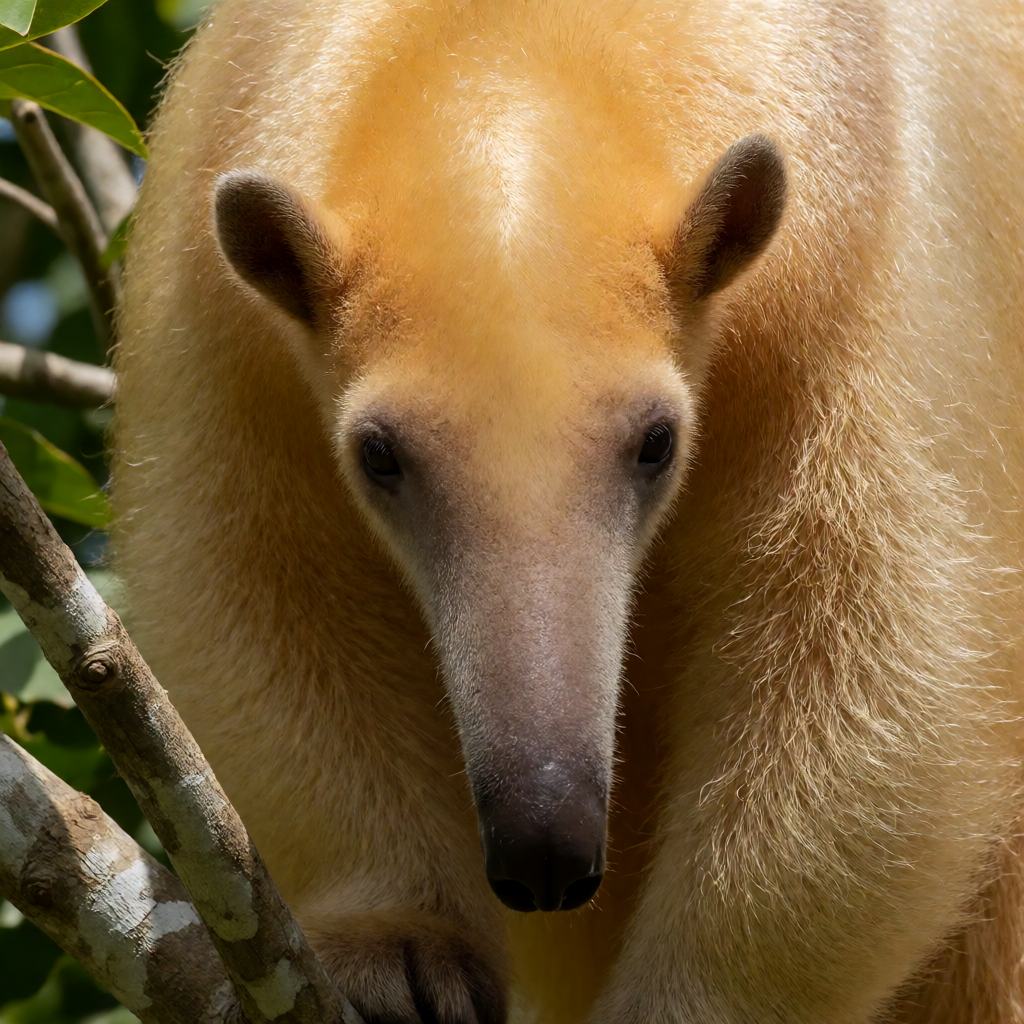
A prehensile tail wraps the branch, and the bare tip grips the bark. Front feet carry two long curved claws. Snout is short and tubular, and the mouth opening is narrow.
Eyes are small, and sight matters less than smell. No teeth sit in the jaw, and the tongue is long and sticky. Females grow slightly larger than males.
1
2
3
Two claws and no teeth
Where it lives
Lowland rainforest below 1500 m holds the species. Forest with many vines and a closed canopy suits it best, since the animal needs bridges between trees. Ceiba trees are a favourite, since their trunks carry deep bark where small insects live in numbers.
Mid level branches hold most animals, where the vines meet the crown. Flooded forest suits it as well as dry ground, and the animal swims without difficulty. Range runs from southern Mexico to Bolivia and Brazil, with records scattered through every country between.
Trinidad holds a separate population. Forest clearance removes habitat, yet the species survives in small patches near farms and roads. A single animal needs little space, and it tolerates disturbed forest as long as ants and cover remain.
Vines and a closed canopy
What it eats
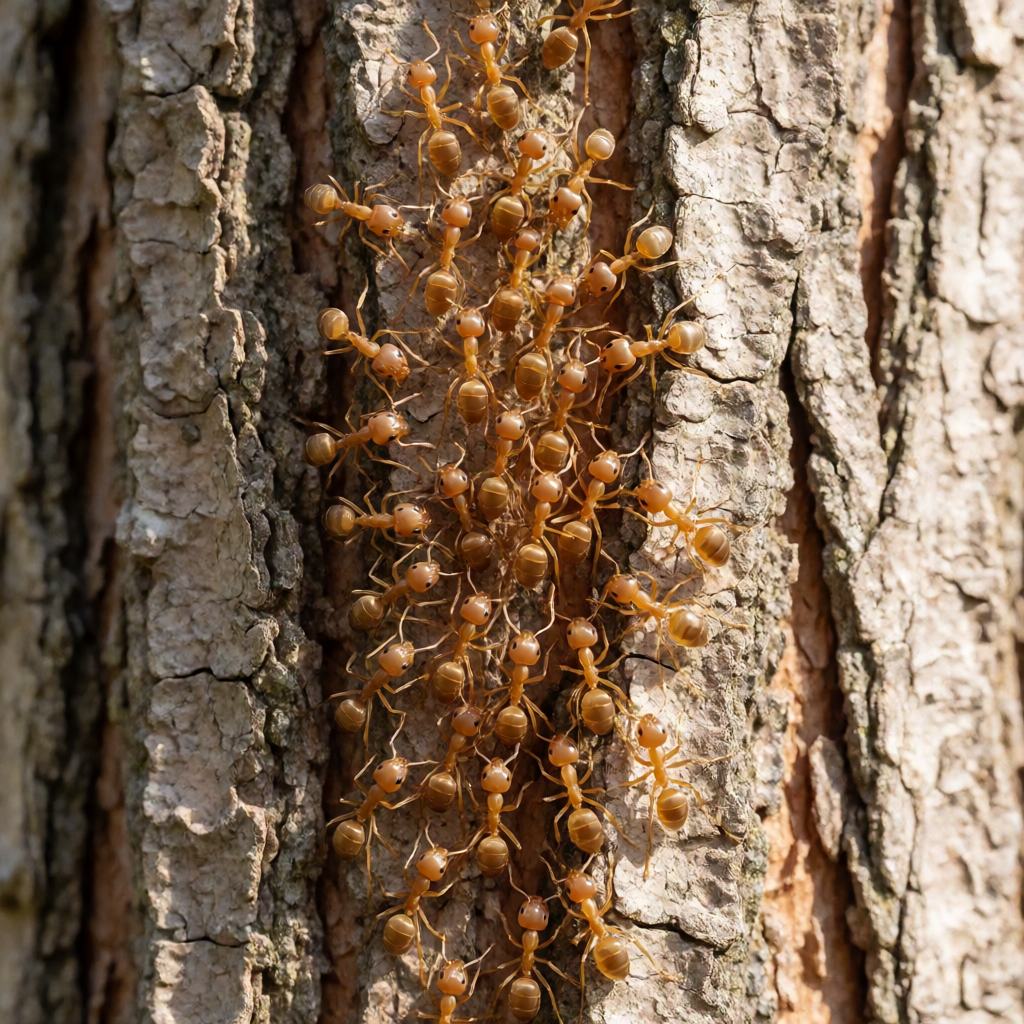
Ants make up almost the whole diet. Claws break a nest open, then the tongue licks up the insects. A long tongue carries sticky saliva, and it flicks in and out.
Several hundred ants may be taken in a single night, and the tongue never stops moving. Termites are eaten as well, and so are small beetles taken from the same nests. Soldier ants are left alone, since they bite back.
Feeding takes place in the canopy, where nests sit on branches high above the ground and the ground stays dark. Nests are revisited after a few weeks, once the colony has recovered. That pause lets the colony recover.
Ants by the hundred
The breeding cycle
Little is known about breeding in the wild, although the pattern looks slow. One young is born after a gestation near 135 days. Mothers carry the young on the back for several weeks.
Fathers take no part in raising it. A captive animal gave birth in a zoo, and the young clung to the mother at once. Weaning follows after a few months, and the young then lives alone.
Sexual maturity probably comes at one year. That slow rate fits a small animal with few predators, since it can afford to wait for a good night. Nothing is known about how far a young animal disperses.
Least Concern, and rarely seen
Conservation
Least Concern is the current rating. Range is wide, and numbers appear large. Forest loss is the main threat, and it affects the edges of the range first.
Pesticides may reduce the ant supply, and that effect is unstudied. Zoos rarely keep the species, since it does poorly in captivity. Guarded areas hold populations across the Amazon, although most sit far from roads.
Monitoring is thin, so the rating rests on the broad range and on guesswork. Records may understate the species, since so few people look for it.
Side by side
How It Compares
| Trait | Silky Anteater | Giant Anteater |
|---|---|---|
| Length | 15 cm to 20 cm, plus a gripping tail | 1.8 m to 2.2 m, tail included |
| Weight | 250 g to 400 g | 30 kg to 40 kg |
| Claws | two on each front foot | four on each front foot |
| Food | ants and termites from tree nests | ants and termites from ground nests |
| Home | the canopy of lowland forest | open grassland and savanna |
| Young | one young, and it rides the mother | one young, and it walks within weeks |
Common misreadings
What People Get Wrong
- Many people think the animal uses its claws to fight, yet they serve only for opening nests. The grip is strong enough to hold a branch, and the animal seldom shows them otherwise.
- A common tale says the tongue is short and narrow, although it reaches far beyond the snout. Sticky saliva covers it, and the ants stick fast as it flicks in and out.
- Some books claim the species is common in zoos, yet it rarely survives captivity for long. The diet and the humidity are hard to copy, and most animals die within a year.
Going further
Sources and Further Reading
Quick hits
Five things to remember
- It has two claws on each front foot.
- The tail tip is bare for grip.
- It eats several hundred ants a night.
- Its fur is the softest of the anteaters.
- The mother carries the young on her back.