 By st20113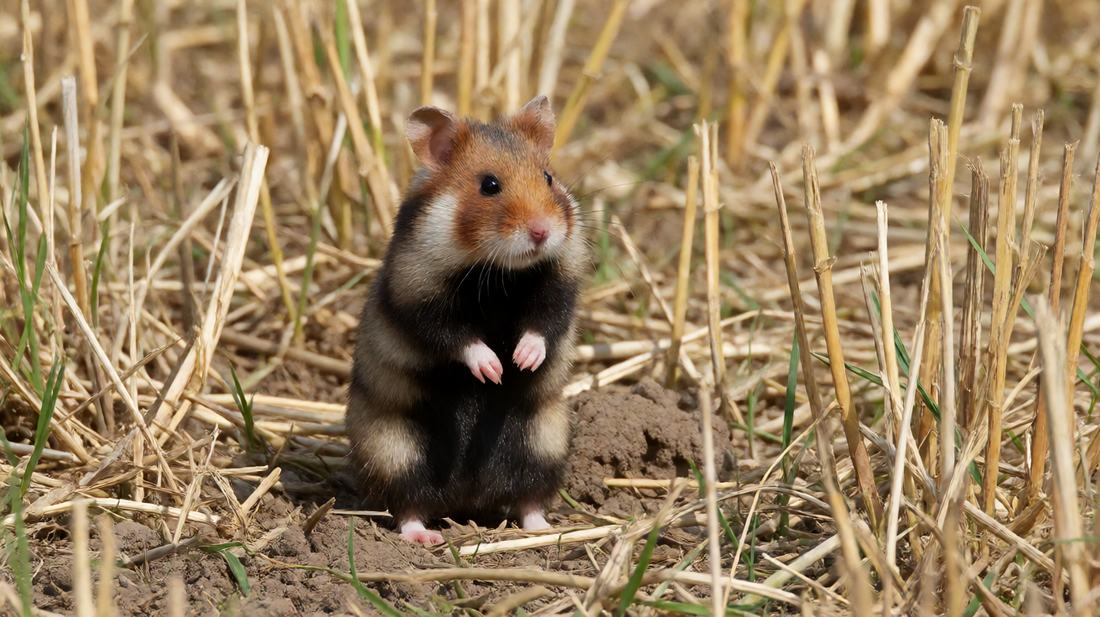
Cricetus cricetus | European Hamster
Species Profile · Cricetidae
European Hamster
The wild ancestor of the pet hamster, and one of Europe’s most endangered mammals — a burrowing grain-hoarder with a black belly and bulging cheek pouches.
IUCN: Critically Endangered
Range
Body
Weight
Hibernation
Status
The wild pet ancestor
Europe’s most endangered hamster
The European hamster is the wild animal behind the pet in a cage, and it looks nothing like the tame form. A wild one is the size of a small guinea pig. It has a brown back, a black belly and bold white patches on the cheeks, shoulders and flanks. It carries two huge cheek pouches that reach back to the shoulders when full. It digs a burrow several metres long and up to 2 m deep, with chambers for sleep, food and droppings.
It sleeps through winter and wakes now and then to eat its stores. It is one of the few rodents that truly hoards. The German word hamstern, to hoard, gave the animal its name. It is also one of the most threatened mammals in Europe. Its numbers fell so far and so fast that the global Red List moved it into the Critically Endangered class.
The main cause is not hunting. It is the way the modern field is farmed. A deep-ploughed, single-crop field has no room for a burrowing hamster.
Family tree
Cricetidae, the voles and hamsters
The European hamster sits in the family Cricetidae, one of the largest mammal families. It is the only living member of the genus Cricetus. Linnaeus named it in 1758 as Mus cricetus. The name Cricetus comes from the old German word for the animal. The family also holds the voles, lemmings and New World hamsters, so the hamster is not as alone as the single-species genus suggests. Its closest kin in Europe are the voles, not the mice.
The family is defined above all by the teeth. The cheek teeth have flat crowns with a pattern of enamel folds. The hamster adds its own specialism. The cheek pouches are huge out-pocketings of the mouth skin. They reach back to the shoulder blades when full. They have no link to the salivary glands and no taste.
The animal can fill them fast and empty them later, safe in the burrow. Dozens of subspecies have been named and their status is debated. The species is not close to the golden hamster of Syria, which is a different genus. It is, however, a distant relative of the wood mouse, another European rodent of the same superfamily. The two live in the same fields and are easy to separate. The wood mouse is a fraction of the weight, has no black belly and does not hibernate.
Black belly, bulging cheeks
How to identify one
The European hamster is a heavy, low rodent built for digging and carrying. Head and body measure 20 to 35 cm. The tail adds only 4 to 6 cm. Adults weigh 220 to 460 g, but a fat winter animal can pass 600 g. Males are larger than females. The colour is unmistakable.
The back and head are brown, from sandy to dark chestnut. The belly is black, sometimes with white patches inside the black. Bright white marks sit on the cheeks, shoulders, behind the ears and on the front feet. The ears are small and round and sit close to the head. The eyes are large, dark and prominent. The limbs are short and strong, and the front feet carry long heavy claws for digging.
The most striking feature is the pair of cheek pouches. When full they bulge so far back that they change the outline. A single load can hold several dozen grams of grain. The incisors are large, orange and ever-growing. Females show a row of 10 or more teats, which shows the size of the litter they can raise.

1
2
3
Burrows in the field
Where it lives
The European hamster is a creature of open country with deep, workable soil. It lives on loess and other fine, well-drained soils that hold a burrow without collapse. In the past it used dry grassland, forest steppe, scrub, field edges and pasture. Today it is mostly a animal of arable land. Winter wheat, clover, peas and root crops give food. The field edges and tracks give the ground it digs.
It needs soil it can dig to a depth of 1 m or more. It needs seeds and green plants through the season. It needs undisturbed ground when it digs and when it hibernates. Its range is huge on paper. It runs from Belgium, the Netherlands, France and Germany east through Poland, Slovakia, Hungary and Ukraine, and on across Russia to Kazakhstan. Within that range it is now scattered into pockets.
In western Europe the collapse has been sharp. The French population is confined to Alsace. The Dutch and Belgian populations are down to a few sites. Germany lost most of its animals after the 1970s. Each adult keeps its own burrow and defends the entrances. A single system may run 6 m or more and may have half a dozen entrances.
Plants, with a taste for meat
What it eats
The European hamster is an omnivore that leans on plants. In spring and early summer it eats green shoots, leaves and young stems. Clover, lucerne, vetch, dandelion and thistle are all taken. As the season goes on it switches to seeds and grains. Wheat, barley, oats, rye, sunflower, peas and maize are all eaten. In autumn it takes roots, tubers and bulbs. It also eats insects, snails, worms and the odd small vertebrate, and it will take carrion.
It forages at night and can travel far from the burrow. It gathers food into its cheek pouches rather than eating on the spot. That is the habit that gave the species its name. The pouches hold far more than the stomach. The load is carried back and emptied into a store chamber. The stores are the key to winter. From October the animal withdraws and sleeps deeply.
It does not sleep through the whole winter. Every few days it wakes, eats from its stores and sleeps again. A good hoard can hold several kilograms of grain and roots. Some put on well over half their summer weight before hibernation. In a poor year with a small hoard, many do not survive the winter.

One big litter a year
The breeding cycle
The European hamster breeds in spring and summer, with the first litters from April. Gestation lasts 18 to 20 days, short for a rodent of this size. A female can have 2 or 3 litters in a season, and in warm years with plenty of food she may raise more. Litters are large, usually 4 to 12 young, with litters of up to 12 known. The young are born blind and naked in a nest lined with dry grass. They grow fast on the rich milk.
They open their eyes at about 2 weeks and take solid food soon after. They are weaned at about 3 weeks and leave the burrow at about a month. Females breed in their first year. Males do not breed in their birth year. Adults of both sexes keep separate burrows, and the female raises her young alone. Males fight hard for a female.
The young scatter to find their own ground. That is risky, because almost every hunter in the landscape will take a young hamster in the open. The species is long-lived for a small rodent, and animals of 4 or even 8 years are known. Most do not reach that.
Critically Endangered
Conservation
The European hamster was long treated as a pest, and much of its history is people trying to kill it. That has reversed. The species is now listed as Critically Endangered on the global Red List, and it is one of the fastest-declining mammals in Europe. The causes follow from its biology. It needs deep, undisturbed soil, and modern ploughing reaches further down each decade. It needs a mixed farm with edges and fallow, and modern fields are large and single-cropped.
It needs stubble and seeds left after harvest, and modern combines take almost everything. It needs the ground left quiet through the months it digs and hibernates, and modern cropping runs almost all year. In western Europe the animals are squeezed into a few fragments. Hunting and persecution took their toll too. Climate change may add a problem. Warm winters wake hibernating animals too often.
Conservation has moved far. France, Germany, the Netherlands and Belgium have run recovery projects since the 1990s. They pay farmers to grow strips, to leave soil uncultivated in autumn and to avoid deep ploughing on burrow sites. Captive breeding and release have rebuilt the Alsace population. The animal is also a useful symbol, because the steps it needs help farmland birds, insects and wild plants at once.
Quick hits
Five things to remember
- Its German name gave English the word hamster, and the animal really does hoard several kilograms of grain in an underground storeroom.
- A full cheek pouch reaches back to the shoulder blades, and one load can hold several dozen grams of grain.
- It hibernates but does not sleep straight through: it wakes every few days, eats from its stores and falls back asleep.
- The wild animal has a black belly and bold white patches, while the pet golden hamster is a different species from Syria.
- Wild hamsters were once so numerous in central Europe that towns paid bounties, and today France protects the last few hundred animals.