 By st20113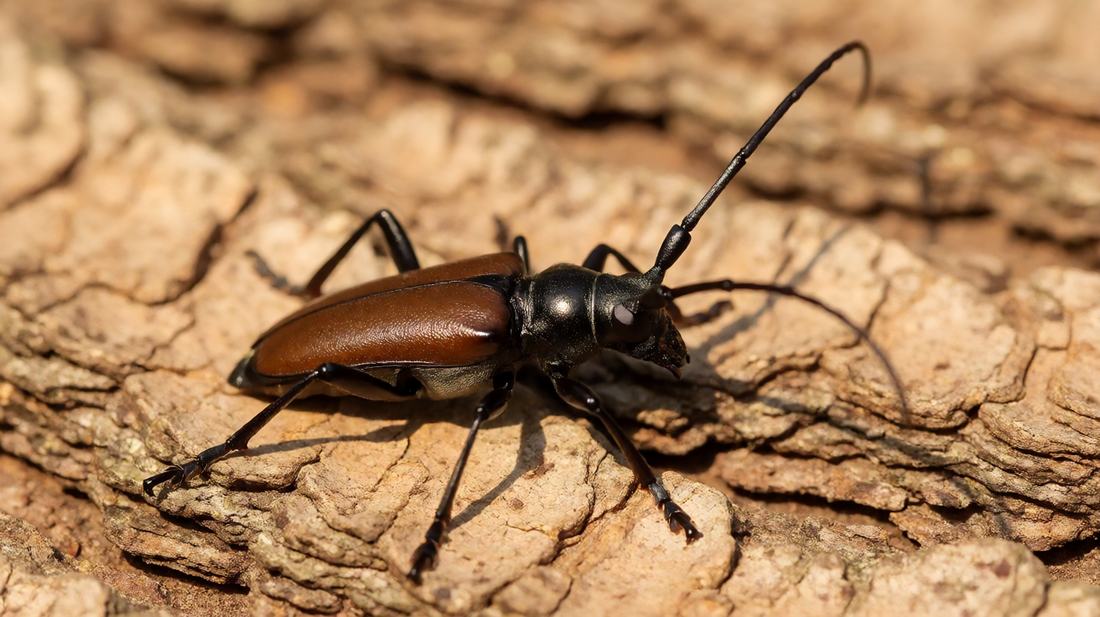
Cerambyx cerdo | Great Capricorn Beetle
Species Profile · Cerambycidae
Great Capricorn Beetle
One of the largest beetles in Europe, with antennae longer than its body, and a creature of ancient oaks that has become a symbol of vanishing old woodland.
IUCN: Near Threatened
Range
Body
Antennae
Larva
Eggs
The giant of the oak bark
One of Europe’s largest beetles
The great capricorn beetle is one of the largest insects in Europe. Its body alone can measure over 5 cm. And its antennae are longer still. On a warm evening in early summer it walks over the bark of an old oak. Glossy black and dark brown, with antennae sweeping the air. It is a creature of veteran trees.
Its larvae take several years to grow inside the wood of a mature oak. And without old oaks in the sun there is no beetle. That need has made it a symbol of Europe’s ancient woodland. And a species in retreat. The animal needs trees old enough to have thick bark and dead patches. It needs those trees in the open.
Where the trunk stays warm. Modern forestry removes both the old trees and the dead wood. And shades the trunks that remain. The beetle is protected across the EU as a species of community interest. Its presence in a wood shows that the wood has been wooded and open for a very long time.
Family tree
Cerambycidae, the longhorn beetles
The great capricorn beetle belongs to the family Cerambycidae. The longhorn beetles. The family is one of the largest in the animal kingdom. With tens of thousands of species. Its members share long antennae and the habit of laying eggs in wood. Their larvae are among the top recyclers of dead timber. The species sits in the genus Cerambyx. A group of large, dark. Glossy longhorns of Europe, North Africa and western Asia. Linnaeus named it in 1758 as Cerambyx cerdo.
The genus gave the family its name. Several close relatives live in southern Europe. Cerambyx miles and Cerambyx scopolii are similar but smaller. The larvae are hard to tell apart. And most records rest on the adults. The name Cerambyx comes from Greek and meant a beetle that feeds on dry wood. The species is not close to the stag beetles. Though the two share old wood. The great capricorn sits in the subfamily Cerambycinae. While the stag beetle sits in the family Lucanidae within the same order.
The two share a problem. Both need large, decaying broadleaved trees. And both have declined as those trees were cleared. The great capricorn is a distant relative of the European stag beetle. The other giant of the European woodland floor. The stag beetle lives on the ground and the stump. With antler-like jaws. The great capricorn lives on standing timber, with huge antennae. The two are easy to tell apart.
Antennae longer than the body
How to identify one
The great capricorn beetle is a large, heavily built insect. The body measures 24 to 53 mm from the front of the head to the tip of the wing cases. Females are larger overall, but males carry much longer antennae. A male’s antennae can reach well beyond the end of the body. In females the antennae reach about the tip of the wing cases. Each antenna has 11 segments and is finely ridged. The wing cases are glossy and very dark.
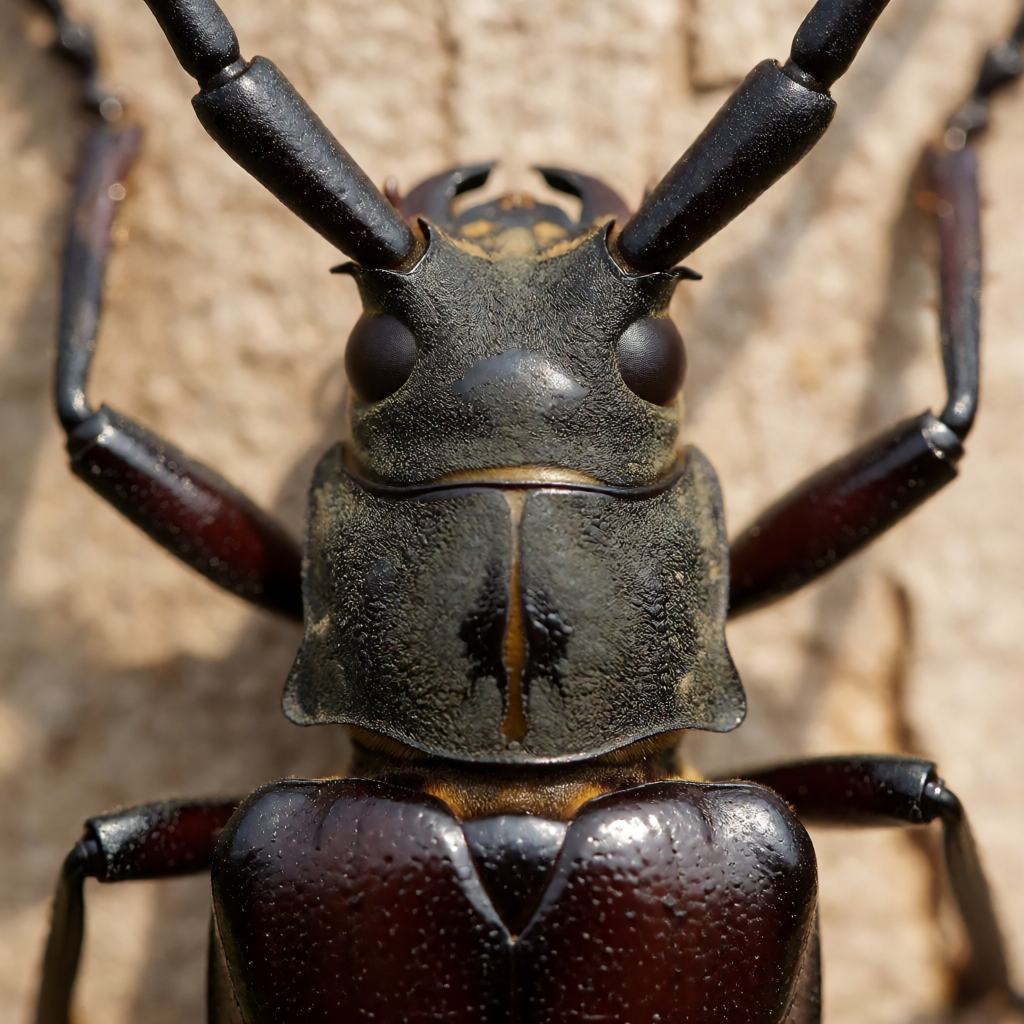
Deep brown to almost black. The surface is smooth and shining, with faint lengthwise ridges. The tips are rounded and each ends in a small point. The thorax is the opposite of glossy. It is dull, thick and covered in a leathery, wrinkled sculpture. And its sides carry a sharp spine. That contrast is one of the best ways to name the species.
The head is broad and carries large jaws. The eyes are deeply notched, wrapping the base of the antennae. The legs are long and strong. The larvae are very different. They are pale, soft. Legless grubs with a hard head and strong jaws. A full-grown larva can reach 8 cm and is one of the largest insect larvae in Europe.
1
2
3
Old, sunlit broadleaved wood
Where it lives
The great capricorn beetle is an animal of old. Sunlit broadleaved woodland. Its main need is a supply of mature oak. It uses several oak species and also breeds in sweet chestnut. And more rarely in willow, ash, elm and walnut. The tree must be large. The beetle needs bark thick enough to shelter the young larva and wood wide enough to hold its gallery for years. It needs the trunk to be warm. The species is strongly heliophilic, meaning it seeks light. It breeds above all on trees in the open or on a wood edge.
On the sunny side of a trunk. Or on lone veterans in a pasture or park. Trees in deep shade are almost never used. Old wood pasture, royal forests, parkland, commons. Avenue trees and sunny coppice edges are its strongholds. Its range covers central and southern Europe. It runs from France and Germany east through Poland. The Czech Republic. Slovakia, Hungary and the Balkans to Ukraine and Russia. And south through Italy, Spain and Portugal to North Africa.
It also reaches Turkey, the Caucasus and Iran. In northern Europe it is rare and in warm pockets. In southern Europe it is more common. Through its range it is patchy. Because it needs a habitat that comes in patches. A single large veteran oak can hold a colony for decades. The animal is not a strong disperser. Most moves are short. A population in an isolated wood is unlikely to be recolonised if lost.
Wood as larvae, sap as adults
What it eats
The great capricorn beetle has two diets in its two lives. The larva eats wood. It is a saproxylic insect. Meaning it lives on dead or dying timber. And feeds on the wood of living but damaged trees. The newly hatched larva bores into the bark and outer sapwood. Where the tissue is soft and rich. As it grows it moves deeper, into the heartwood. And its gallery grows wider and longer.
The larva cannot digest wood alone. Like other longhorn larvae it carries gut microbes that break down cellulose. And it takes in the wood’s own fungi. The result is a slow meal and a slow growth. A larva takes 3 to 5 years to reach full size. And may spend most of that in one tree. It pupates in a chamber at the end of its gallery. And the new adult chews out through a large oval hole. Those exit holes.
About 1 to 2 cm across and often in a neat row on the sunny side. Are the classic sign that a tree reared the species. The adult eats almost no solid food. It feeds on sap from wounds in old trees. Above all the fermenting juice of a bleeding oak. It also takes over-ripe fruit and the sugar of damaged tissue. Sap runs on old trees are critical for the adult. Adults live only a few weeks to a couple of months.
Years inside one oak
The breeding cycle
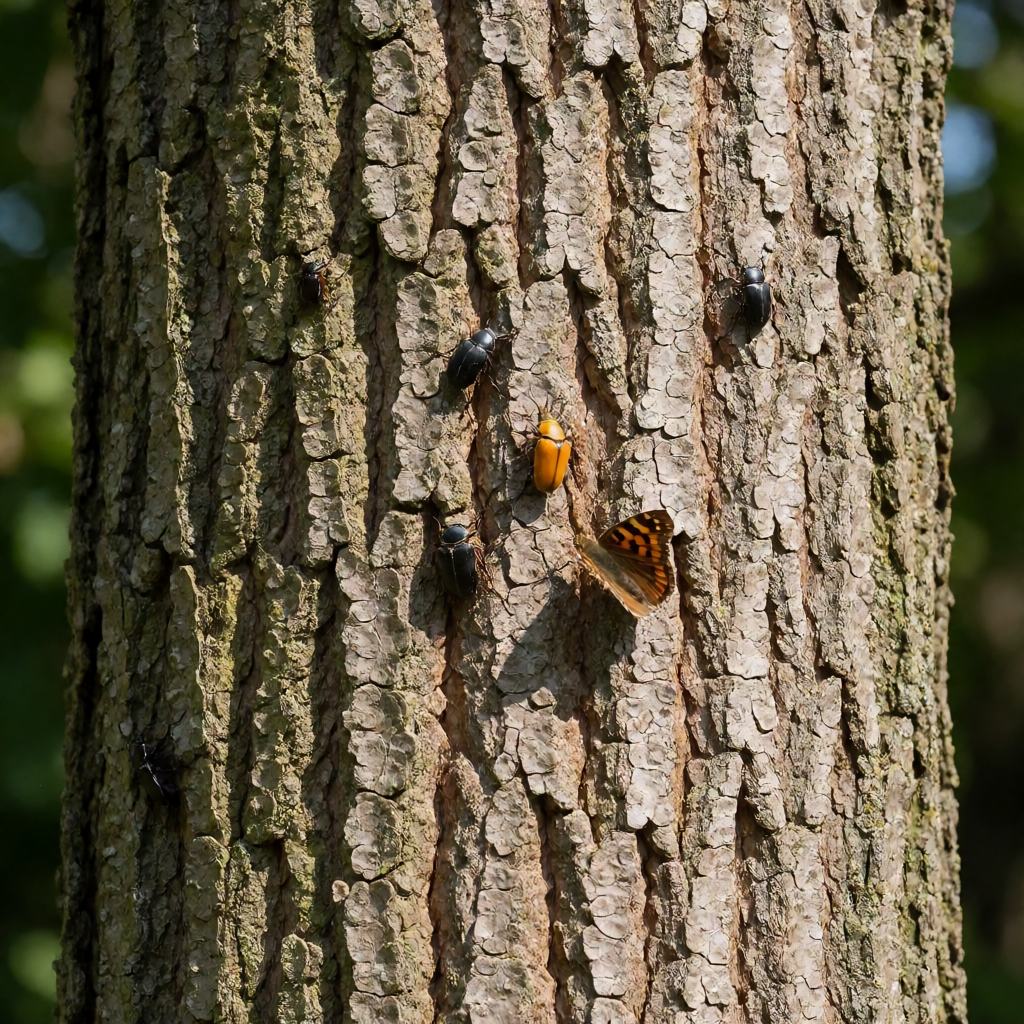
Adult great capricorn beetles leave their pupal chambers in late spring and are active from May to August. They are mostly crepuscular and partly nocturnal. They walk the bark and fly on warm evenings. Males search for females by scent and guard a mate after they find one. Rival males push and bite, and the fights can be long. The female must find a tree fit for her young. She lays her eggs one at a time in small cracks in the bark. In wounds.
In old branch scars or where the bark is loose. She tests the tree by walking it and probing with her antennae. The choice she makes decides the fate of every larva that hatches. She lays a small number of eggs, each placed with care. That is the opposite of the many insects that scatter hundreds of eggs. It reflects a scarce and varied resource. A female lays perhaps 20 to 60 eggs in her life. The young larva hatches within a fortnight and begins to bore.
It spends its first winter in the sapwood and usually 3 or 4 winters in the tree. Woodpeckers can hear it chew and dig out the gallery. Wasps and flies also attack it. When ready, it enlarges a chamber and pupates. The new adult stays inside for a few weeks while its shell hardens. Then chews out.
Near Threatened, a wood symbol
Conservation
The great capricorn beetle is listed as Near Threatened on the global Red List. And it is in Annex II of the EU Habitats Directive. That listing obliges member states to protect it and to name sites for it. Its decline has been recorded across northern and central Europe for over a century. The causes follow from its biology. The first is the loss of mature oak. Old trees were felled for timber, ships and fuel. And the trees that replaced them are not old enough to host the beetle. The second is the removal of dead wood and dying branches.
This forestry long treated as dirt. The third is the shading of woods. When coppice-with-standards stopped and woods grew up. The sunny trunks the beetle needs vanished under a closed canopy. The fourth is fragmentation. A species that needs a few veteran trees cannot cross a large young plantation. Climate change may push its range north and change its emergence time. Conservation focuses on the tree, not the beetle. The key step is to keep veteran oaks standing and let them die standing.
The second is to open the canopy around known trees so the trunk catches sun. The third is to keep the sap runs the adults feed on. The fourth is to keep a network of suitable trees. So populations are not isolated. Several countries now run veteran-tree projects and pay owners to keep old oaks and dead wood. The species responds well when the trees are kept. And can persist in one ancient wood for centuries.
Quick hits
Five things to remember
- Its antennae are longer than its body in males, which is why it is named after the horned goat of the constellation Capricornus.
- The larva spends 3 to 5 years inside one oak trunk and can grow to 8 cm, one of the largest insect larvae in Europe.
- It feeds on fermenting sap from wounded oaks, and it is strongly drawn to the smell of beer and wine traps.
- A single veteran oak can hold a colony for decades, and the loss of that one tree can remove the species from a whole wood.
- It is listed in Annex II of the EU Habitats Directive, which means its woods must be protected by law.