 By st20113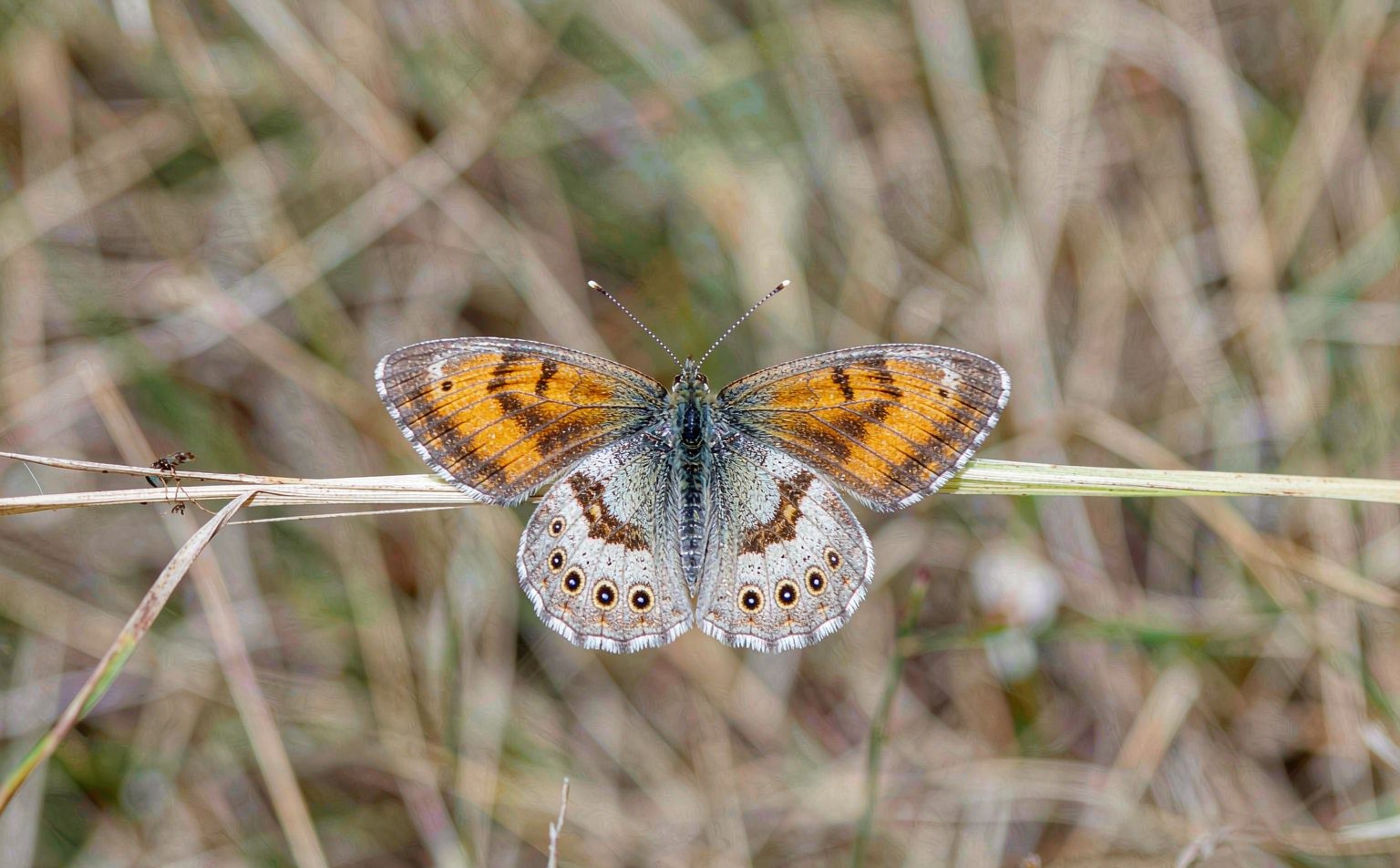
Coenonympha pamphilus | Small Heath
Introduction
The Small Heath (Coenonympha pamphilus) is the smallest and one of the most widespread of the browns, a delicate butterfly of short turf and flower-rich grassland. Its understated orange and brown wings and fast, low flight make it easy to overlook, yet it can be abundant where the right grasses grow. It is notable for the male’s weakly fluttering, almost moth-like flight as it searches for females among the grass.
Taxonomy
The Small Heath is a member of the family Nymphalidae and the subfamily Satyrinae, related to the [Meadow Brown](https://www.gloencyc.com/peacock-butterfly-aglais-io/) and the [Ringlet](https://www.gloencyc.com/peacock-butterfly-aglais-io/). It is placed in the genus Coenonympha and occurs across temperate Europe and temperate Asia, with several regional forms. It is the smallest European satyrine and prefers shorter grass than most of its relatives.
Physical Characteristics
Adults have a wingspan of just 32 to 40 millimetres. The upper side is orange with a broad brown margin and, in the male, a faint scent-scale brand on the forewing; females are slightly brighter orange. The underside of the hindwing is grey-brown with a row of small white-pupilled eyespots, while the forewing underside shows an orange band, giving the closed wing a neat, inconspicuous pattern against dry grass.
The body is tiny and lightly furred, the antennae thin with rounded clubs. The caterpillar is a small green larva with a reddish line and a forked tail, coloured to match fine grass blades. The chrysalis is green or brown and lies in a silk cocoon at the base of a grass tuft.
Habitat
The Small Heath favours short, dry or moderately moist grassland: chalk downland, calcareous lawns, coastal turf, roadside verges, heath edges, meadows and upland pasture. It needs fine-leaved grasses for the caterpillars and open, sunny conditions, so it disappears from rank, overgrown sward. It is one of the few browns that tolerates close-cropped turf kept by grazing or mowing.
Diet
Adults nectar from small, low flowers such as bird’s-foot trefoil, white clover, thyme, hawkbits and daisies, rarely visiting tall blooms. The caterpillars feed on fine grasses including sheep’s fescue, red fescue, meadow grass and bent, eating mainly at night and sheltering at the base of the plant by day.
Reproduction
Females lay single pale eggs on grass blades or drop them among low vegetation. The caterpillars feed slowly and may take several weeks to mature, then pupate near the ground. In warm regions there are two broods a year, with the second generation flying in late summer; in cooler areas a single brood occurs and the caterpillar overwinters, sometimes twice, before pupating.
Conservation
The Small Heath has declined locally where intensive grazing, fertiliser and the loss of flowery short turf have removed its habitat, and it is a species of conservation interest in parts of its range. It responds well to careful grassland management that keeps short, flower-rich sward, such as light grazing or timed mowing. Because it uses small patches, even roadside verges and amenity grassland can help sustain it.
Fun Facts
- It is the smallest brown butterfly in Europe, easily mistaken at speed for a moth.
- Males patrol a tiny territory just above the grass, fluttering weakly as they search.
- The eyespots on the underside may startle predators when the butterfly flashes them open.
- It often settles with wings closed, showing only the plain grey underside for camouflage.
- Unlike many butterflies, it is comfortable in very short, sun-baked turf that others avoid.