 By st20113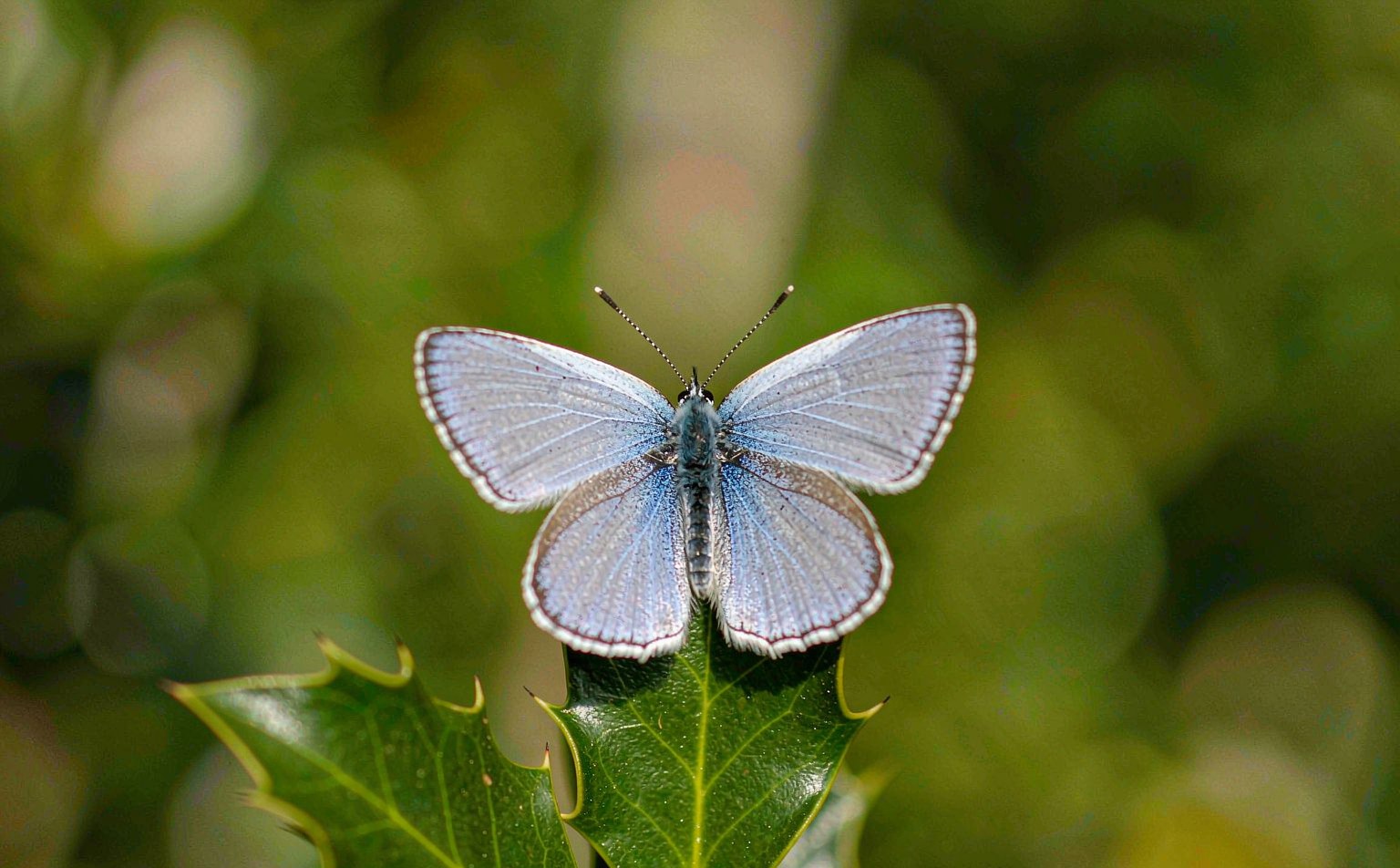
Celastrina argiolus | Holly Blue
Introduction
The Holly Blue (Celastrina argiolus) is a small, luminous blue butterfly whose silvery wings and gentle flight make it a highlight of garden and woodland edge from early spring onward. Uniquely among common British blues, it is not a grass-feeding species but one tied to shrubs, laying its eggs on holly and ivy. It produces two broods a year, the spring generation on holly and the summer generation on ivy.
Taxonomy
The Holly Blue is a member of the family Lycaenidae, the blues, but unlike most European blues it belongs to the subfamily Polyommatinae and the genus Celastrina rather than the grassland-associated genus Polyommatus. Its life cycle is linked to the spindle and ivy family plants rather than legumes, setting it apart from the [Small Heath](https://www.gloencyc.com/peacock-butterfly-aglais-io/) and other meadow species. It ranges across Europe, North Africa and temperate Asia.
Physical Characteristics
Adults have a wingspan of 30 to 36 millimetres. Both sexes are pale silvery-blue above with narrow dark margins, the female slightly greyer with a broader border than the male. The underside is a uniform powdery grey-blue with a scatter of small black spots, lacking the orange crescents of many other blues and giving the closed wing a frosted look.
The body is slim and lightly furred, the antennae ringed with black and white. The caterpillar is a small green larva with a yellow line and, in later instars, a reddish tinge, often attended by ants that take its honeydew. The chrysalis is green or brown and formed among leaf litter or in a crevice of the food shrub.
Habitat
The Holly Blue is a butterfly of hedgerows, woodlands, gardens, parks, churchyards and scrub where holly and ivy grow. The spring brood depends on holly (Ilex aquifolium) for egg-laying, the summer brood on ivy (Hedera helix), so the species needs both shrubs present in the same area. It flies higher and more openly than most blues, often flitting around the tops of shrubs rather than settling in grass.
Diet
Adults take nectar from a range of flowers including holly and ivy blossom, bluebell, hawthorn, privet, bramble and various garden blooms, favouring creamy or white flowers. The caterpillars feed on the flower buds, fruit and young leaves of holly in spring and ivy in summer, sometimes damaging the buds but rarely harming the shrub’s health.
Reproduction
Females lay single pale eggs on the buds or undersides of leaves of holly in spring and ivy in summer. The caterpillars feed on the developing buds and fruit, attended by ants attracted to their secretions, and pupate in leaf litter below the shrub. Two broods are normal: the spring generation emerges around April, the summer generation in July and August, with the latter’s chrysalis overwintering.
Conservation
The Holly Blue is generally common and has expanded its range in some regions, helped by the abundance of garden holly and ivy, though it suffers periodic crashes linked to a parasitic wasp (Listrodomus nycthemerus) that attacks the caterpillar. It is not of conservation concern, and planting holly and ivy in gardens directly supports it. Its reliance on two specific shrubs makes it sensitive to over-zealous pruning of these plants.
Fun Facts
- It is the only common blue butterfly in Europe that lays eggs on shrubs rather than low plants.
- The spring brood uses holly and the summer brood uses ivy — two host plants in one year.
- Ants often tend the caterpillars for their sweet secretions, offering some protection from predators.
- Its underside is plain grey-blue with spots, lacking the orange of most other blues.
- Populations rise and fall in cycles driven by a tiny parasitic wasp rather than by weather alone.