 By st20113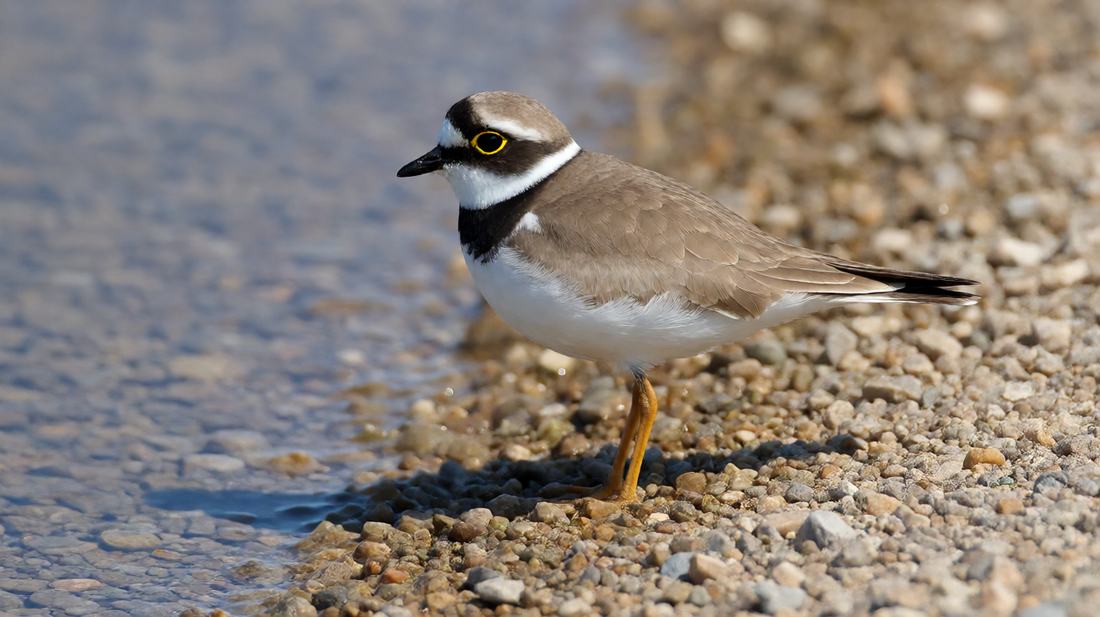
Charadrius dubius | Little Ringed Plover
Species Profile · Charadriidae
Little Ringed Plover
The plover that turned a human accident into a home — a bird that came out of the river valleys and settled in the gravel pit, the quarry and the building site.
IUCN: Least Concern
Range
Length
Weight
Nest
Incubation
The plover of the gravel pit
A gainer of the last century
The Little Ringed Plover is a small, neat, long-legged wader. It has a smart black and white head pattern. A single black band crosses the breast. Its last century has been one of gain rather than loss. That is rare among European birds. The species came out of the river valleys. It colonised the gravel pits, quarries and building sites that people created. It also uses industrial wasteland. The bird first bred in Britain in 1938. It is now a familiar nesting species in pits and works. The bird is 14 to 17 cm long. Its wings span 42 to 48 cm.
It weighs 32 to 48 g. That makes it only slightly larger than a sparrow. Several features separate it from the Ringed Plover. Once known, they are easy to see. The best clue is a ring of bright yellow skin around the eye. The bird also has no white wing bar in flight. Its upperparts are plain sandy or earthy brown. The Ringed Plover is cool grey. The bill is black at the tip. The basal half is orange or yellowish. The bird depends on bare ground above all. It cannot nest where the vegetation closes over.
So it does best on shingle banks and gravel bars. It uses dried-out mud at the edges of reservoirs. It uses the flat floors of extraction sites scraped clean of plants. Industry produces exactly that kind of flat, disturbed ground. That is why the species has spread so widely. It breeds across Europe and Asia as far as Japan. It winters in Africa, the Middle East and southern Asia. The birds migrate at night in loose flocks. They often call as they pass overhead. It is classed as Least Concern on the global Red List. Its European population is now probably larger than before sand and gravel extraction began.
Family tree
Charadrius, the ringed plovers
The Little Ringed Plover belongs to the family Charadriidae, the plovers and lapwings. This is a large family of small to medium waders. Its members have a compact body and a short bill. They have large eyes. They hunt by sight rather than by probing. Within the family the bird sits in the genus Charadrius, the ringed plovers. That group holds about 2 dozen species on every continent. They have black and white head markings. They carry one or 2 dark breast bands. Its closest relatives include the Ringed Plover of Europe. They also include several small ringed plovers of Asia and Africa. Comparing it with them is the most useful exercise.
The differences are small but consistent. That is exactly what defines species in this difficult genus. Look at the eye ring and at the presence or absence of a wing bar. Look at the colour of the legs and the base of the bill. Count the dark bands across the head and chest. The Snowy Plover makes a good comparison. So does the Ringed Plover. The species was described by Scopoli in 1786. Three subspecies are generally recognised. The nominate form breeds across Europe and Asia. A second occurs in the Middle East and north-east Africa. A third is found in east Asia.
They differ mostly in size and in the pale markings on the head. The scientific name is more picturesque than most. Charadrius is a classical Greek word for a bird that lived in a ravine. Dubius is Latin for doubtful or uncertain. So the whole name means the doubtful ravine bird. It refers to the uncertainty of early taxonomists. They were unsure how the little ringed plovers of the world should be grouped. That uncertainty persists in a sense today. The bird is also unusual among waders in its love of bare ground. It has colonised man-made habitats so completely that some districts hold more pairs on gravel workings than on natural river shingle.
Eye ring and breast band
How to identify one
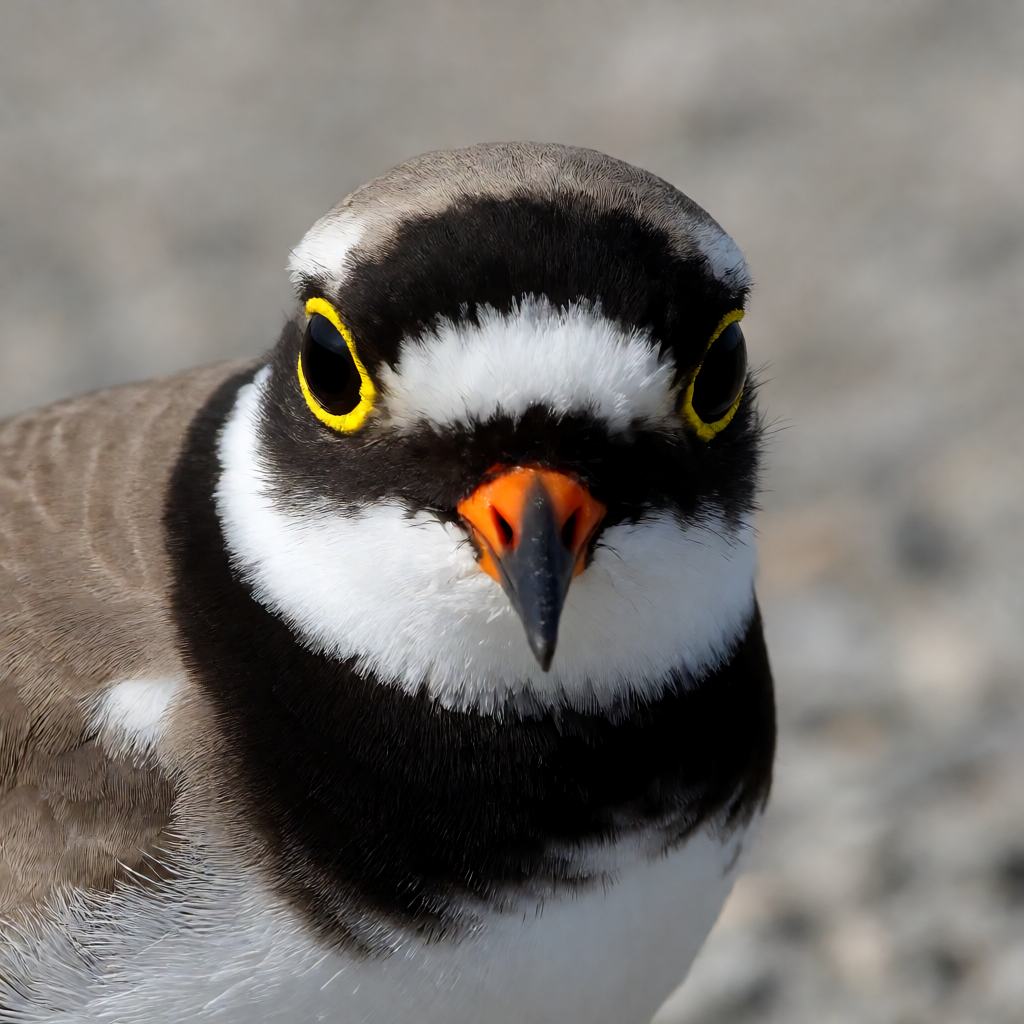
An adult is 14 to 17 cm long. Its wings span 42 to 48 cm. It weighs 32 to 48 g. The bird’s build is slender and upright. It has a fairly long tail for a plover. Its long bare legs are a dull yellowish or fleshy colour. Its wings are relatively long and pointed. They give it a fast, direct flight with steady wing beats and a flickering quality. The most important feature of the head is a bare ring of skin around the eye. In adults it is a brilliant yellow. It is conspicuous at a surprising distance. This ring sits inside a dark mask.
The mask runs from the bill through the eye and across the cheeks. The forehead is white above the bill. A black band separates it from the crown. So the whole head carries a bold pattern of black and white. That pattern is reversed in young birds and looks quite different. The upperparts are a plain greyish or sandy brown. There is no pale wing bar at all. That is the single most useful feature in flight. The underparts are white apart from one black band. The band crosses the lower throat and the upper breast. It is narrower than the Ringed Plover’s and usually complete. The Ringed Plover carries a broader band.
It also shows white above it in a different pattern. The bill is black at the tip and orange or yellow over the basal half. The Ringed Plover’s bill is all black. Young birds have a much less distinct head pattern. The pale parts of their plumage carry neat buff edges. That gives a scaly look. A young bird in autumn can be surprisingly hard to separate from a small stint. Check the eye ring and the absence of a wing bar first. The sexes are alike in plumage through the year. There is no seasonal change except a slight dulling of the bare parts outside the breeding season. Weight and general look stay much the same from 1 year to the next.
1
2
3
Bare shingle and quarry floor
Where it lives
The Little Ringed Plover is above all a bird of bare, open ground. It wants sparse vegetation beside shallow fresh water. Nature creates that habitat only at intervals. Human activity creates it constantly. In its original setting the species nested on shingle banks and sand bars along rivers. It used gravel spits in the middle of streams. It used the stony shores of lakes where flooding and scouring kept plants off. It needed a site with clear views in every direction. It needed stones or gravel to hide the eggs. It needed shallow water within easy reach for feeding. Since the middle of the twentieth century the same bird has taken to gravel pits and sand quarries.
It uses clay pits and the beds of drained reservoirs. It uses sewage farms, canal banks and spoil heaps. It uses car parks, building sites and the edges of airfields. It uses any flat area where the surface is disturbed often enough to keep plants off. In many parts of Europe those industrial sites now hold most of the breeding population. The need for open water is important. The bird feeds at the margins of pools and streams. It will not nest where there is nothing but dry ground. It prefers fresh water to salt water. So it is generally a bird of rivers, pits and reservoirs rather than of the coast. Small numbers do occur on the shore in some areas.
The species is a long-distance migrant. European birds leave in late summer and autumn. They travel to the Sahel and other parts of Africa. They also winter around the Mediterranean and in the Middle East. The migration happens mainly at night. The birds can often be heard calling over inland towns far from any water. Its habitats are temporary by nature. They are frequently destroyed or allowed to grow over. So the bird must move between sites. A network of extraction sites and river shingles matters more to it than any single site.
A hunter by sight
What it eats
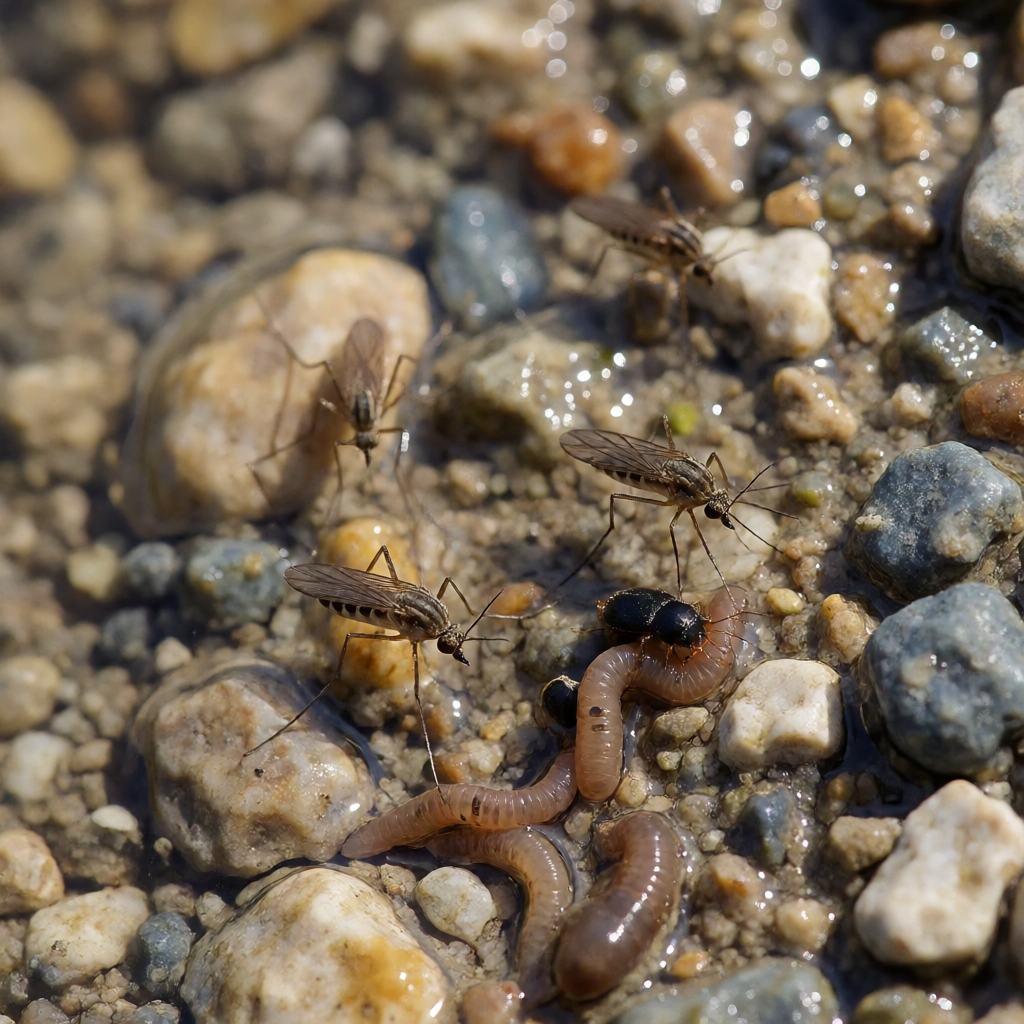
The Little Ringed Plover is an insect eater and a visual hunter. It takes a small number of other invertebrates as well. Its diet is mainly the insects that live around bare ground at the water’s edge. These include midges and their larvae, small beetles and ants. They include caddisflies, mayflies, small grasshoppers and the larvae of several flies. It also takes small earthworms and spiders. A few tiny crustaceans are eaten where available. It finds food by sight rather than by probing. It hunts by running across open ground in short bursts. Then it stops abruptly and stares at the surface.
It pecks quickly at whatever it has spotted. It rarely stands still for long. That gives the bird a busy, restless, mechanical quality. It is quite different from the slow, steady probing of a Dunlin on the same shore. One of its most engaging habits is foot-trembling. The bird stands on one leg and pats the ground rapidly with the other foot. The vibration seems to disturb small invertebrates into moving. The bird can then see them and catch them. Several related plovers share the technique. It is one of the most reliable ways to confirm a small plover at a distance.
The Ringed Plover does the same thing, but less often and with less enthusiasm. Feeding happens mostly at the water’s edge on wet sand or gravel. The bird also hunts on damp mud and in shallow water. It works around the margins of any small pool. It will take insects from the air when they swarm in numbers. The species feeds by day. It also feeds on moonlit nights during migration. Its feeding territory is generally close to the nest. So a pair spends the breeding season within a small radius. That patch of bare ground provides both the nest site and the food supply.
A scrape in the stones
The breeding cycle
The breeding season starts as early as March in the south of the range. It runs through to July. The species nests on the ground in open, exposed places. So the nest is often lost to flooding, vehicles, dogs and predators. The birds routinely lay replacement clutches. They may do so 2 or even 3 times in a single year. That is how the species holds its numbers in such unstable habitats. The nest is a shallow scrape in sand, gravel or shingle. It is often unlined. Sometimes a few small stones are arranged around the rim. The site is chosen so that the eggs are hidden by their own camouflage.
The sitting bird must also be able to see any approach. So a pair on a gravel pit usually nests on a raised, stony ridge. They avoid the smoother areas. Between 3 and 4 eggs are laid, most often 4. They are cream or pale buff with dark speckles and scrawls. These match the surrounding stones so closely that the clutch is very hard to find. Incubation lasts between 22 and 28 days and both birds share it. The off-duty bird feeds nearby and stays in contact by call. The chicks leave the nest within hours of hatching. They are covered in pale down with dark streaks. They are extremely good at freezing in position against a stony background.
The adults lead them to the best feeding areas around the pool. There they feed themselves from an early age on small insects. They can fly at about 24 days of age. After that their parents progressively abandon them. They begin to gather in small flocks of their own before migration. Parent birds defend the nest and chicks with great energy. They use distraction displays. One display has the adult run away trailing a wing as though injured. They also perform a broken-wing display and utter alarm calls. The young are moved away from danger and hidden in vegetation at the first sign of a predator.
Helped by accident, harmed by tidying
Conservation
The Little Ringed Plover is assessed as Least Concern on the global Red List. The species has a very large range. Its numbers have almost certainly gone up in Europe over the last century. Industrial activity caused that gain. Gravel pits, quarries and reservoirs provided an enormous supply of bare ground. That is not to say the bird has no problems. Three of them matter. The first is that the habitats behind the increase are temporary by definition. A worked-out pit is normally reclaimed, filled with waste, flooded into a lake or allowed to grow over. That removes the open ground the birds need and forces them to move on. New extraction sites are not guaranteed.
There is also pressure to restore old ones quickly. So the supply of suitable ground could easily shrink. The second is that many of these sites are also used for recreation. The birds are highly vulnerable to disturbance while nesting. The exposed scrapes and chicks are so hard to see. They are easily crushed or abandoned. Off-road vehicles, uncontrolled dogs and model aircraft all cause damage. Motorbike scrambling and casual visitors do the same. They can destroy a season’s breeding at a single site. The third is the state of the migration route and the wintering grounds. The species depends on staging sites in the Sahel.
It depends on the wetlands of the Mediterranean and Africa. Those places face drought, farm intensification and water extraction. A bird that has done well on its European breeding grounds may still be limited by what happens south of the Sahara. In practice its conservation comes down to 3 things. Keep a steady supply of bare gravel in the landscape. Manage disturbance at the sites that matter. Secure the wetlands along its migration route. The species shows that a bird can be helped enormously by accident. It can then be harmed by the tidying up of the same accident.
Quick hits
Five things to remember
- The bright yellow ring around the eye is the first feature to check when a small plover is being named.
- It has no white wing bar, unlike the Ringed Plover.
- Foot-trembling, patting the ground with one foot, is used to make hidden insects move into view.
- The species first bred in Britain in 1938, in a gravel pit.
- Gravel workings and quarries now hold far more breeding pairs than the natural river shingle the bird once used.