 By st20113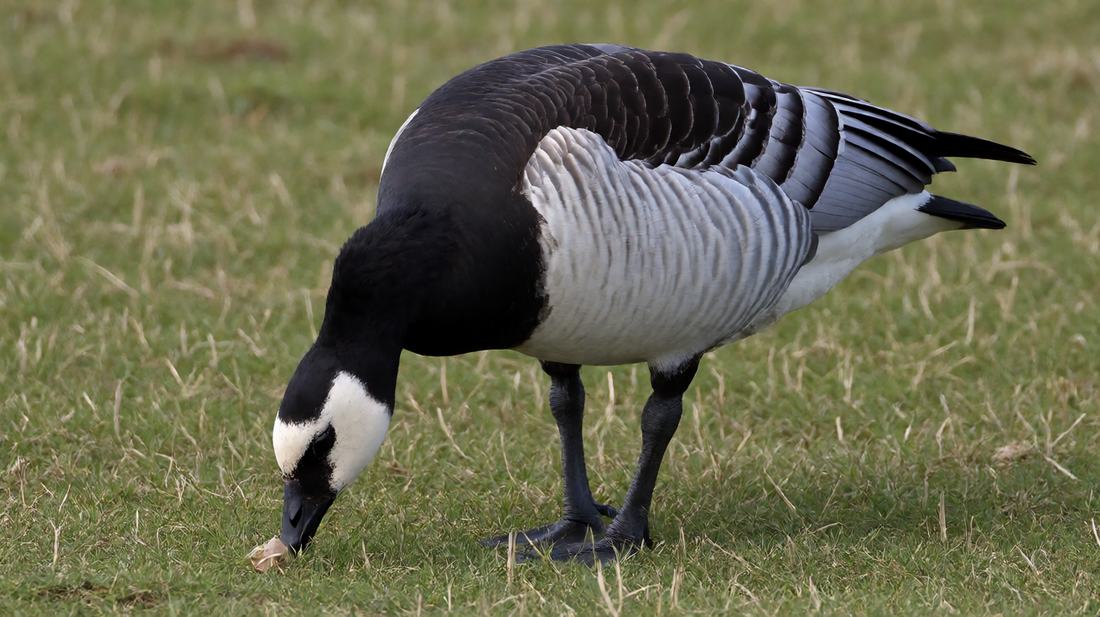
Branta leucopsis | Barnacle Goose
Species Profile · Anatidae
Barnacle Goose
A small black-and-white goose of the arctic cliff whose medieval legend said it grew from a barnacle — now a best-loved winter bird of Scotland, Ireland and the Netherlands.
IUCN: Least Concern
Range
Length
Weight
Nest
Migration
The goose of the legend
From barnacle myth to winter field
The barnacle goose is a small, short-necked black-and-white goose of Anatidae. It is among the most odd and best-loved wildfowl of western Europe. The same bird spends summer on a cliff ledge above the arctic sea in Svalbard and Greenland. In autumn it flies south to graze the saltmarsh and pasture of Scotland, Ireland and the Netherlands. Its crisp black-and-white plumes and sharp call make it a favourite winter goose. It is unmistakable in the field. The head and neck are black.
The face is white. The body is pale grey with black bars. The bill is short and black. It looks like a small copy of the larger brent. It feeds in close groups on the coast. It roosts on the near water. It flies between the two in long lines.
Its place in the winter scene of the western isles is far bigger than its numbers. The bird carries the strangest tale in ornithology. In the Middle Ages people thought it hatched from a barnacle on driftwood. This let them eat it on fast days as a fish, not a bird. The error was fixed centuries ago. Yet the name and the legend live on. They show how little was known of the arctic geese until explorers reached the north.
Family tree
Branta, the black geese
The barnacle goose is in the genus Branta, the black geese. The black geese differ from the grey Anser geese by the black, not grey, head and neck. They also lack the soft chinstrap marks of the grey geese. The barnacle is close to the larger Canada goose. It is also kin to the Nene (Branta sandvicensis). That Hawaiian goose evolved apart from the same stock.
It became a mostly land bird with reduced webbing. This shows how far the black geese have spread within one north Pacific and north American line. Linnaeus described the bird in 1758. Experts now see several populations. They differ in where they breed and where they winter. The Svalbard birds nest on arctic cliffs and winter on the Solway and Islay.
The Greenland birds nest on that island’s coast and winter in Ireland and west Scotland. The Russian birds nest on the Barents Sea islands and winter in the Netherlands and Germany. These flocks are not split into species. Yet their separate moves mean a goose from Islay will likely never meet one from the Dutch polders.
Black, white and short-billed
How to identify one
An adult barnacle goose is 55 to 70 centimetres long. Its wingspan is 120 to 150 centimetres. The female weighs about 1.2 kilograms. The larger male can reach 2.3 kilograms. This compact size makes it among the smallest northern geese. A bird in the hand is told from a brent by its paler belly. It is told from every other goose by the clean white of its face. The two sexes look alike.
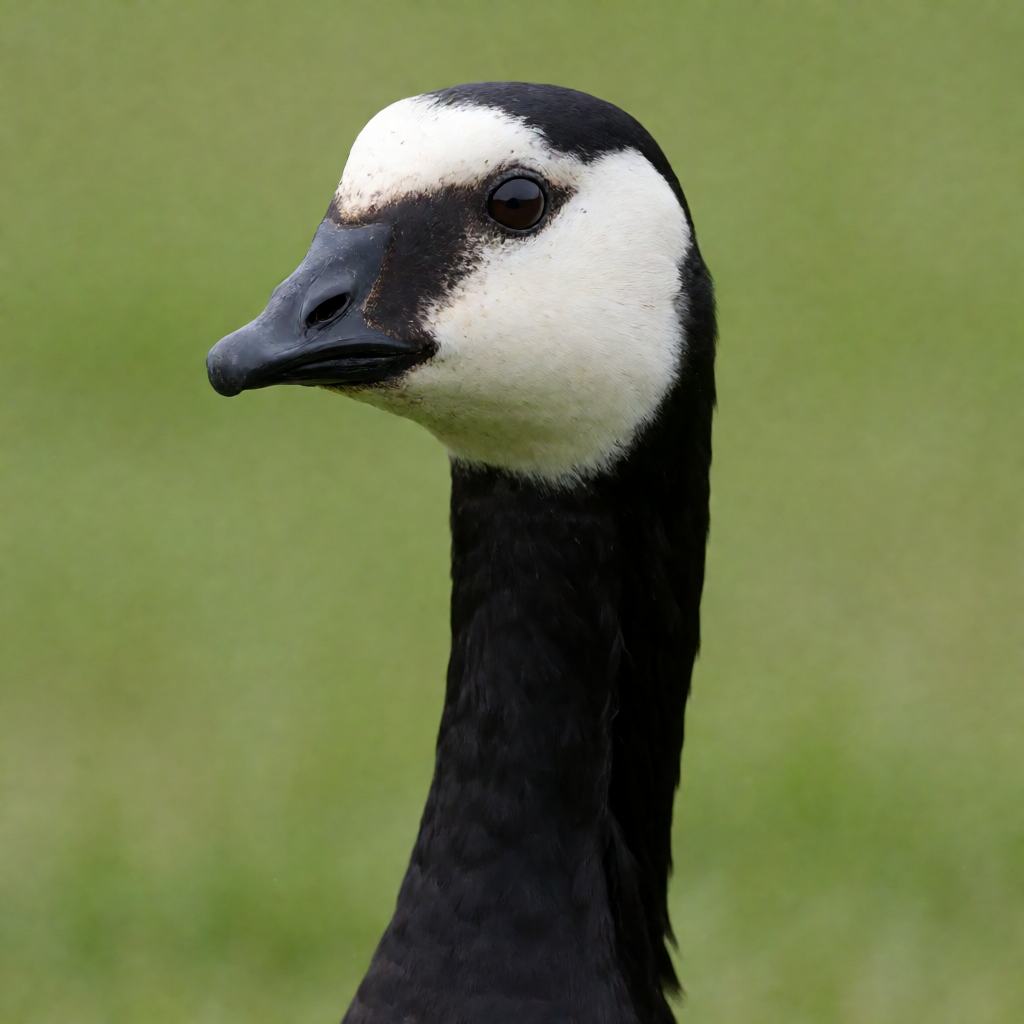
The head and neck are black. A large white patch runs from the chin to in front of the eye. The back and breast are pale blue-grey with black bars on each feather. The belly is white. The rump and tail are black. The only colour in this plain bird is the dull olive bill. The legs are black in the adult and grey in the young. The wings are short and round for a goose.
Flight is fast and light with quick beats. The bird crosses the sea between its homes in one flight. Its call is high, yelping and sad. It carries well across the winter marsh. The wing feathers moult soon after breeding. The flightless adults gather on tidal water for three or four weeks.
1
2
3
Cliffs and coastal grassland
Where it lives
The barnacle goose lives on the arctic coast and the temperate shore. In summer it needs the cliffs and coastal tundra of the high north. In winter it needs the short grass and saltmarsh of the mild lowland coast. Both hold open water and the short plants it eats. The species is odd among geese: it nests on sea-cliff ledges, not on the ground. This shields the eggs and young from the arctic foxes below.
In Svalbard the birds breed on the steep cliffs of the fjords and islands. In Greenland they breed on the coastal tundra and low cliffs. In Russia they breed on the rocky Barents Sea islands. The short summer gives long light and a burst of plant growth for the goslings. In Britain the winter birds stay on the coastal grass of Scotland, Ireland and north-west England. The largest groups are on Islay, the Solway and the Forth merse.
They also line the Dutch and German Wadden Sea. The bird is a strong, regular migrant. Rings show a single bird returns to the same winter field and same summer cliff for life. That life can exceed twenty years.
A grazer of grass
What it eats
The barnacle goose feeds almost wholly on grass. Its diet is leaves and growing tips of grasses and saltmarsh plants. A short bill crops them close to the ground like shears. It is not the comb of a filter-feeding duck. A feeding flock leaves a close-cropped turf with the coarse blades left. To this grazing the birds add clover and low plants.
They take spilled grain where they can. They dig roots and rhizomes of shore plants. At egg time they eat small animals for protein. The bird cannot digest cellulose well on its own. It needs a large gizzard and a long gut. So it feeds through much of the day.
It makes a heavy load of droppings. This enriches the saltmarsh but hurts the farmer. A flock of thousands on improved pasture can cut the grass yield. It can also harm the sward by trampling. Managers give other fields and scare birds from the best land.
A ledge on the cliff
The breeding cycle
Barnacle geese pair for life in most cases. A bird picks its mate in its second or third year. It stays with that mate through each later move and winter. The pair bond is among the strongest of wildfowl. The two adults return to the same cliff each spring. Nesting starts in early June and runs into July. The site is a narrow ledge on a sea cliff.
It is often many metres above the water. It sits near the nests of seabirds that share the rock. The female builds a shallow scrape lined with moss, down and breast feathers. The clutch is three to five eggs. She lays one every day and a half. She sits on them alone for twenty-three to twenty-five days. The male guards and drives off gulls and skuas.
The goslings can walk soon after hatch. They hatch on a cliff, so they must climb down to the shore and water within a day or two. Their parents lead them to the shallows. They learn to feed under close care. They can fly at forty to fifty days. By then the family must move to the coast and south.
A recovered wildfowl
Conservation
The barnacle goose is Least Concern on the global Red List. Its recovery is one of the clear wins of wildfowl care. The Svalbard flock fell to a few hundred birds in the mid 1900s. Hunting and disturbance caused this. It has since risen to more than forty thousand. The Greenland and Russian flocks have also grown. The total is now counted in hundreds of thousands.
It is steady or rising in most years. The species is protected across its range. In Britain the winter flocks are covered by deals between agencies and farmers. The birds are scared from improved grass. They are left to graze the poor saltmarsh and the nature reserves. This compromise let the flock grow while crop loss stayed within bounds. Legal protection now extends to the stops on migration.
This removed the worst of the shooting that once cut the flocks on passage. The main threats remain. A warming climate shifts the timing of arctic plant growth. Better coastal farms remove the weedy grass the birds need. A hard winter on the wrong route could cut one isolated flock. Managing the goose stays a cross-border task in the interest of the bird and the land.
Quick hits
Five things to remember
- In the Middle Ages the barnacle goose was thought to grow from a barnacle on driftwood. This is why it was counted as a fish and allowed at table on fast days. The name records a legend not disproved until the breeding grounds were explored.
- The barnacle goose is one of the few geese that nests on sea cliffs, not the ground. The goslings must climb down the rock and reach water within a day or two of hatch. This costs some of the brood each year.
- The white face patch and black neck make the species unmistakable. It is the smallest of the black geese. It looks like a neat copy of the larger brent, with which it sometimes feeds.
- The Svalbard barnacle geese that winter on Islay and the Russian ones that winter in the Netherlands take separate trips. They are unlikely ever to meet, though they are the same species.
- A barnacle goose returns to the same winter field and same summer cliff for life. Rings have found birds on the very coast they used two decades earlier.