 By st20113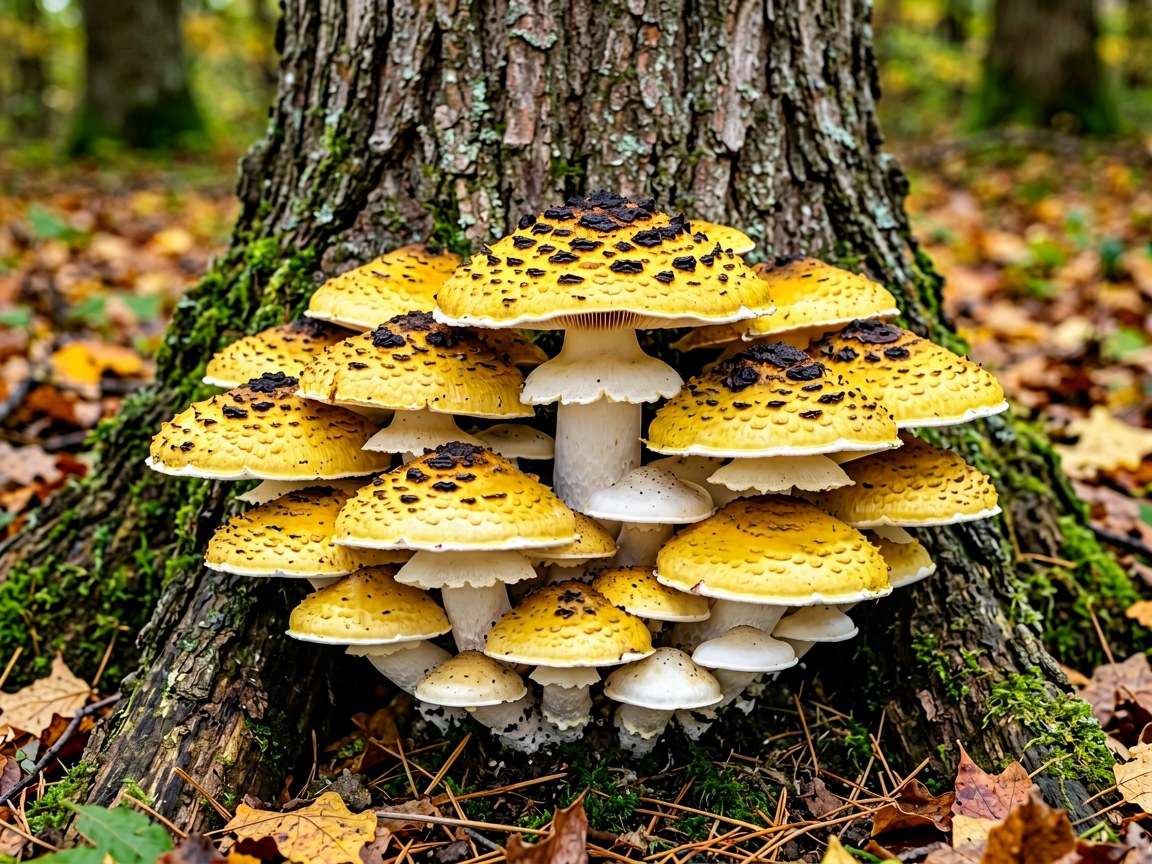
Armillaria mellea | Honey Fungus
Introduction
The honey fungus (Armillaria mellea) is a honey-colored woodland mushroom that grows in dense clusters at the base of trees and stumps in autumn, but the visible mushrooms are only a small part of the story. Beneath the soil spreads a vast network of black, bootlace-like strands that attack the roots of living trees, making this one of the most destructive fungal pathogens in gardens, orchards, and forests. The same network can also glow faintly in the dark, and some individuals rank among the largest living organisms on Earth.
Taxonomy
Armillaria mellea belongs to the family Physalacriaceae within the order Agaricales, in the phylum Basidiomycota—the same broad fungal group that includes Amanita muscaria (Fly Agaric). The genus name Armillaria means “bracelet” or “ring,” referring to the distinct ring on the stem, while the species name mellea means “honey-colored,” describing the cap. Several closely related species are now recognised alongside it.
Physical Characteristics
The cap is 3–15 cm across, convex then flattening, honey-yellow to olive-brown, and covered with small dark scales toward the center. The gills are white to cream, running slightly down the stem. The stem is tough, pale at the top and darker toward the base, and carries a noticeable white, skirt-like ring. The mushrooms appear in dense, sometimes enormous clusters. The most distinctive feature, however, is underground: flat, black, branching strands called rhizomorphs, which look like bootlaces and spread through soil and along roots.
Habitat
Honey fungus grows on and around living and dead trees, stumps, and woody debris in woodland, gardens, parks, and orchards across temperate regions of the world. It is a parasite and a saprotroph at once: it kills weakened trees by attacking their roots and then continues to live on the dead wood, sometimes for decades. Once established in a garden or orchard, it is extremely difficult to eradicate because the rhizomorphs persist in the soil.
Diet
This fungus feeds on wood. As a parasite it invades the roots and lower trunk of living trees, digesting the woody tissue and blocking the flow of water and nutrients, which causes the characteristic dieback of the crown. Once the tree dies it continues as a saprotroph, breaking down the dead wood and recycling its nutrients into the soil. It is one of the relatively few organisms able to digest lignin, the tough compound that makes wood rigid.
Reproduction
The clusters of mushrooms are the fruiting bodies of a single, far larger underground organism. Spores are produced on the gills and released into the air in autumn, but most spread happens through rhizomorphs, which grow through the soil and along roots until they contact a new host. Because the fungus can also spread by direct root contact between neighboring trees, infections often radiate outward from a single original stump across a whole stand.
Conservation
As a native woodland fungus, honey fungus is a natural part of forest ecosystems and a decomposer of the first importance. The problem is economic: in gardens, orchards, and plantations it kills valuable trees and shrubs, and control is difficult—management focuses on removing infected stumps and roots, installing physical barriers, and replanting with less susceptible species. In natural woodland its role as a recycler of dead wood outweighs the damage it does.
Fun Facts
- Some individual Armillaria networks are among the largest living organisms on Earth, spreading over many hectares.
- Its underground rhizomorphs can glow faintly in the dark, a phenomenon known as foxfire.
- The black bootlace strands are the main way it spreads, creeping through soil from tree to tree.
- It is edible only when thoroughly cooked; raw or undercooked specimens can cause stomach upset.
- A single clump of mushrooms at a tree base is usually just the visible tip of a much larger organism.