 By st20113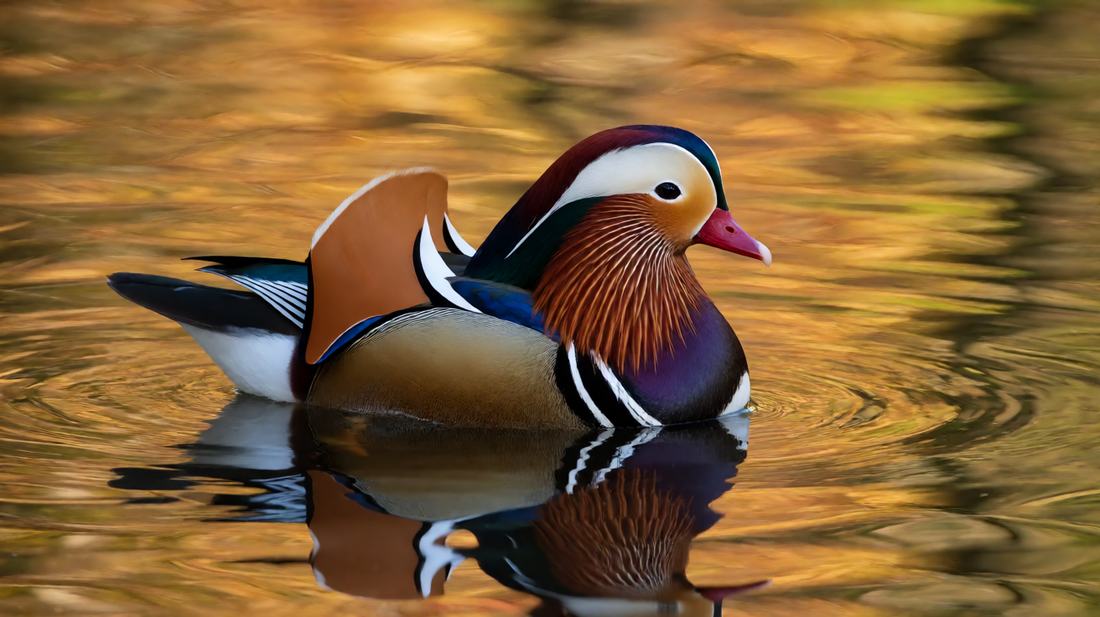
Aix galericulata | Mandarin Duck
Species Profile · Anatidae
Mandarin Duck
The most ornate duck in the world, a bird of small wooded pools whose native population is shrinking in the east while it thrives in the west — the great paradox of Asian waterfowl.
IUCN: Least Concern
Range
Length
Weight
Nest
Incubation
The most beautiful of ducks
A bird of the wooded pool
The mandarin duck is a small and very brightly coloured perching duck. It lives on the wooded lakes of the east of Asia. It is one of the most beautiful of all the waterfowl. It is also one of the most familiar of the ornamental birds of the parks and gardens of the world. One puzzle runs through the species. The bird is in serious decline over the whole of its native range. Yet it has settled in the wild in the countries of the west. So a bird that is now scarce in its own country is common in the British Isles. It is also increasing on the rivers of the north of Europe. The male is the bird that most people know. His plumage mixes green and purple and orange and white. He has a red bill and a white stripe above the eye.
He also has great orange sail feathers on the back. People regard him as the most ornate of all the ducks. That elaborate plumage came from a very long period of sexual selection. The female is a much plainer bird. She is grey and brown with a white tear-shaped patch around the eye. She looks very like the female of the wood duck of North America. That bird is the only other member of the genus. The likeness of the 2 females shows how mate choice works in the ducks. The female does the choosing. The plumage of the male answers her. The mandarin duck nests in the holes of the trees. The ducklings must jump from the height of the cavity to the ground.
They make the jump on the day after the hatching. That jump is one of the most remarkable events in the life of the bird. The ducklings weigh no more than a few tens of grams. They fall a distance that can pass 10 metres. Then they bounce and run to the water with no harm at all. The species is assessed as Least Concern on the global Red List. That rating rests on the whole of its world population. But the native population of the east of Asia has fallen very heavily. So the bird is now protected. It is also the subject of conservation programmes in China and in Japan.
Family tree
Aix, a genus of two species
The mandarin duck was described by Linnaeus in 1758. Modern work places it in the genus Aix. That genus sits in the family Anatidae. The genus is a very small group of 2 living species. The other member is the wood duck of the east of North America. The 2 are the only survivors of an old line of ducks. That line has been separate from the rest of the family for a very long time. People call the birds the wood ducks or the perching ducks. The second name comes from 2 habits. The birds perch on the branches of trees. They also nest in the cavities of the trunks. Both habits are very unusual among the ducks.
They are the reason that the 2 species were once placed with the other hole-nesting birds of the family. The mandarin duck is a close relative of the Wood Duck (Aix sponsa). The 2 are very alike in the look of the female. They are also alike in their anatomy and in their behaviour. So the older authors were inclined to treat them as a single species. Comparing the 2 is one of the most interesting exercises of comparative ornithology. The 2 birds live on the 2 sides of the world. An ocean and a very long period of geological time separate them. Yet they arrived at almost the same way of life. They also arrived at almost the same pattern of colour in the female. The species name means the little cap or the wig in Latin. It refers to the crest of feathers on the head of the male.
The name of the genus is the old Greek name of a diving bird that nobody can identify. Naturalists of the 19th century gave that name to the group. The species is the same over the whole of the native range. The birds of the different parts of the east of Asia do not differ in any steady way. So people do not split them into subspecies. The birds of the west are the descendants of escaped captives. Those birds came from the collections of wildfowl of the 18th and the 19th and the 20th centuries. Genetic studies of the modern period have shown something interesting. The birds of the British Isles come from a small number of founders. The group went through a period of very reduced genetic variety. It has since recovered that variety.
Green crest, red bill
How to identify one
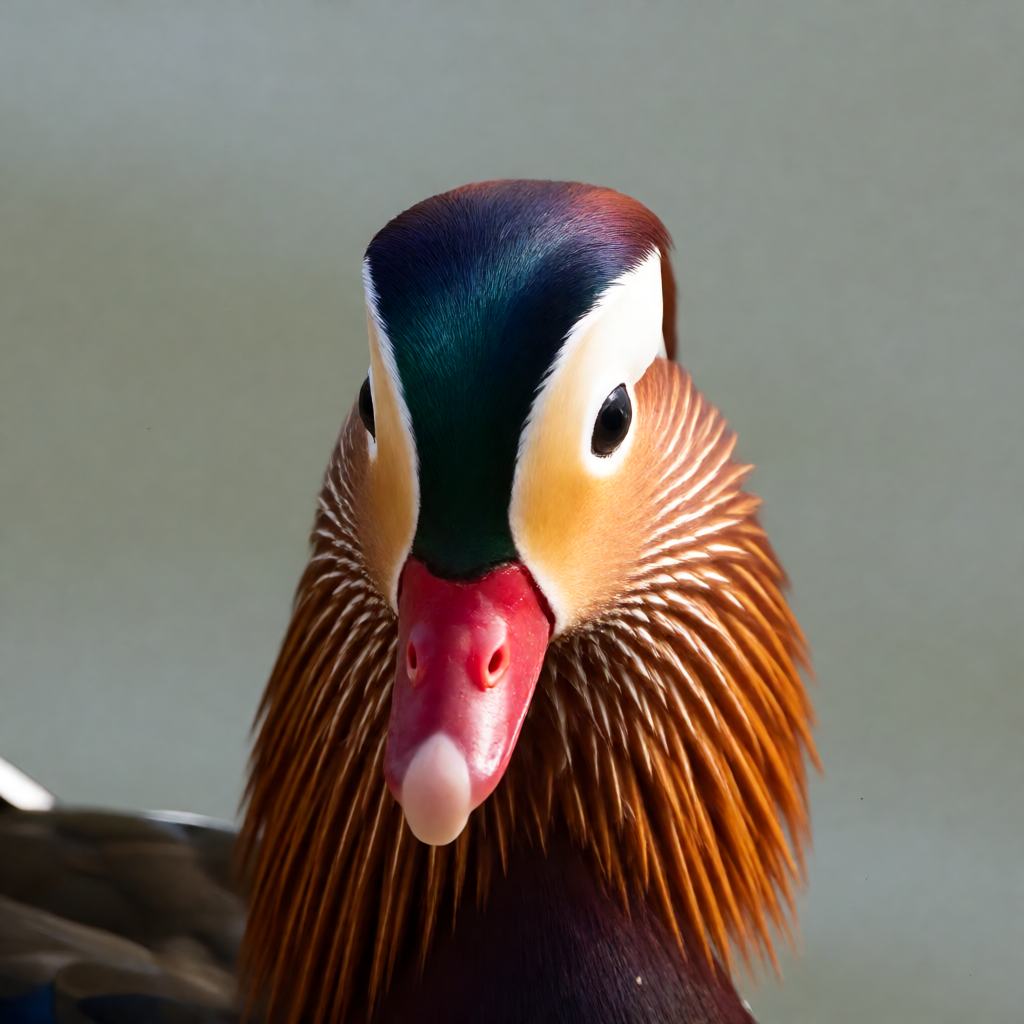
An adult mandarin duck is between 41 and 49 centimetres long. Its wingspan is between 65 and 75 centimetres. Its mass runs from about 430 grams in the smaller females. The heaviest males reach 700 grams. Those birds are in full condition in the winter. The bird is a small duck. It is not much larger than a teal and much smaller than the mallard. The male in full breeding plumage is the most elaborate of all the ducks of the world. His head carries a crest of metallic green and copper feathers. That crest falls over the nape. The bill is bright red with a pale tip and a pale nail. The eye is dark and is ringed with white and orange. A broad white stripe runs from the base of the bill above the eye and back to the nape. The cheek and the neck are a rich chestnut.
A narrow white line runs down from the eye to the throat. The breast is a deep purple-chestnut with pale spots at the sides. The flanks are a warm grey with fine pale bars. The belly is white. The back and the upper tail are a dark olive-brown. The most striking character of the male is a pair of enlarged fan-shaped feathers on the back. People call them the sails. The sails are bright orange with black and blue and white edges. The bird raises them in the display. They give the bird the look of a ship in full sail. The female is a much plainer bird of grey and brown. Fine mottling and pale spots cover her. The head is a soft grey with the white patch around the eye. A white tear-shaped line runs back from the eye.
The female of the mandarin differs only slightly from the female of the wood duck. The difference lies in the shape of the white patch of the eye. It also lies in the exact tone of the plumage. The legs and the feet are a dull yellow-orange. The tail is long and is carried low. It works as a rudder in the very agile flight through the trees. The bird flies fast and twists in the manner of the genus. That lets it move through wooded country at speed. It can land on the branches of trees. Most ducks cannot do that. The male moults into the eclipse plumage in the summer. That reduces him to a dull and female-like bird for the flightless weeks. He regains the full plumage of the breeding season in the autumn. A male in the eclipse plumage is very easily confused with a female.
1
2
3
Wooded lake and slow river
Where it lives
The mandarin duck needs wooded water. It needs small and shallow and sheltered water. A lake or a slow river will do. It also needs mature trees along the bank. Those trees give the cavities for the nesting. Those 2 needs together decide where the species can live. They also explain its absence from the open and treeless water of the marshes and of the estuaries. The bird is commonest in the country of the mixed forest. It likes the small and intimate pools within the native range. That range covers the east of China and the south of Japan. It also covers the Korean peninsula and the south-east of Russia. The species is present in the wooded country of the far east as well.
It is also found on the island of Taiwan. The bird is the most arboreal of all the ducks. It perches on the branches of trees. It walks on the fallen trunks. It nests in the cavities of the trunks at a height of between 2 and 10 metres. That perching habit explains something useful. The bird is one of the few of the family that can be seen in woodland far from water. The bird can also nest in the nest boxes that conservation programmes have put up. Those boxes have become one of the most effective instruments of the management of the species. The habitat of the bird in the introduced part of the range is the same. The species has settled in the wooded parks and the rivers and the lakes of the British Isles. It has also settled in the countries of the north of Europe.
The bird has been recorded as breeding in the wild in a great many countries of the west. The group of the British Isles has grown from a few escaped birds of the middle of the 20th century. It is now estimated at several thousand pairs. That growth is one of the most successful of the naturalisations of an introduced wildfowl. It has come about with none of the damage to the native species that has followed some other introductions. The bird is a partial migrant over the native range. The northern groups move south in the winter. The birds of the far east of Russia move to the warmer parts of China and of Japan. The birds of the introduced groups are mostly resident. They stay on the same stretch of the river for the whole of the year.
A dabbler of shallow pools
What it eats
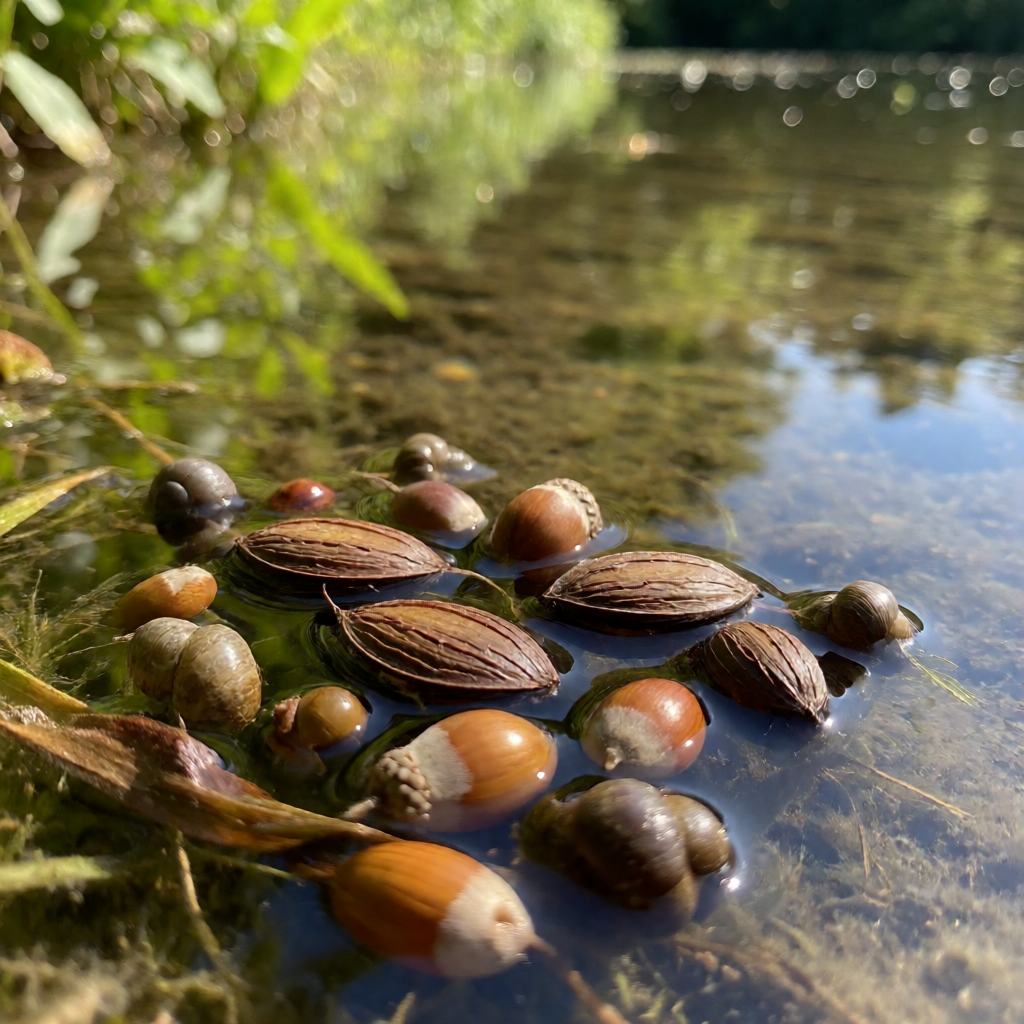
The mandarin duck is an omnivorous bird. It feeds on a very wide range of plant and animal food. The water it uses is wooded water. The greater part of the diet is the seeds and the soft parts of water plants. Acorns and the other tree seeds that fall into the water matter too. The bird is very fond of the acorns of the oak. It also likes the seeds of the chestnut and of the beech. The animal food is very important as well. It includes insects and the larvae of insects. Snails and small fish and frogs add to the list. So do the other small animals of the shallow water. The bird feeds mostly by dabbling on the surface. It also feeds by up-ending in the shallow water.
It does not dive for food as the diving ducks do. Its bill is short. The bill is not built for filtering the water as the shoveler does. So the bird takes the food item by item. It is more of a selective feeder than most dabbling ducks. The bird also grazes on the land. It walks on the bank and on the meadow. It feeds on the grass and on the seeds of the grasses. Feeding on the land is one of the most typical behaviours of the species. You often see the bird in the fields and in the parks far from the water. That habit helps to explain something else. It is one of the reasons that the species has adapted so readily to the parks and the gardens of the west. The diet changes with the season.
Animal food matters most in the period of the breeding. It also matters in the period of the growth of the young. The female and the ducklings need the protein then. Plant food becomes the greater part of the diet in the autumn and in the winter. Seeds and acorns are abundant then. The bird can store a considerable amount of fat in a good autumn. Those reserves carry it through the coldest part of the winter. The young ducklings feed mostly on small invertebrates of the shallow water. They do that for the first weeks of the life. They can catch insects on the surface from a very early age. The female leads them to the places where the food is most abundant.
A cavity in an old tree
The breeding cycle
The mandarin duck pairs in the winter and in the early spring. The pair bond forms after a period of display. The male performs an elaborate sequence of movements. He raises the sails. He shakes the bill. He makes a drinking motion. He preens the wing. That display is one of the most complex of any bird of the world. Ethologists have studied it in detail for the whole of the last century. The nest sits in the cavity of a tree or in an old nest hole of a woodpecker. It also sits in a nest box that people have put up. The bird will use the hole in the wall of a building. It will use a cavity in a stack of straw as well. The bird adds nothing to the nest but a lining of down. The female plucks that down from her own breast.
The female chooses the cavity. It is often at the height of several metres above the ground. Sometimes it sits at the height of more than 10 metres. The clutch holds between 8 and 12 eggs. The usual clutch is of 9 or 10. The eggs are a pale cream or a white. They are laid at the intervals of about a day. The female does the sitting alone. Incubation lasts for between 28 and 30 days. The male stays near the nest for the whole of that period. Then he deserts the female and the brood at about the time of the hatching. He joins the flock of the moulting males and passes the summer in the eclipse plumage. The ducklings are covered in down. They can swim and feed themselves within hours of the hatching. The whole of the brood leaves the cavity on the day after the hatching.
The ducklings jump to the ground from the height of the nest. They make the jump with no help at all. They bounce and scramble to their feet. Then they follow the female to the water. The female calls to them from the ground. The whole of the brood makes the jump within a short period of the one another. The female leads the brood to the water and guards them. She does that for the whole of the period of the growth. The ducklings can fly at between 55 and 60 days of age. They stay with the female for a period after the fledging. The family group breaks up in the autumn. The species raises a single brood in the native range. A second clutch is sometimes laid in the introduced groups when the first is lost. The female will sometimes lay her eggs in the nest of another female of the species. Clutches of more than 20 eggs in a single nest come from that behaviour.
Scarce at home, thriving abroad
Conservation
The mandarin duck is assessed as Least Concern on the global Red List. The assessment rests on the whole of the world population. That total now includes the large and growing groups of the introduced range in the west. The native population of the east of Asia tells a very different story. It has fallen very heavily over the last century. The species has lost a great deal of the habitat of the wooded wetland. That loss covers the whole of the native range. Small pools have been drained. Mature trees of the bank have been felled. The water has been polluted. The nesting sites have been disturbed. All of those things have added to the decline.
The collection of the birds for the ornamental trade made the losses worse. Shooting for food added to them. Shooting for the plumage did the same. By the middle of the 20th century the species was reduced to a small remnant over most of the range. The bird is now protected by the legislation of China and of Japan. It is also protected by the other countries of the native range. It is listed on the appendix of the convention on the international trade in the endangered species. The trade in the wild-caught birds is prohibited. The captive groups of the parks and of the collections now supply the birds of the introduced range. Those birds are no longer drawn from the wild. Conservation in the native range now concentrates on 3 things. It protects the remaining wooded wetland.
It provides nest boxes. It reduces the disturbance. The bird has answered well to those measures where they have been applied. The groups of the protected areas of the east of China and of Japan have grown over the recent decades. The introduced group of the British Isles is of very considerable interest to conservation. The bird has become one of the most popular of the waterfowl of the country. People feared possible competition with the native species. They also feared hybridisation. Neither fear has come true. The bird is now generally seen as a harmless and very welcome addition to the birds of the west.
Quick hits
Five things to remember
- The male is very widely regarded as the most beautiful of all the ducks. His plumage includes the red bill and the white eye stripe. It also includes the pair of orange sail feathers that he raises in the display.
- The female is a plain grey and brown bird with a white patch around the eye. She looks so like the female of the wood duck of North America that the 2 were once thought to be a single species.
- The ducklings jump from the nest hole on the day after the hatching. The fall from a cavity at the height of more than 10 metres does no harm to a bird of a few tens of grams.
- The bird perches on the branches of trees and nests in the cavities of the trunks. It is the most arboreal of all the ducks. It is one of the very few of the family that can be seen well away from the water.
- The native population of the east of Asia has fallen very heavily over the last century. The birds that escaped from the collections of the west have built a large and growing wild group in the British Isles.