 By st20113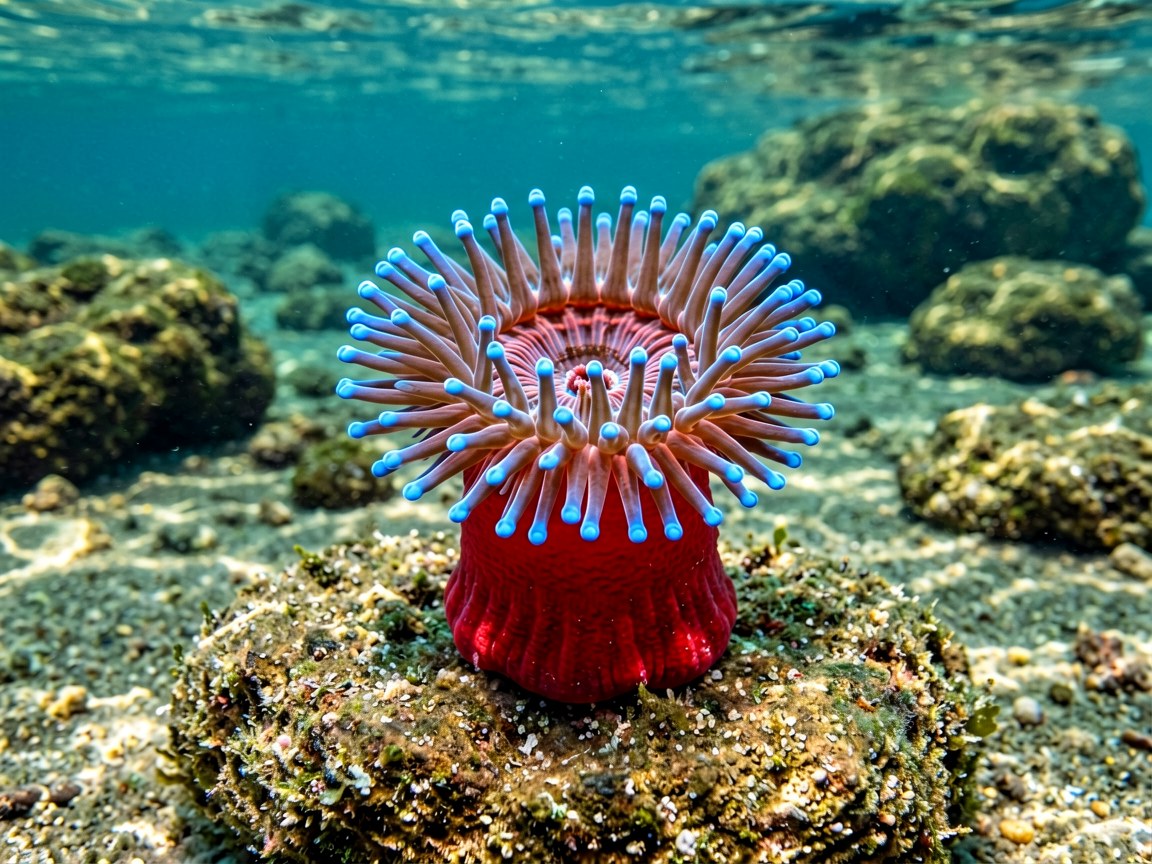
Actinia equina | Beadlet Anemone
Introduction
The beadlet anemone (Actinia equina) is the familiar red, blob-like animal of the rock pool, often mistaken for a plant or a jelly. At low tide it sits as a fleshy cushion; as the water returns it opens a ring of blue-tipped tentacles to catch food. Common on the rocky shores of the north-east Atlantic, it is one of the most numerous and toughest of all intertidal animals, and a perfect introduction to the strange world of the cnidarians.
Taxonomy
Actinia equina is an animal in the phylum Cnidaria—the jellyfish, corals, and anemones—within the class Anthozoa. It is a simple, sedentary relative of corals and, more distantly, of jellyfishes. It is not a mollusc, but like shore animals such as Mytilus edulis, the common mussel, it is a familiar resident of the same rocky intertidal zone, staying put and filtering or catching what the sea brings.
Physical Characteristics
The beadlet anemone is a squat cylinder 4–6 cm across, in shades of red, orange, brown, or green, with a flat top surrounded by up to 200 tentacles tipped with tiny blue beads. The tentacles bear stinging cells used to catch prey. If touched or exposed, it contracts into a tight, glistening blob, shrinking dramatically. A sticky foot disc anchors it firmly to the rock, and it can slowly creep if disturbed.
Habitat
Beadlet anemones live on hard surfaces in the intertidal zone, from the mid shore down into shallow water, favouring rocky coasts and the walls of tide pools. They tolerate being exposed to air for hours at low tide, sealing in moisture, and thrive on both exposed and sheltered shores. Different colour forms often occupy different zones of the shore.
Diet
Anemones are carnivores. Their tentacles are armed with stinging cells that paralyse small prey—tiny crustaceans, larval fish, and drifting animals—which the tentacles pass to the central mouth. They also absorb dissolved organic matter from the water. They do not chase food; instead they wait, mouth upward, for the tide to deliver a meal, and they can survive long fasting periods between feeds.
Reproduction
Beadlet anemones reproduce both by releasing eggs and sperm into the water and by splitting in two—a form of asexual division. A single animal can pinch in the middle and separate into two clones. They also regenerate lost parts readily. Young anemones settle and grow into the same squat, sticky form, eventually finding their own patch of rock to guard.
Conservation
The beadlet anemone is abundant and not considered threatened. It is sensitive to severe pollution and to the loss of rocky habitat, but it remains one of the commonest shore animals. As both predator and prey it links the tiny drifting life of the plankton to larger shore creatures, and its presence signals a healthy, unpolluted intertidal zone.
Fun Facts
- Those blue beads on its tentacles are clusters of stinging cells used to zap prey.
- When the tide is out it shrinks to a blob and traps its own water inside.
- It can split in half to make two identical anemones—a form of cloning.
- Despite looking like a plant, it is a close relative of jellyfish and corals.
- The same shore can show red, green, and orange forms side by side.
[…] known by the tiny spicules in the colony tissue. The species shares the class Anthozoa with the beadlet anemone. That is a lone animal of the rocky shore. The two are built on the same plan. Each has a polyp […]