 By st20113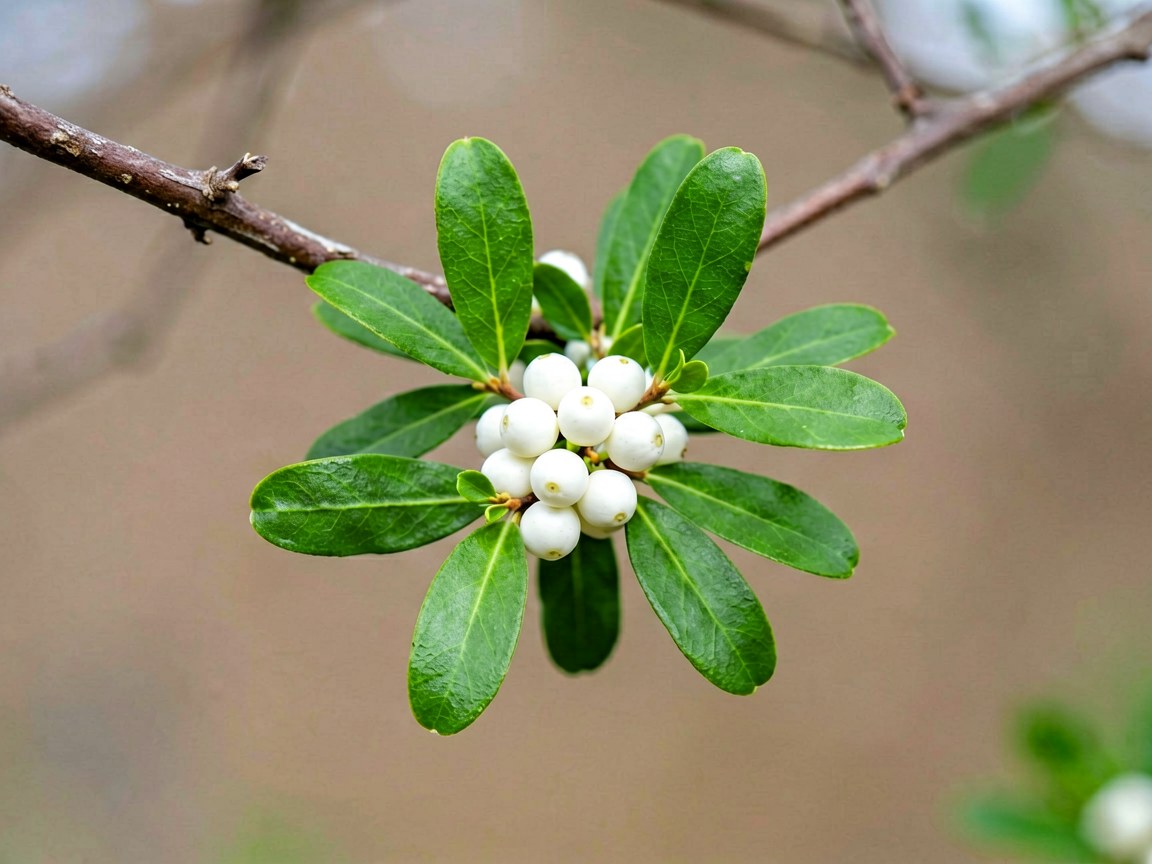
Viscum album | Mistletoe
Introduction
Mistletoe (Viscum album) is an evergreen shrub that grows not in soil but high in the branches of trees, forming distinctive spherical clumps that stay green through winter when the host tree is bare. It is a hemiparasite: it makes its own food in its green leaves but draws water and minerals from the tree it grows on. Famous for its role in midwinter traditions, mistletoe is also a keystone species in orchards and woodland, supporting specialised insects and birds.
Taxonomy
Viscum album belongs to the family Santalaceae—the sandalwood family—within the order Santalales, a group rich in parasitic plants. It is the only mistletoe native to Britain and much of Europe, though many related species occur elsewhere. The genus name comes from the Latin for “sticky birdlime,” and the species name album refers to its white berries. Like other green plants it carries out Photosynthesis, which is why it is only a partial parasite rather than a full one.
Physical Characteristics
Mistletoe forms a rounded, densely branched bush 30–100 cm across, anchored into a tree branch. Its stems are smooth, green, and repeatedly forked into pairs. The leaves are opposite, leathery, narrow and strap-shaped, 2–8 cm long, yellowish-green and evergreen. Small, inconspicuous yellow-green flowers open in early spring, and the female plants then produce round, waxy white berries about 1 cm across, filled with extremely sticky pulp.
Habitat
Mistletoe grows on the branches of broadleaf trees, most often apple, poplar, lime, hawthorn, willow, and maple. Because it needs plenty of light, it is most visible in open-grown trees such as orchard apples, parkland limes, and roadside poplars rather than in dense closed woodland. Its distribution is closely tied to the birds that spread it, and it is commonest in traditional orchards and old parkland in parts of western and central Europe.
Diet
Mistletoe is a hemiparasite, which means it both feeds itself and steals. Its green leaves photosynthesise and manufacture sugars, but it cannot take up water and minerals from soil, so it sends modified roots called haustoria into the host tree’s branches to tap its water and nutrients. A light infestation does little harm, but a heavy one can starve the host branch beyond the point of attachment.
Reproduction
Male and female flowers grow on separate plants, so both must be present for berries to form. The small flowers are pollinated by insects, chiefly flies and bees, in early spring—unusually early for a European plant. The white berries ripen in winter and are eaten by birds, above all the mistle thrush, which is named for its fondness for them. The sticky seed is wiped onto a branch or passes through the bird, glues itself in place, and sends a root into the bark.
Conservation
Mistletoe is not globally threatened and in some regions, including southern and western Britain, it has become notably more common. Its fortunes track those of traditional orchards and old parkland, both of which have declined, so conserving mature, open-grown host trees and the mistle thrushes that disperse it is the best way to sustain it. In some places it is protected, and cutting it from wild trees is restricted.
Fun Facts
- Its English name comes from “mistel” (dung) and “tan” (twig)—because it grows from seeds deposited in bird droppings.
- The berries are so sticky that birds often wipe the seed off their beaks onto a branch to get rid of it.
- The mistle thrush is named after mistletoe and is one of its most important seed dispersers.
- Mistletoe is evergreen, so it is most conspicuous in winter when its host tree is bare.
- Its tradition of midwinter kissing is a comparatively recent custom; the plant was revered by the Druids long before that.
[…] plant shares the order with the Mistletoe of northern Europe. That plant stays green all year. Its berries are white and sticky. Our plant is […]