 By st20113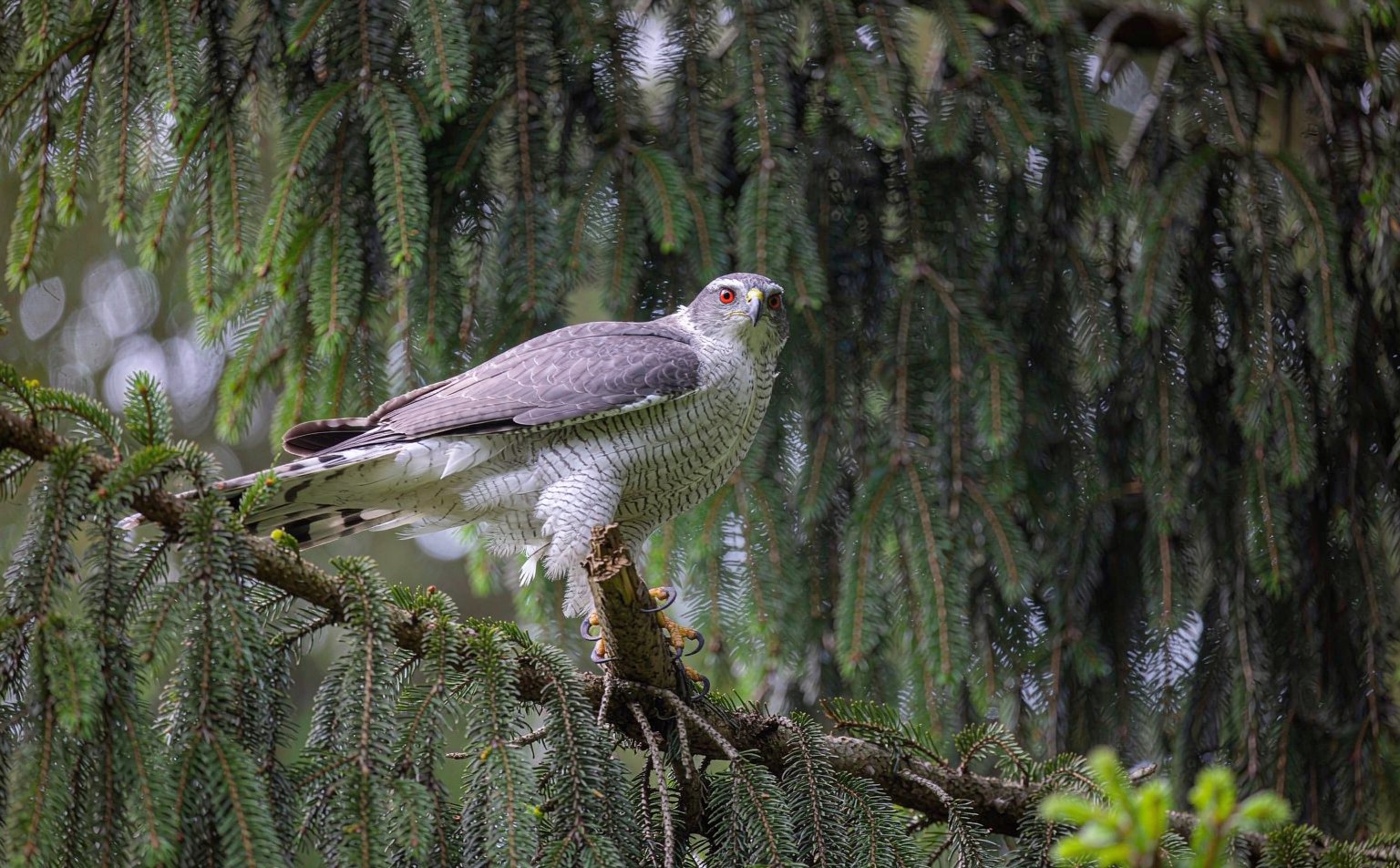
Accipiter gentilis | Northern Goshawk
Introduction
The Northern Goshawk (Accipiter gentilis) is a powerful, secretive forest raptor and the largest of the Eurasian accipiters, a group of short-winged hawks built for explosive flight through woodland. With its steely gaze, barred underparts, and relentless hunting style, it has long been revered by falconers and feared by the birds and mammals of the forest canopy. The goshawk is a bird of mature woods and broken woodland, where it combines speed, agility, and strength to take prey that many other raptors cannot.
Across its vast range, from the forests of North America and Europe across Siberia to Japan, the goshawk occupies a similar ecological role wherever broad-leaved and coniferous woodland predominates. In Europe it recovered strongly through the late twentieth century after decades of persecution and pesticide-related decline, and it now breeds again in many regions from which it had vanished.
As an apex predator of the forest, the goshawk helps regulate populations of its prey and shares the upper canopy with other hunters such as the golden eagle, though the two rarely compete directly because of their different habitats and hunting methods.
Taxonomy
The Northern Goshawk was first described by Carl Linnaeus in 1758 and is the type species of the genus Accipiter, the true hawks, which includes the sparrowhawks and many similar woodland raptors worldwide. Its scientific name reflects its status: Accipiter is Latin for “hawk,” and gentilis means “noble” or “gentle,” a name bestowed because the bird was considered worthy of gentlemen and falconers.
Several subspecies are recognized across the Northern Hemisphere, varying mainly in size and plumage tone, with northern birds generally larger and paler than those from warmer regions. The widespread Eurasian form intergrades with the North American goshawk, and most authorities treat the species as a single Holarctic taxon rather than splitting it regionally.
Molecular work places the accipiters within the family Accipitridae, alongside the buzzards, harriers, and eagles, and confirms the close relationship between the goshawk and the smaller sparrowhawks of the genus Accipiter. Their shared body plan, a long tail and rounded wings for maneuvering through trees, marks them as specialists of the forest interior.
Physical Characteristics
The Northern Goshawk is a large, robust hawk, with females considerably larger than males, a common pattern among raptors. Females typically measure 58 to 64 centimeters in length with a wingspan of 108 to 127 centimeters and a weight of about 0.9 to 1.4 kilograms, while males are roughly a third smaller. The adult is slate-grey above with finely barred grey underparts, a broad dark head, and a striking white eyebrow stripe above fierce red eyes.
The wings are relatively short and rounded, and the tail is long and banded, adaptations that let the bird twist and accelerate through dense timber. The legs are thick and heavily feathered, and the talons are long and formidable, built for seizing and holding struggling prey. In flight the goshawk appears powerful and direct, often crossing open ground with a few deep wingbeats followed by a glide.
Juveniles are quite different in appearance, clad in brown plumage with streaked, rather than barred, underparts and yellow eyes that darken to red with age. The bird’s bulk and dark cap distinguish it from the smaller Eurasian sparrowhawk, with which it is sometimes confused at a distance, but the goshawk’s greater size and heavier build are usually evident on closer view.
Habitat
Goshawks are birds of extensive woodland, preferring a mix of mature trees for nesting and hunting and more open patches that allow the birds to pursue prey. They use both coniferous and broad-leaved forests and are particularly associated with older stands that provide tall nest trees, dense cover, and abundant bird and mammal life, though they also hunt along forest edges, rides, and adjoining farmland.
The key requirements are seclusion during the breeding season and enough prey to feed a hungry brood. Pairs defend large territories centered on one or more nests, which are substantial structures of sticks placed high in a fork near the trunk of a large tree and reused and rebuilt over many years.
Although fundamentally a forest species, the goshawk will venture into more open country when hunting, and in some regions it has adapted to parks, large gardens, and wooded urban fringes. Its presence is often a sign of a healthy, structurally diverse woodland, since it needs both cover for ambush and enough prey to sustain a territory.
Diet
The Northern Goshawk is a versatile predator whose diet shifts with the seasons and the availability of prey, taking mainly medium-sized birds and mammals. Birds such as grouse, pigeons, corvids, and thrushes are important, and the hawk is fast and agile enough to catch them in flight or by a sudden dash from a perch, while mammals including rabbits, squirrels, and blackbirds supplement the diet, especially in winter.
The goshawk hunts chiefly by surprise, using cover to approach and then exploding into a short, blistering chase, its long tail acting as a rudder through the trees. It is powerful enough to overpower prey larger than itself, and where gamebirds are abundant these can form a major part of the diet, a fact that has sometimes brought the species into conflict with gamekeepers.
In lean periods the hawk may take a wider range of prey, including waterfowl, reptiles, and carrion, and it caches surplus food in the branches near the nest. This dietary flexibility, together with its mastery of the woodland environment, allows the goshawk to thrive across a broad sweep of northern forest.
Reproduction
Breeding begins in late winter or early spring, when established pairs renew their bond through soaring displays and mutual calling around the territory. The female lays two to four eggs in the large stick nest, and she alone incubates for about 35 to 38 days while the male brings food, a division of labor typical of raptors.
The chicks hatch asynchronously and are brooded and fed by the female, with the male supplying prey, though as they grow both parents hunt. The young fledge at roughly six to seven weeks but remain dependent on the adults for several more weeks, learning to hunt among the trees before dispersing to find their own territories.
Goshawks usually breed at two to three years of age and may live for a decade or more in the wild. Because they invest heavily in a small number of young and defend a substantial territory, their breeding success is closely tied to prey abundance, and poor years see fewer fledged chicks, keeping the population responsive to the condition of the forest.
Conservation
The Northern Goshawk suffered severe declines across Europe during the nineteenth and twentieth centuries from shooting, trapping, and the effects of organochlorine pesticides that reduced reproductive success. By the mid-twentieth century it had been eliminated from much of Britain and many parts of central Europe, surviving mainly in remote forests.
Strong legal protection, the banning of the most harmful pesticides, and the recovery of mature woodland have allowed a remarkable comeback, and the species now breeds across much of its former range and has even recolonized countries where it had been lost. Its recovery is often cited alongside that of other protected raptors as a conservation success.
Ongoing pressures include illegal persecution in some intensive game-management areas, collisions with vehicles and structures, and the loss of suitable nesting woodland to fragmentation. Because the goshawk is long-lived and slow to reproduce, the protection of large, quiet forests and the enforcement of wildlife law remain the most important measures for securing its future alongside the golden eagle and other recovered European raptors.
Fun Facts
- The goshawk’s name comes from the Old English for “goose hawk,” a nod to its ability to take surprisingly large prey.
- Females can be up to a third larger than males, one of the most pronounced size differences among European birds of prey.
- The bird is a favorite of traditional falconry and has been trained for hunting for well over a thousand years.
- A goshawk can accelerate through a dense thicket at full speed without visibly slowing, threading gaps that seem impossibly narrow.
- Pairs often maintain several nests within a territory and may switch between them from year to year.