 By st20113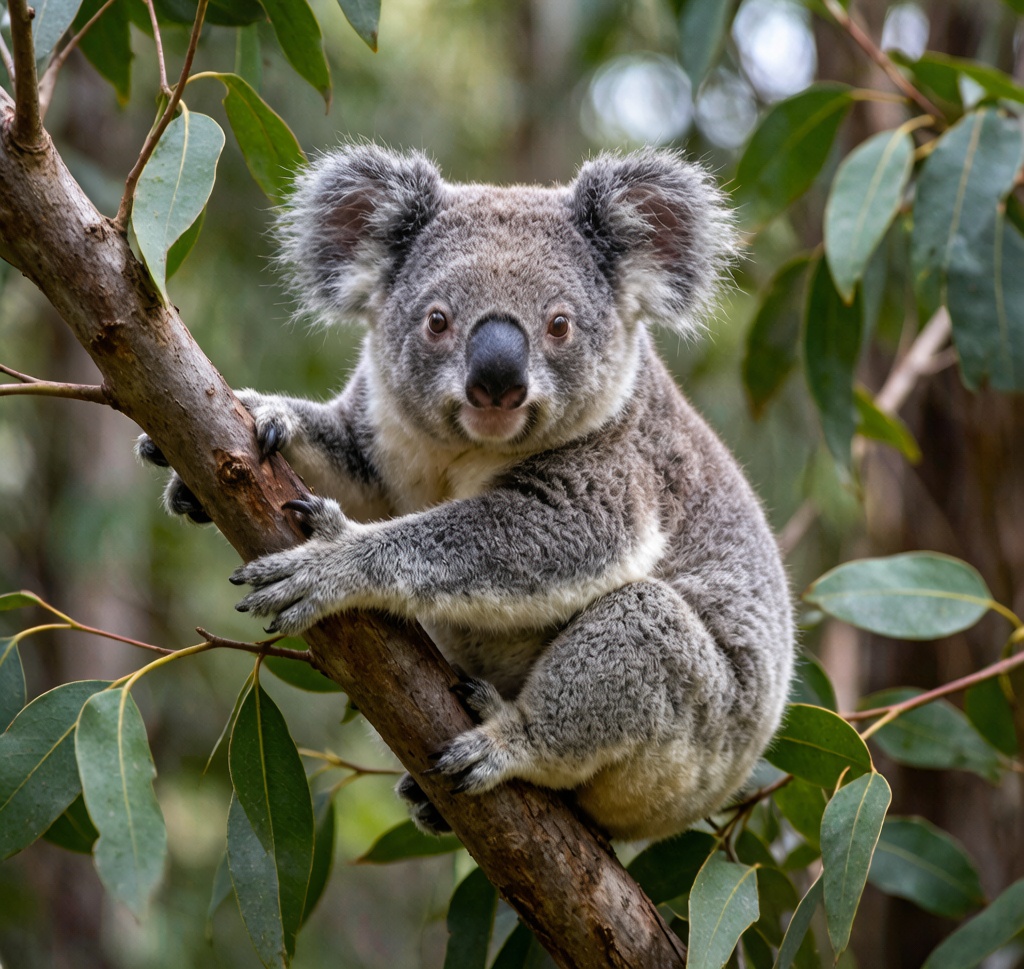
The koala (Phascolarctos cinereus) is one of Australia’s most iconic and beloved marsupials — a nocturnal tree-dweller whose round, fluffy body, large spoon-shaped ears, and placid expression have made it a symbol of the unique and ancient Australian bush. Despite their teddy-bear appearance, koalas are not bears at all but marsupials — mammals that carry their young in a pouch. Found throughout the eucalypt forests and woodlands of eastern and southern Australia, the koala is a highly specialized feeder, surviving almost exclusively on the leaves of certain eucalyptus species, which are toxic to most other animals. Each koala’s survival depends on access to quality eucalyptus forest, and as Australia’s bushland continues to shrink under the pressures of agriculture, development, and climate change, the koala has become an increasingly important indicator of forest health — a “canary in the coal mine” for the eucalypt ecosystems that define the Australian landscape.
## Physical Characteristics
The koala has a stocky, thickset body measuring 60 to 85 centimeters in length, with males significantly larger than females. Males weigh 6 to 12 kilograms, while females weigh 4 to 8 kilograms. The fur is thick and woolly, providing insulation against both heat and cold, and ranges in color from grey to reddish-brown depending on the region. The underside of the body, inner ears, and chin are whitish. The ears are large, rounded, and heavily fringed with long, creamy-white fur on the inner surfaces. The nose is large, black, and leathery — a defining feature of the species. Koalas have strong, clawed forelimbs and hindlimbs adapted for climbing, with two opposable digits on the front paws and a clawless opposable toe on the hind foot. The pouch opens backward, a characteristic of burrowers and climbers that prevents joeys from falling out.
## Habitat and Distribution
Koalas are found in the eucalypt forests and woodlands of eastern and southeastern Australia — from Queensland through New South Wales, Victoria, and into South Australia, as well as on some coastal islands including Kangaroo Island. They require two critical habitat elements: eucalyptus trees for food and shelter, and proximity to reliable water sources. Individual koalas occupy a home range that overlaps with the ranges of several other koalas. Within this range, they select specific “core” trees that provide the best-quality leaves and offer shelter from wind, rain, and predators. Koalas do not drink water frequently, obtaining most of their moisture from eucalyptus leaves, though they will drink from ground water sources during heat stress events.
## Behavior and Diet
Koalas are primarily nocturnal and crepuscular, sleeping for up to 20 hours per day to conserve energy — a metabolic strategy necessitated by the low nutritional value of their eucalyptus leaf diet. They feed and move primarily at night, climbing through the canopy to select leaves from specific trees. Eucalyptus leaves contain compounds called tannins and essential oils that are toxic to most animals, but koalas have evolved specialized detoxification mechanisms in their liver and an extremely long caecum — a digestive organ that hosts bacteria capable of breaking down these compounds. Despite their sluggish reputation, koalas can climb rapidly when threatened and are capable swimmers.
## Reproduction
Koalas breed once per year, with mating typically occurring between September and February. After a gestation of approximately 35 days, the female gives birth to a single, extremely underdeveloped joey — blind, hairless, and weighing less than one gram. The joey immediately crawls into the mother’s pouch, where it attaches to a teat and remains for approximately six to seven months. After emerging from the pouch, the joey rides on its mother’s back or clings to her belly, continuing to nurse for several more months before becoming independent. Sexual maturity is reached at approximately three to four years of age for females and four to five years for males. Wild koalas typically live 10 to 15 years.
## Conservation
The koala is classified as Endangered in New South Wales, Queensland, the Australian Capital Territory, and South Australia on the IUCN Red List. The species faces multiple, compounding threats including habitat loss and fragmentation, climate change (which is causing more frequent and severe droughts and heatwaves), disease (particularly chlamydia, which causes blindness and infertility), vehicle strikes, and dog attacks. Conservation efforts include the protection and restoration of koala habitat, the creation of wildlife corridors linking fragmented forest patches, wildlife hospitals and rehabilitation programs, and research into chlamydia vaccines.