 By st20113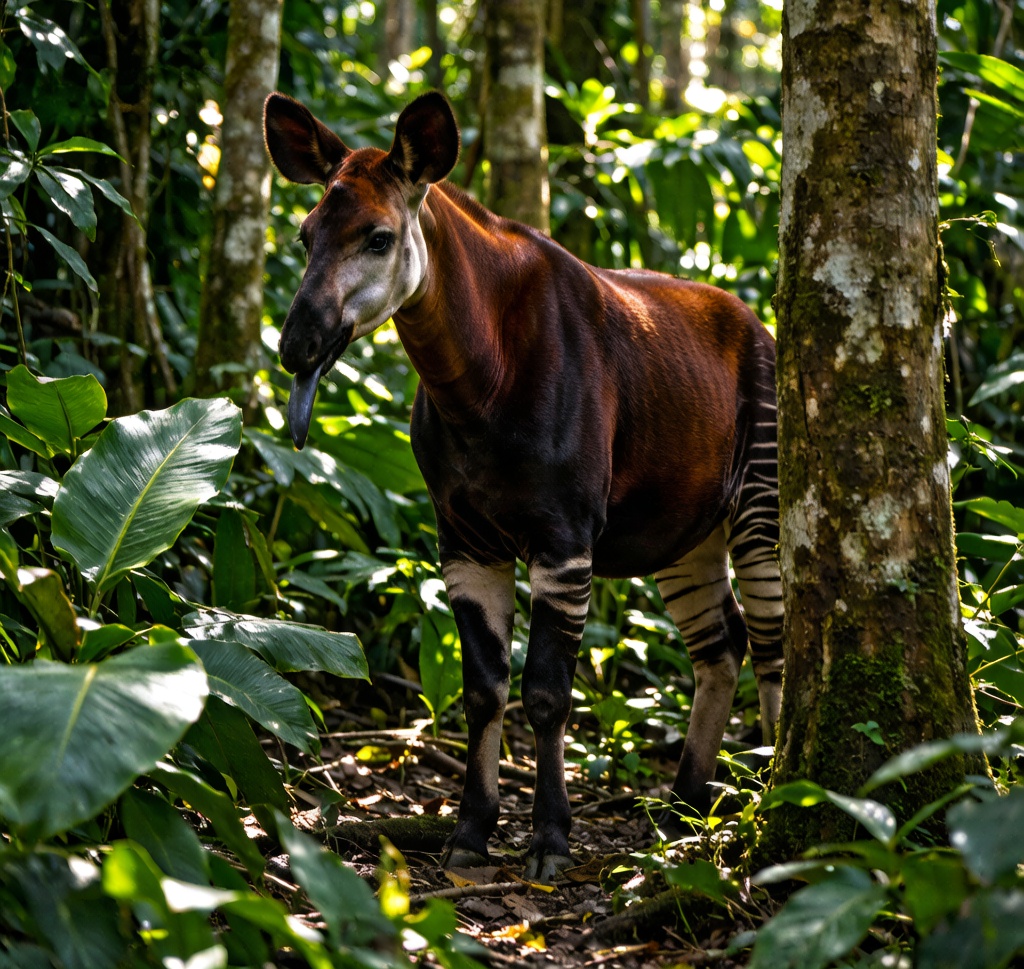
The okapi (Okapia johnstoni) is one of the most remarkable and elusive large mammals on Earth — a striking forest-dwelling relative of the giraffe, endemic to the dense, humid rainforests of the Democratic Republic of the Congo in central Africa. For decades after its initial discovery by Western science in 1901, the okapi remained shrouded in mystery, its remote habitat and secretive habits making it one of the last large mammals to be described by scientists. The okapi’s most striking feature is its unique coloration: a velvety reddish-brown coat over most of its body, contrasted with bold black-and-white horizontal stripes on its hindquarters and upper legs — a pattern so distinctive that early naturalists initially believed the animal to be a hybrid of giraffe and zebra.
## Physical Characteristics
The okapi is a large, sturdy ungulate measuring 1.5 to 2.0 meters in height at the shoulder and 2.0 to 2.5 meters in length, with males weighing 200 to 350 kilograms and females slightly larger. Its body is covered in short, dense, velvety fur that is a rich reddish-brown on the neck, back, flanks, and face. The hindquarters and upper legs are patterned with bold, irregular horizontal stripes of black and white — a striking contrast reminiscent of a zebra’s stripes, though the two species are not closely related. This pattern is thought to provide camouflage in the dappled light of the forest understory, breaking up the animal’s outline and making it harder for predators to detect. The legs below the knees and hocks are dark grey to black, as are the ears. The okapi’s head is elongated, with a long, prehensile tongue — dark grey or black and up to 45 centimeters long — used for grasping leaves and stripping bark from trees. Males possess short, knob-like horns called ossicones, covered in skin, which grow from the frontal bones of the skull and are used in ritualized combat between males. Females lack horns but may have small bony bumps.
## Habitat and Distribution
The okapi is endemic to the Democratic Republic of the Congo, where it inhabits the dense, humid lowland and submontane rainforests of the northeastern and eastern regions. Its range is centered on the Ituri Forest, but it is also found in adjacent forested areas and the Virunga National Park. The okapi is a habitat specialist, preferring primary forest with a dense understory of shrubs and small trees, along with forest clearings and riverine gallery forests. It avoids open areas, dense swamp forests, and disturbed or secondary growth habitats. The species’ secretive nature and the inaccessibility of its habitat have made it one of the most difficult large mammals to study in the wild.
## Behavior and Diet
The okapi is primarily diurnal, though it may be active at night during periods of bright moonlight. It is a solitary and highly territorial animal, with males and females coming together only for mating. Adults establish and defend large home ranges, marked by scent glands on the feet and by scent-marking with urine. The okapi is a browser, feeding on a wide variety of leaves, buds, twigs, and fruits from over 100 different plant species, including ferns, fungi, and even some trees that are toxic to other animals. Its long, prehensile tongue allows it to grasp and pull down vegetation from branches and to strip leaves from stems with great precision. The okapi’s gastrointestinal tract is adapted to efficiently digest fibrous plant material, and like giraffes and other ruminants, it chews cud to extract maximum nutrition.
## Reproduction
Okapi females give birth to a single calf after a gestation period of approximately 14 to 15 months. Newborn calves are able to stand within 30 minutes of birth but spend most of their first two months of life hidden in a secluded nest, a behavior known as “hiding.” During this period, the mother visits the calf to nurse, calling it with low-frequency sounds that are inaudible to most predators. This strategy minimizes the calf’s exposure to predation by leopards, the okapi’s primary natural predator. After emerging from hiding, the calf remains with its mother for approximately six to 12 months before becoming independent. Sexual maturity is reached at two to three years of age. Wild okapis are thought to live 15 to 20 years.
## Conservation
The okapi is classified as Endangered on the IUCN Red List. Its population is estimated at approximately 10,000 to 35,000 individuals, though exact numbers are difficult to determine due to its elusive nature and remote habitat. Major threats include habitat loss due to logging and human settlement, poaching for meat and skins, and civil unrest in the Democratic Republic of the Congo. The species is protected in several national parks and reserves, including the Okapi Wildlife Reserve — a UNESCO World Heritage Site established specifically to protect the okapi and its forest habitat.