 By st20113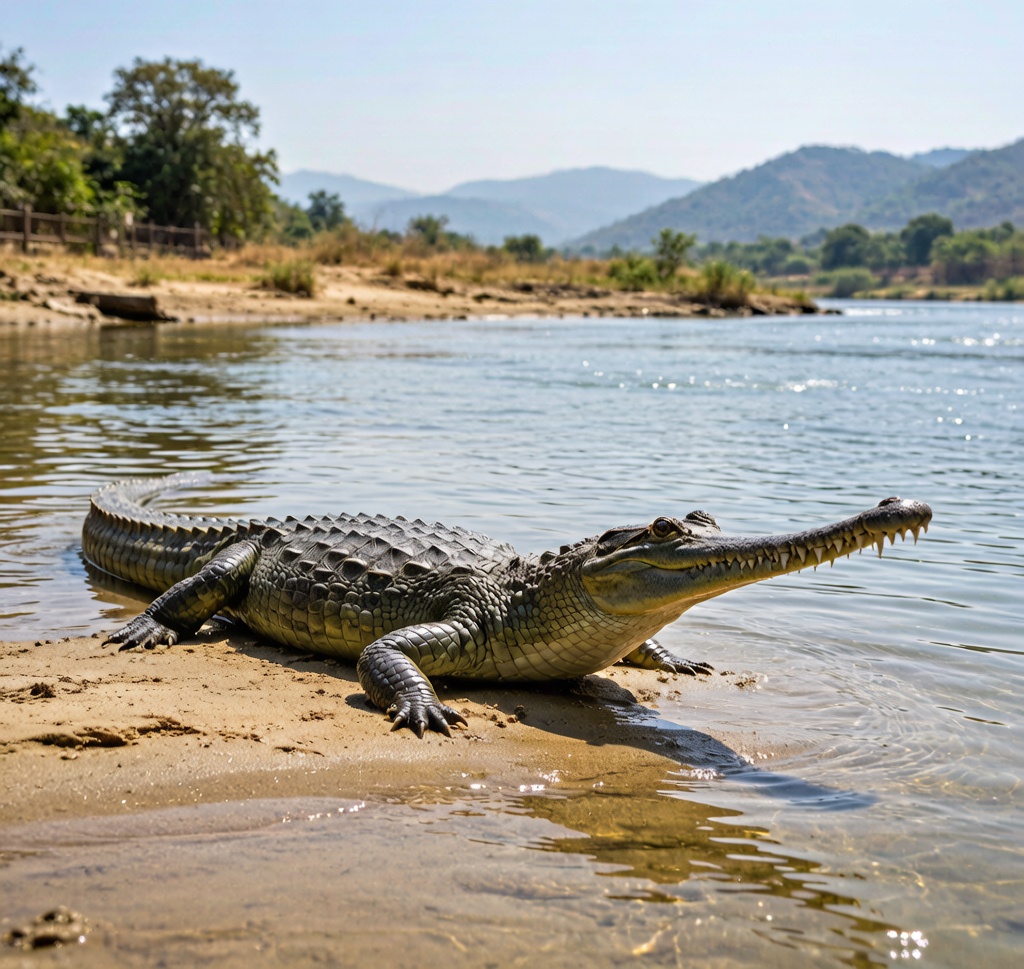
The gharial (Gavialis gangeticus) is one of the most distinctive crocodilians on Earth — an ancient, river-dwelling reptile instantly recognizable by its extraordinarily long, slender, and fragile-looking snout, lined with dozens of needle-sharp teeth perfectly adapted for catching fish. Endemic to the major river systems of the Indian subcontinent — primarily the Ganges, Brahmaputra, and their tributaries — the gharial is the sole surviving member of the family Gavialidae and represents a lineage that has persisted for over 50 million years. Once abundant across its range, the gharial has undergone a catastrophic decline, leaving it as one of the most endangered crocodilians in the world, with fewer than 1,000 individuals remaining in the wild. Its specialized morphology — with a long, narrow snout and weak jaw musculature — makes it an extraordinarily efficient fish trap but highly dependent on pristine riverine habitats with undisturbed sandbanks for nesting.
## Physical Characteristics
The gharial is one of the largest crocodilians, with males reaching lengths of 5 to 6 meters and occasionally exceeding 7 meters. Its most distinctive feature is its extremely long, narrow, and laterally flattened snout, or rostrum, which constitutes approximately 75 percent of the total skull length. This elongated snout is lined with 106 to 110 sharp, interlocking teeth — 48 to 50 in the upper jaw and 52 to 58 in the lower — which are ideal for seizing fast-moving fish but poorly suited for catching larger prey. The bony nasal opening is located far back from the tip of the snout. Males possess a distinctive bulbous, cartilaginous growth called a ghara, or narial ornament, at the tip of the snout, which grows progressively larger with age and is thought to play a role in vocalization and mating displays. The body is olive-green to grey, covered in bony, keeled scales, with dorsal scutes arranged in transverse rows. The tail is long and laterally compressed, providing powerful propulsion for swimming.
## Habitat and Distribution
The gharial is found exclusively in the major river systems of the Indian subcontinent. Its historical range encompassed the Ganges, Brahmaputra, Indus, and Mahanadi river systems, including numerous tributaries in India, Nepal, Bangladesh, and Pakistan. Today, the species persists in only a fraction of its former range, with the largest populations found in the Chambal River in India and the Girwa River in Nepal. Gharials inhabit deep, fast-flowing rivers with clear water, rocky bottoms, and abundant fish. They are almost entirely aquatic, rarely venturing far from the water, and depend on undisturbed sandbanks for basking and nesting. The degradation of riverine habitats through sand mining, dam construction, irrigation projects, and pollution has been a primary driver of the species’ decline.
## Behavior and Diet
The gharial is the most aquatic of all crocodilians, spending the vast majority of its time submerged in deep river channels. It is an expert swimmer, propelling itself through the water with powerful lateral sweeps of its long, laterally compressed tail. Unlike other crocodilians, the gharial cannot walk effectively on land for any distance, instead using a distinctive “belly slide” to move from water to basking sites. It is a specialized fish-eater, its long, narrow snout minimizing water resistance when snapping sideways at passing fish. It may also consume small crustaceans and insects. Gharials bask in groups on sandbanks during the cooler months, often with individuals stacked together in close proximity. Males produce a distinctive buzzing vocalization through the ghara, thought to attract females and repel rival males.
## Reproduction
Gharials breed during the dry season, with mating occurring in December to January. Females lay their eggs — typically 30 to 50 per clutch — in an excavated nest burrow in a sandy bank, between February and April. The eggs, among the largest of any crocodilian species, weigh approximately 150 to 200 grams each and incubate for approximately 60 to 80 days. Like all crocodilians, the sex of hatchlings is determined by nest temperature, with higher temperatures producing males. The mother provides minimal parental care after hatching, though some degree of nest protection has been observed. Hatchlings are approximately 35 centimeters in length and grow rapidly, reaching sexual maturity at approximately 10 years of age for males and 8 years for females. Wild gharials can live 40 to 60 years.
## Conservation
The gharial is classified as Critically Endangered on the IUCN Red List, with fewer than 1,000 mature individuals remaining in the wild. The species experienced a catastrophic population crash of over 96 percent between 1946 and 2006, driven primarily by habitat loss, entanglement in fishing nets, and egg collection for consumption and traditional medicine. Major conservation initiatives, including captive breeding and head-starting programs in India and Nepal, have released thousands of juvenile gharials into the wild. The creation of protected areas along critical river stretches, community-based conservation programs, and efforts to reduce fishing-related mortality have contributed to a gradual, fragile population recovery in some areas.