 By st20113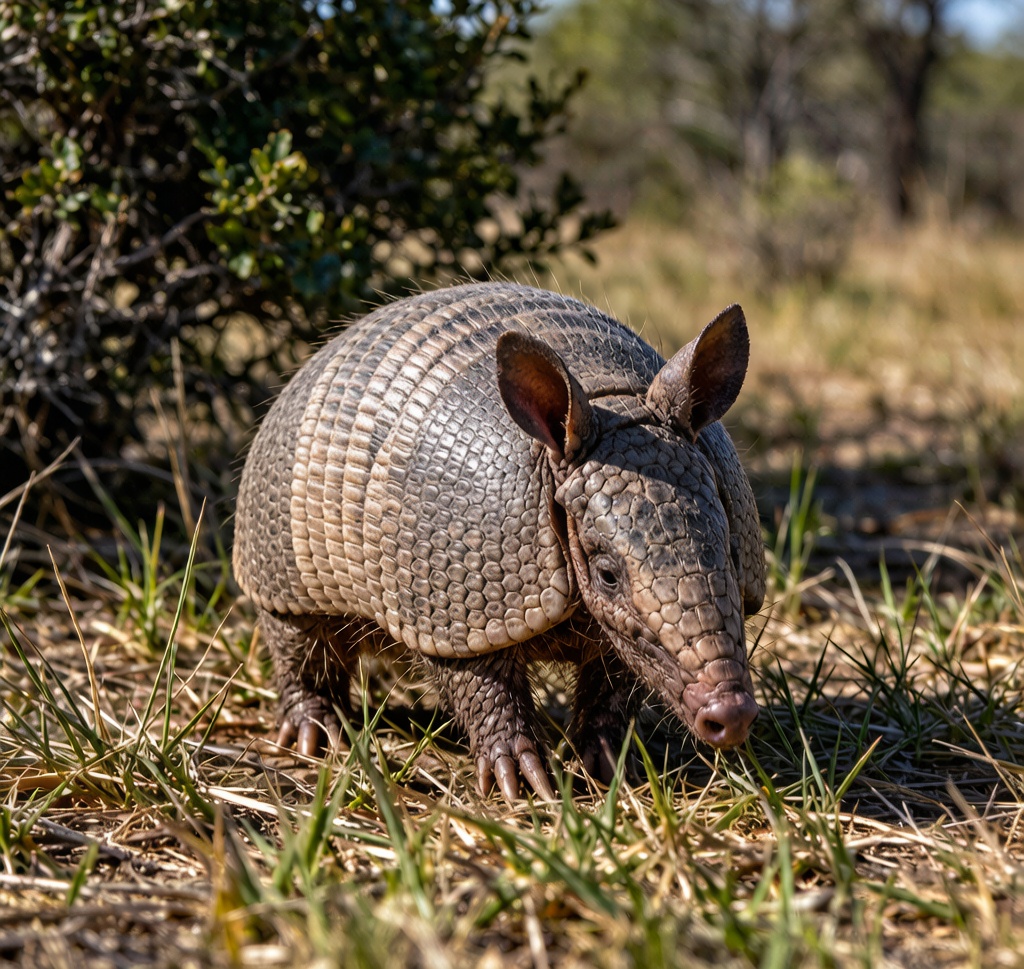
The nine-banded armadillo (Dasypus novemcinctus) is a distinctive medium-sized mammal native to the Americas, instantly recognizable by its unique protective armor of bony plates. As the most widespread and abundant of all armadillo species, it ranges from the southern United States through Mexico and Central America into northern Argentina. Its leathery, jointed carapace — composed of approximately 8 to 11 movable bands across its back — provides exceptional defense against predators while allowing sufficient flexibility for the animal to run and dig with remarkable agility. The nine-banded armadillo is an accomplished digger, using its powerful front claws to excavate burrows and root out insects and other invertebrates, its primary food source.
## Physical Characteristics
The nine-banded armadillo measures approximately 60 to 90 centimeters in total length, including a tail of 30 to 50 centimeters, and weighs between 3 and 9 kilograms. Its most distinctive feature is its protective armor — a series of large, bony scutes covered in keratin, forming a leathery, jointed carapace across its back. The carapace is typically greyish-brown to yellowish-white in color, with sparse hairs projecting from between the scutes. The head is relatively small and pointed, with large, upright ears and small eyes. The snout is elongated, equipped with a keen sense of smell used to locate buried insects. The forelimbs end in four robust, curved claws — the longest of which can exceed 6 centimeters — adapted for tearing open insect nests and excavating burrows. The hind feet have five smaller claws. The underside of the armadillo is covered in soft, sparse fur and lacks armor.
## Habitat and Distribution
The nine-banded armadillo is found across a vast range encompassing much of the southern United States, from Texas and Oklahoma eastward through the Gulf Coast states into Florida, and southward through Mexico, Central America, and northern South America into Argentina. It occupies a variety of habitats including woodlands, grasslands, scrublands, and even suburban areas, wherever soils are sufficiently soft for digging and insect prey is abundant. Armadillos are particularly fond of areas near water, such as streambanks, where they can find both food and moist soil for digging. The species has been expanding its range northward in the United States, likely facilitated by the absence of natural predators and its adaptability to human-modified landscapes.
## Behavior and Diet
The nine-banded armadillo is primarily nocturnal during the summer months in hot climates, but becomes increasingly diurnal in cooler seasons. It is a solitary forager, using its acute sense of smell to detect buried insects, larvae, and other invertebrates. Its diet consists primarily of beetles, ants, termites, and other insects, supplemented by earthworms, spiders, small reptiles, and occasionally bird eggs and carrion. The armadillo excavates its prey by rooting and digging with its powerful front claws, often leaving characteristic cone-shaped holes in the ground where it has fed. During the day, it rests in a burrow — a tunnel system that can extend 1 to 5 meters into the ground, lined with grass and leaves, and often located at the base of a tree, rock, or in a thicket. Armadillos are capable swimmers and can cross rivers by inflating their stomachs with air to increase buoyancy or by walking along riverbeds while holding their breath for up to six minutes.
## Reproduction
The nine-banded armadillo exhibits a remarkable reproductive strategy: females almost invariably give birth to four genetically identical quadrupplets — the result of a single fertilized egg splitting into four embryos. Mating occurs during a brief summer breeding season, and implantation of the fertilized egg is delayed until November. After a gestation period of approximately 120 days following implantation, the female gives birth in her burrow to four identical young. Newborn armadillos are born with soft, leathery skin that hardens into the adult armor over several weeks. They nurse for two to three months and remain with the mother for several more months before becoming independent. Sexual maturity is reached at approximately one year of age.
## Ecological Significance
The nine-banded armadillo plays an important ecological role as both predator and prey. By consuming large numbers of insects — particularly pest species such as fire ants and crop-damaging beetle larvae — it provides natural pest control in agricultural and suburban areas. Its burrows provide shelter for other species, including opossums, skunks, and various reptiles and amphibians. However, armadillos are also hosts for the bacterium Mycobacterium leprae, the causative agent of leprosy, and are the only known non-human reservoir for the disease. This has led to increased attention to their role in public health, though the risk of transmission to humans is low. The species is currently classified as Least Concern, as its population is large and expanding.