 By st20113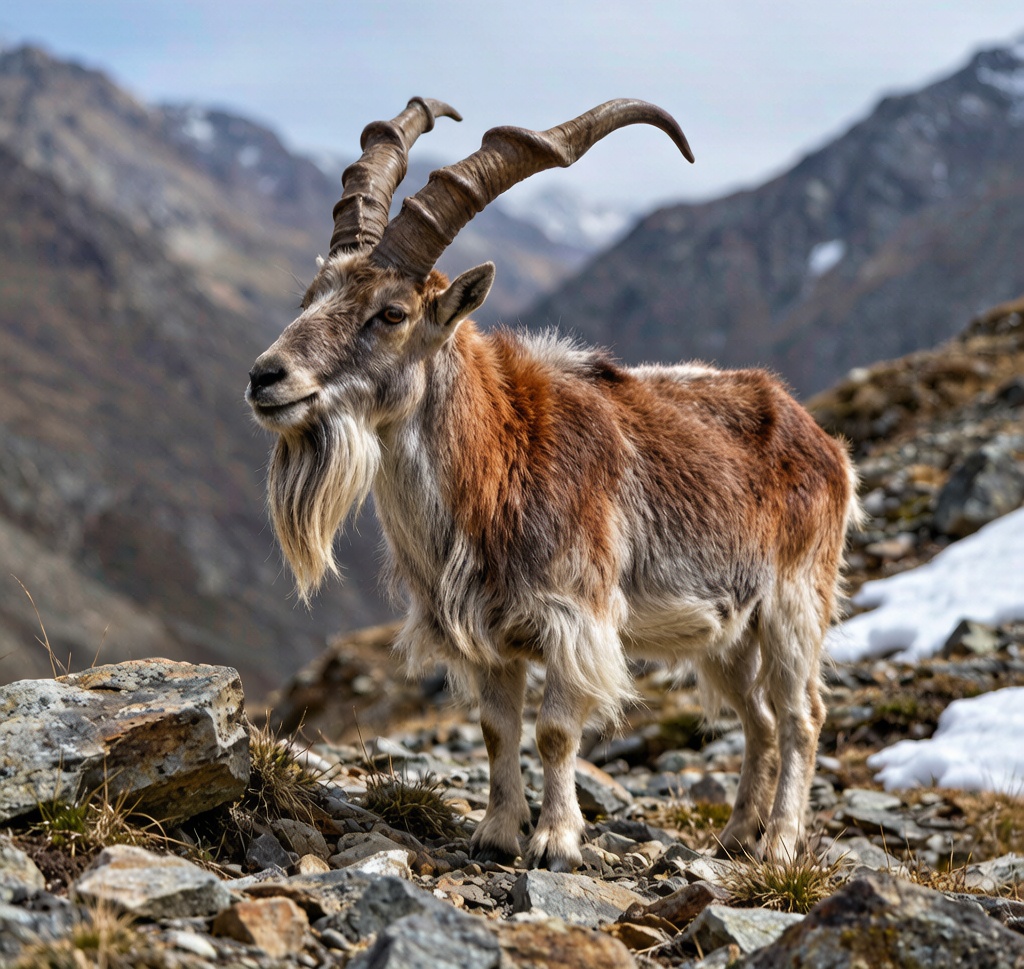
The markhor (Capra falconeri) is one of the most spectacular and largest members of the goat family, distinguished by its magnificent twisted horns and imposing presence. Native to the rugged mountains of Central Asia, the markhor inhabits the steep, arid slopes of the western Himalayas, the Karakoram, and the Hindu Kush, ranging across northeastern Afghanistan, northern Pakistan, southern Tajikistan, and southern Uzbekistan. The species’ name derives from the Persian words “mar” (snake) and “khor” (eater), a reference to local legends that markhors kill and eat snakes — though in reality they are strictly herbivorous. The markhor’s spectacular corkscrew horns — which can exceed 1.5 meters in length in males — make it one of the most prized trophies in the hunting world, a factor that has historically contributed to its decline but now, through regulated trophy hunting programs, provides an important source of conservation funding.
## Physical Characteristics
The markhor is a large, sturdy goat, standing 65 to 115 centimeters at the shoulder and weighing 32 to 110 kilograms, with males significantly larger than females. Its coat is coarse and shaggy, varying in color from light brown to reddish-grey, with a darker dorsal stripe and a lighter underbelly. In winter, the coat becomes longer and denser, particularly in males, which develop a long, flowing beard and a prominent mane of hair on the neck and chest. The legs are relatively short and sturdy, ending in large, concave hooves adapted for climbing on steep, rocky terrain. The markhor’s most striking feature is its horns: in males, these are long, thick, and spiraled, forming one or two complete twists depending on the subspecies. The horns of the Astor markhor (Capra falconeri falconeri) have wide, open spirals, while those of the straight-horned markhor (Capra falconeri jerdoni) are more tightly twisted. Female markhors have shorter, straighter horns, typically 20 to 40 centimeters long. Both sexes possess a distinctive beard, though it is more developed in males.
## Habitat and Distribution
The markhor inhabits rugged, mountainous terrain at elevations of 600 to 3,600 meters, preferring steep, arid slopes with sparse vegetation, open woodlands, and rocky cliffs. It is found in isolated populations across northeastern Afghanistan, northern Pakistan (particularly in Gilgit-Baltistan and Khyber Pakhtunkhwa), southern Tajikistan, and southern Uzbekistan. The species avoids dense forests and deep snow, favoring areas where it can graze on grasses, browse on shrubs and trees, and find shelter in caves and overhangs. Markhors are highly adaptable and can survive in extremely arid conditions, obtaining most of their water from vegetation and dew.
## Behavior and Diet
Markhors are primarily diurnal, with peak feeding activity in the early morning and late afternoon. They are agile climbers, capable of navigating near-vertical cliffs and rocky outcrops with remarkable sure-footedness. Their diet consists of grasses, herbs, leaves, shoots, and fruits, with a strong preference for browse from trees and shrubs such as oak, pine, juniper, and Pistacia species. During summer, markhors may ascend to higher elevations to access fresh grazing, descending to lower slopes in winter to avoid deep snow and find accessible forage. They are social animals, forming herds of females and their young, typically numbering five to 15 individuals, while adult males are either solitary or form small bachelor groups. During the breeding season, males join female herds and engage in dramatic rutting displays, including loud alarm calls, scent marking, and fierce horn-clashing battles with rival males.
## Reproduction
The markhor breeding season, or rut, occurs in late autumn and early winter (October to December). Males compete vigorously for access to females, engaging in intense head-butting contests that can last for hours. After a gestation period of approximately 135 to 170 days, females give birth to one or two (rarely three) kids in late spring or early summer (May to June). Kids are born in secluded locations and are able to stand and follow their mother within hours of birth. They nurse for four to six months and remain with their mother for up to one year. Sexual maturity is reached at 18 to 30 months, though males may not successfully breed until they are older and larger, typically at four to five years of age. Wild markhors can live 12 to 13 years.
## Conservation
The markhor is classified as Near Threatened on the IUCN Red List, with an estimated global population of approximately 6,000 mature individuals. Historically, the species declined dramatically due to uncontrolled hunting for meat and trophies, habitat loss, and competition with domestic livestock for forage. In recent decades, however, innovative community-based conservation programs — particularly in Pakistan — have enabled significant population recoveries. Trophy hunting programs, in which a limited number of permits are auctioned to international hunters, generate substantial revenue that is shared with local communities, providing financial incentives for markhor protection. This approach, combined with protected areas and anti-poaching efforts, has been credited with increasing markhor populations in several regions. Nevertheless, the species remains vulnerable to habitat degradation, illegal hunting, and climate change impacts on its mountainous habitat.
[…] representing an ancient lineage. Its closest living relatives among bovids include various Markhor and other caprines, but the saola’s lineage split off millions of years ago, leaving it as a […]
[…] such as the Nubian and Siberian ibex. The domestic goat shares the same genus, as does the imposing markhor of Central Asia. Genetic studies place the Alpine ibex within a cluster of Western Eurasian […]