 By Iris
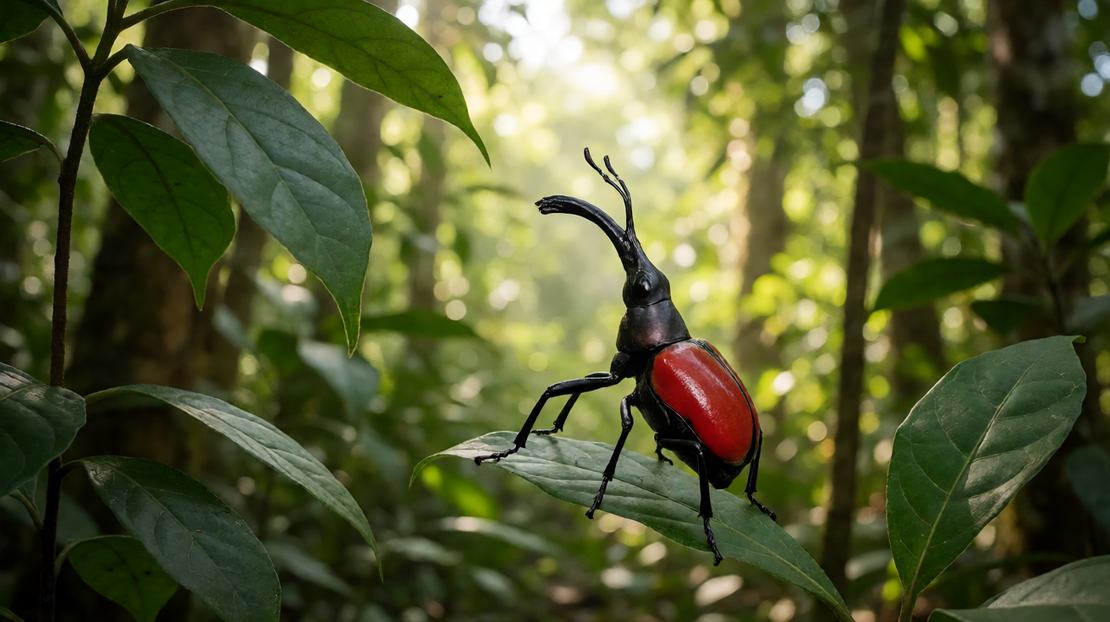
Trachelophorus giraffa | Giraffe Weevil
Species Profile · Attelabidae
Giraffe Weevil
A small beetle whose male carries a neck longer than its own body.
Not Evaluated
Body
Neck
Colour
Range
Young
Rating
Twenty millimetres of orange and black
A neck longer than the body
A male giraffe weevil carries a neck longer than the rest of its body. This neck is a plain tube of hard shell, with no branch and no horn. Females keep a short one. Both sexes wear bright red wing cases over a black body.
Rainforest in eastern Madagascar is the only home it has. Nobody outside the island sees it alive, although zoos have tried for decades. Length runs to about 2.5 cm, neck included. That size hides a fierce contest, since males use the neck as a lever and shove rivals off the leaf.
One male pushes another while a female watches. One male stays on the leaf, and the loser walks away with nothing.
Family tree
Attelabidae, the leaf rolling weevils
Workers name the species Trachelophorus giraffa, one of the leaf rolling weevils. Family Attelabidae is large, and most of its members roll leaves as well. Its closest kin here is the Great Capricorn Beetle, a long horned relative from Europe. Both are plant eaters, and both carry absurd extensions of the head.
Yet one uses its antennae and the other uses its neck. Workers described the weevil in 1860 from a handful of specimens sent from Madagascar, and the name has stood since. Some twenty species fill the genus, and all of them live on the island. Gene work has not sorted the group yet.
Some populations may be separate species, since the forests sit far apart. Naming is slow here, because few people collect the insects.
Attelabidae, the leaf rollers
How to tell one
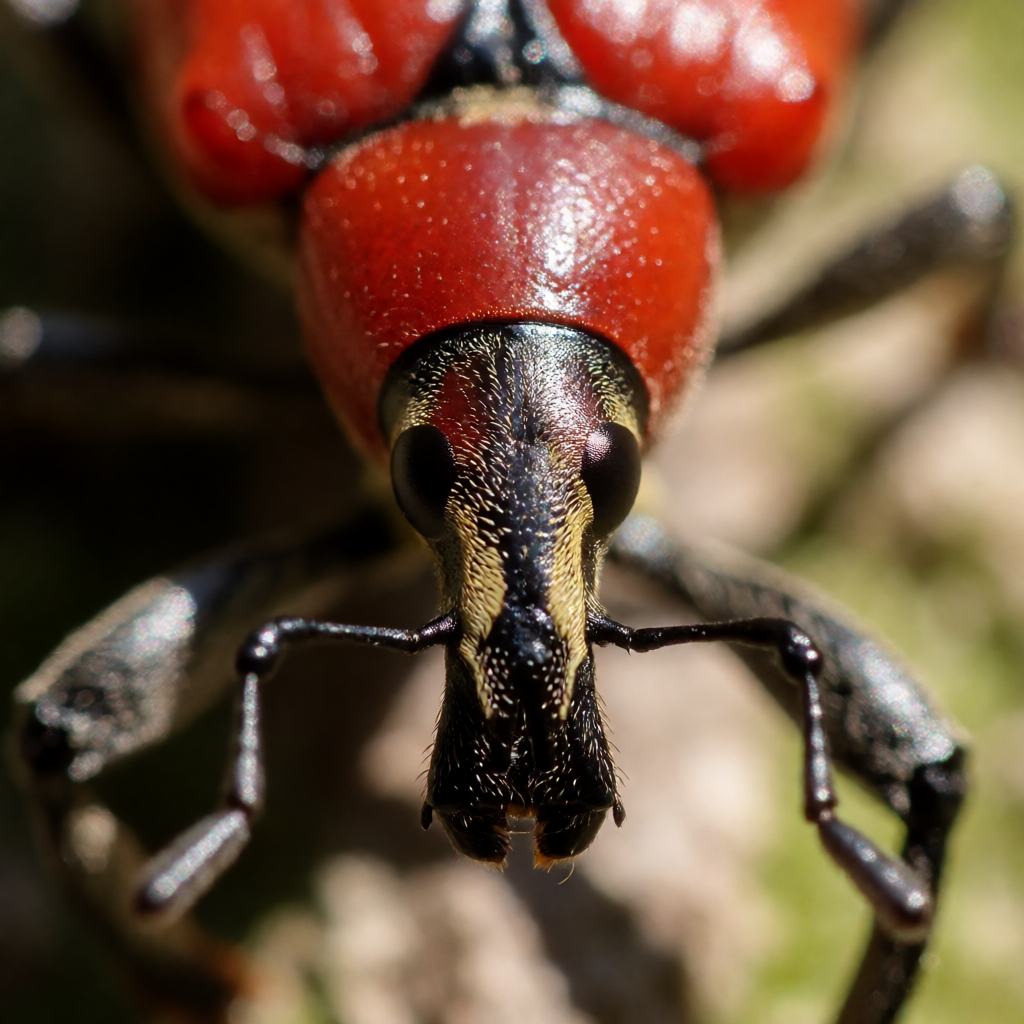
Body length reaches 2.5 cm. The neck adds much more. In males that neck runs two or three times the body length. Small head sits at the tip, with two short antennae.
Wing cases are scarlet. They shine in wet forest light. Legs are black and short, although the hooked feet grip a leaf well. The neck is not a horn, and it carries no muscle for fighting.
It works as a lever, so a male can lift a rival and shove him off the leaf without a bite. Females have a neck of normal length for a weevil. That difference makes the sexes easy to tell apart. Nothing about the red colour warns a predator, as far as anyone knows.
1
2
3
A neck built for wrestling
Where it lives
This insect lives in the eastern rainforest belt of Madagascar, and nowhere else. Wet forest suits it, since the host plant grows in clearings. Dichaetanthera shrubs provide both food and a nursery. Those shrubs spring up where a tree has fallen and light reaches the ground.
Adults stay on the host plant. They rarely fly far. Forest edges hold the densest groups. Clearings last a few years, and then the canopy closes.
The weevil must then find another patch, since its plant dies in shade. Roads split the forest into blocks, so a cleared gap can become a barrier that the insect never crosses. Nobody has measured how far one insect will travel.
Madagascar rain forest only
What it eats
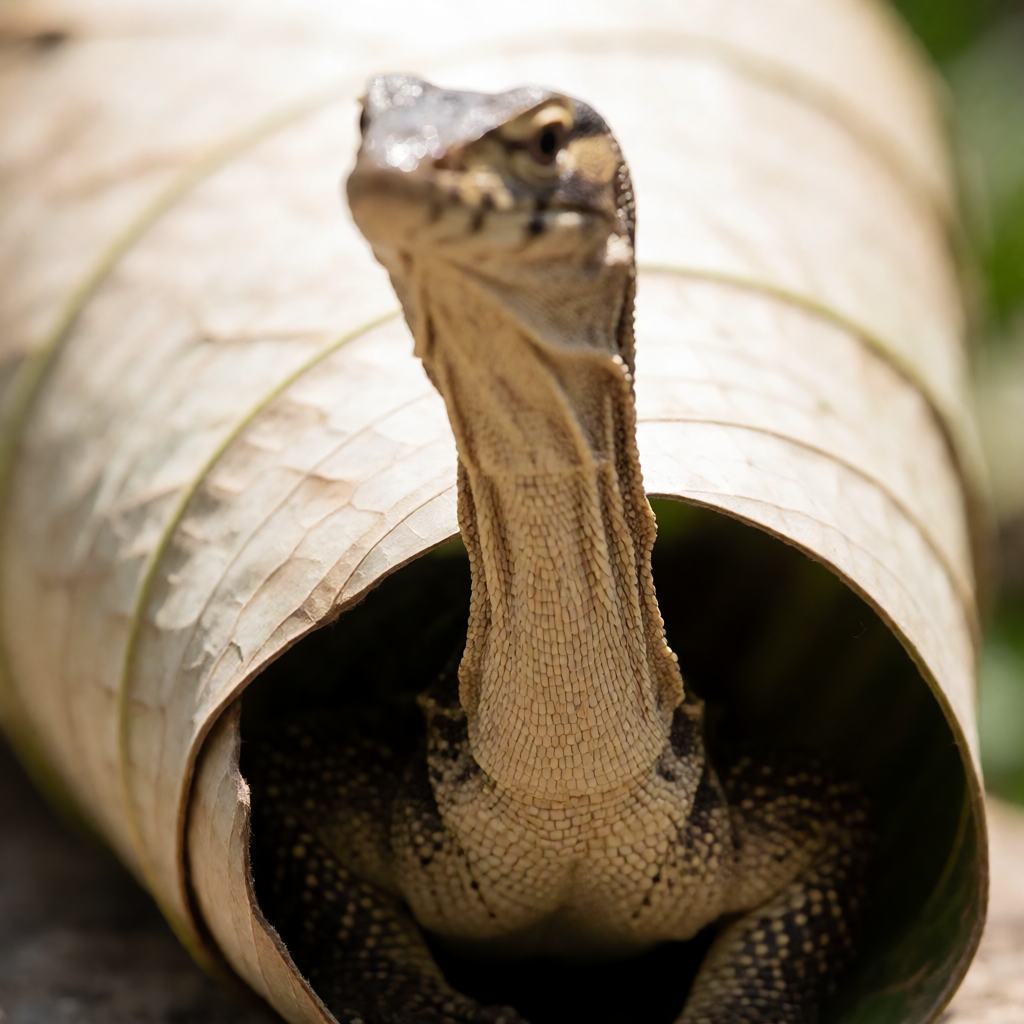
Adults chew the leaves of the host shrub. Feeding marks show as torn edges along a leaf, while the veins stay intact. Larvae eat the leaf they were born in. That leaf is rolled into a tube before the egg is laid.
She cuts the leaf along two lines first. She then folds the flap into a tight cylinder. One egg goes inside, and the tube becomes a cradle that keeps the larva moist and hidden. Larvae eat the walls, and they grow in the dark, safe inside the tube.
When the leaf dries, the tube drops to the ground. The insect then pupates in the soil, safe from the light.
Leaves, wood and one egg
The breeding cycle
Males gather on a leaf and fight for the space. Long necks win most of these contests, and the biggest male holds the leaf. The winner mates with the female nearby. She then begins the slow work of rolling a leaf.
Cutting takes an hour or more, and the work is slow because the leaf must stay whole. Rolling takes another, and the tube must stay tight. One female makes a single tube for a single egg, and she may build a dozen in a season. Nobody has watched the whole sequence in the wild.
Most of the story comes from a few careful observations. A pair may meet again, though nothing suggests a lasting bond.
Not Evaluated, and locally common
Conservation
No Red List entry covers the species. Forest loss is the main threat, since the eastern belt is being cut. Slash and burn clears land for rice and cattle, and the fire takes the understorey first. The host shrub depends on gaps, so it survives where forest is broken.
That habit helps the insect for a while. It fails when the gaps are too far apart. No breeding programme exists, and none is planned. Protected parks cover part of the range, though the eastern belt is still being cut.
Ecotourism gives local people a reason to keep the forest. A weevil with a long neck sells a picture, and that picture has value.
Side by side
How It Compares
| Trait | Giraffe Weevil | Great Capricorn Beetle |
|---|---|---|
| Length | 2 cm in the body, and the male neck adds another 2 cm to 3 cm | 2.5 cm to 5.5 cm, and the feelers alone match the body |
| Colour | black body with bright orange red wing cases | black brown shell that carries a grey blue bloom |
| Food | adult beetles strip young leaves, and larvae eat dead wood | larvae bore through oak bark and stay inside for years |
| Young | a female rolls a leaf into a tube and lays one egg inside | a female lays on bark, and the larva tunnels inward |
| Build | a long neck on the male, while the female stays short | feelers longer than the body, and no neck at all |
| Range | Madagascar only, and nowhere else on earth | Europe and western Asia, wherever old oaks stand |
Common misreadings
What People Get Wrong
- Many people assume the long neck helps feeding, yet the male uses it as a lever in fights. Two males swing their necks at each other, and the winner takes the branch.
- A common tale calls the species a crop pest, although it feeds on one wild plant. The female rolls a leaf around one egg, so the larva never leaves the tube.
- Guides say the neck grows on both sexes, yet only the male carries one. The female stays dull brown, since she spends her life inside rolled leaves.
Going further
Sources and Further Reading
Quick hits
Five things to remember
- Males have a neck longer than the body.
- Females have a short neck.
- A female rolls a leaf around one egg.
- The species lives only in Madagascar.
- Wing cases are bright red.