 By st20113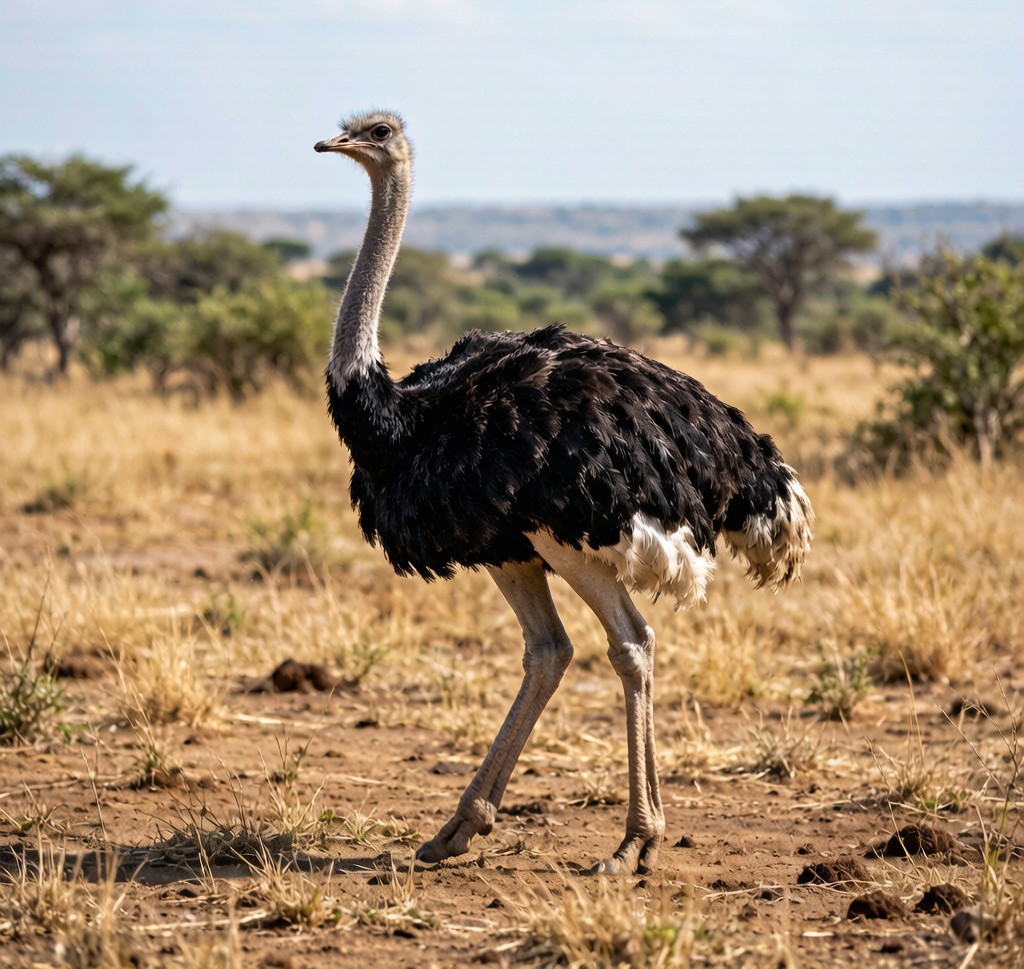
Overview
The Common Ostrich (Struthio camelus) is the largest and heaviest bird in the world – a magnificent, flightless giant that stands up to 2.8 meters tall and weighs as much as 160 kilograms. Found across the vast open savannas and semi-desert regions of sub-Saharan Africa, the ostrich is one of the most distinctive and iconic animals of the African continent, instantly recognizable by its extraordinary proportions: a massive, fluffy body covered in black-and-white plumage (in males) or greyish-brown plumage (in females), a long, sinuous neck that accounts for nearly a third of the bird’s total height, and a small, flattened head bearing a large, expressive dark eye and a distinctive broad, flat bill.
The ostrich’s legs – long, muscular, and covered in scales rather than feathers – are among the most powerful in the animal kingdom, capable of carrying the bird’s enormous weight at speeds of up to 70 kilometers per hour, making the ostrich the fastest-running bird and the fastest two-legged animal on Earth. Each powerful leg ends in a two-toed foot armed with a sharp, claw-like talon that serves as a formidable weapon: an adult ostrich kick is powerful enough to kill a lion. Despite its apparent simplicity, the ostrich’s anatomy represents a remarkable evolutionary adaptation to life on the open African plains.
Habitat and Social Behavior
The Common Ostrich inhabits the vast open savannas, grasslands, and semi-arid thorn scrub of sub-Saharan Africa, from Senegal in the west to Ethiopia in the east, and south to South Africa. Within this broad range, the species is most common in areas with scattered trees and bushes that provide shade and shelter, and where the open ground allows the bird to spot predators from a distance. Ostriches are highly nomadic within their home ranges, moving in response to seasonal rainfall patterns and the availability of food and water. The species can survive for long periods without water, obtaining most of the moisture it needs from the plants it eats.
Ostriches live in highly social groups called flocks, which can range in size from a few individuals to more than 100. The typical social structure involves a dominant breeding pair – the alpha male and his primary mate – surrounded by a harem of subordinate females and immature birds. The alpha male defends a territory and performs a remarkable courtship display in which he kneels before the female, inflates his neck, and swings his massive black-and-white tail feathers from side to side. After mating, all the females in the harem lay their eggs in a single communal nest – a shallow scrape in the ground – and the dominant pair takes primary responsibility for incubating the eggs and protecting the chicks.
Diet and Reproduction
The ostrich is primarily herbivorous, feeding on a wide variety of plant matter including grasses, leaves, seeds, fruits, and flowers, as well as occasional insects and small vertebrates. The bird’s diet varies seasonally: during the wet season it feeds mainly on fresh green vegetation, while during the dry season it relies more heavily on seeds, dry grasses, and plants with high water content. The ostrich has a highly efficient digestive system that allows it to extract maximum nutrition from fibrous plant material, and it regularly swallows small stones and grit that accumulate in its muscular gizzard to help grind up tough plant fibers.
The communal nesting system of the ostrich is one of the most unusual reproductive strategies in the bird world. A single nest – a simple scrape in the bare ground lined with dry plant material – may contain 15 to 60 eggs at any one time, laid by the dominant female and all the subordinate females in the harem. Each egg weighs approximately 1.4 kilograms – the largest egg of any living bird – and is cream-colored with tiny pores that allow the embryo to breathe. Both parents share incubation duties: the male sits on the nest at night (his black plumage providing camouflage in the darkness) while the female incubates during the day (her grey-brown plumage blending with the surrounding vegetation). After approximately 42 days of incubation, the chicks hatch and are able to run within hours of emerging from the egg.
Conservation
The Common Ostrich is listed as Least Concern on the IUCN Red List, reflecting its relatively large population – estimated at approximately 1.5 to 2 million individuals in the wild – and its broad distribution across sub-Saharan Africa. However, the species’ population is declining in some parts of its range due to habitat loss, overhunting, and competition with livestock for grazing land and water. The ostrich has also been heavily impacted by the trade in its feathers: in the late 19th and early 20th centuries, millions of wild ostriches were slaughtered for their plumes, which were used in ladies’ hats, and the species was driven to near-extinction in many parts of its range.
The modern commercial ostrich industry – based on farmed ostriches raised for meat, leather, and feathers – was developed largely from birds rescued from the brink of extinction by early breeding programs in South Africa in the 19th century. Today, there are several times more farmed ostriches globally than wild individuals, and the commercial farming of ostriches has largely eliminated demand for wild-caught birds and their products. In the wild, ostriches are protected in national parks and conservation areas throughout their range, and conservation programs focus on maintaining habitat connectivity and reducing human-wildlife conflict in areas where ostriches and human settlements overlap.
[…] great white pelican is classified as Least Concern by the IUCN, though some populations are declining due to habitat loss, pollution, and human […]
[…] Bolivia, Paraguay, and Uruguay. Reaching up to 1.5 meters tall, it is smaller than the African common ostrich but shares its long neck, powerful legs, and inability to fly. Rheas are social, often gathering in […]
[…] The Indian peafowl (Pavo cristatus), also called the common peafowl, is one of the most recognizable birds in the world thanks to the male’s spectacular train of iridescent feathers. Native to the Indian subcontinent, it has been introduced to many regions as an ornamental bird. The male is known as a peacock and the female as a peahen, while the young are called peachicks. As a member of the pheasant family, it shares ancestry with a wide array of ground-dwelling birds, including the far larger common ostrich. […]