 By st20113
Arceuthobium pusillum | Dwarf Mistletoe
Species Profile · Santalaceae
Dwarf Mistletoe
A tiny parasitic plant that lives inside spruce and tamarack branches and spreads by firing its seeds like small bullets.
Not assessed globally
Shoots
Colour
Hosts
Seed flight
Fruit
Rating
The Dwarf Mistletoe
A plant inside a tree
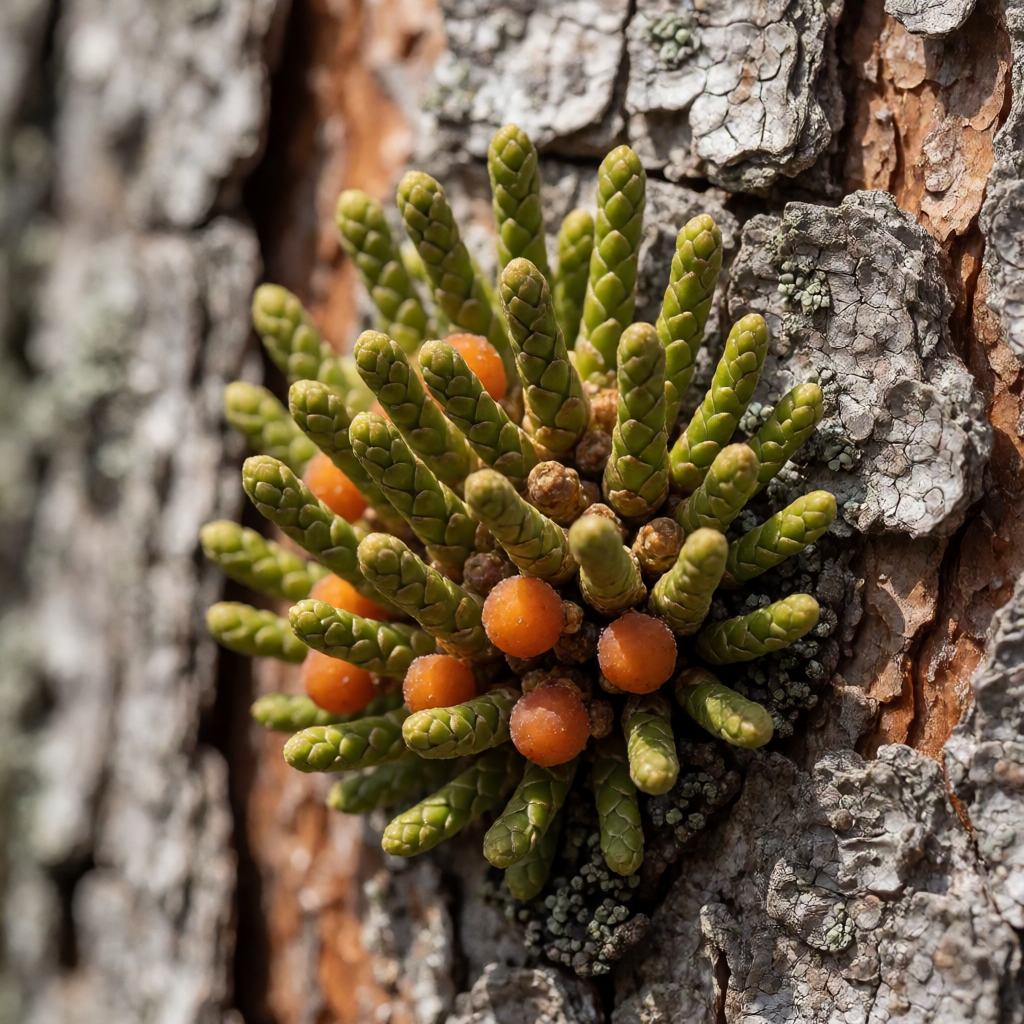
This is the smallest mistletoe in eastern North America. Shoots stand only 0.5 cm to 3 cm tall. They look like tiny green and orange twigs.
The plant lives inside a spruce branch. Only the tips stick out. Because it steals water and sugar from its host, the tree suffers.
Branches swell into a dense mass. Foresters call the mass a witch’s broom. Though the shoots are barely visible, the damage they cause can cut a spruce’s growth by more than half, and the effect lasts for decades.
Family tree
Santalaceae, the sandalwood order
This plant sits in the sandalwood family, Santalaceae. Early workers put it with the true mistletoes. Charles Peck named it in 1872. A woman called Lucy Millington found it first.
She wrote to a botanical club in 1871. Her letter described a strange growth on spruce. Henry Thoreau noticed the same brooms in 1858. He never learned what caused them, though he wrote about the brooms.
The Mistletoe is a distant relative. Because the genus is most closely tied to a species from Hispaniola, its small size looks like a recent change, not an ancient one.
5 cm of scaly shoots
How to tell one
Aerial shoots reach 3 cm at most. Colour runs from green to orange to maroon. Male and female parts grow on separate plants, though both feed from the same branch. Male flowers measure 2 mm across.
They carry 2 to 4 red petals. Female stems are longer and pale, while male stems flush red. Berries ripen in September and October. Each berry holds one sticky seed.
Roots thread through the host wood. Because the plant keeps only a little green tissue, it cannot feed itself, and it draws almost everything it needs straight from the spruce.
1
2
3
Spruce and tamarack forest
Where it lives
Spruce forest is the only home. It needs a living tree. Black spruce is the favourite host, since its branches stay low and dense. White and red spruce also serve, while pines almost never do.
Tamarack takes it now and then. Jack pine and balsam fir resist it. The range, however, runs from Saskatchewan to Newfoundland. In the United States it reaches Minnesota and Maine.
Sites sit near bogs, lakes and rivers. Although the mistletoe can live in a dry upland stand, it spreads best in damp, crowded spruce where branches touch and seeds can land close by.
Water and sugar from the host
What it eats
This plant does not eat insects. It takes food from a tree. Water and minerals come up the wood. Sugar comes from the host’s leaves.
A root like organ taps both streams, because it must feed two ways. That organ is called a haustorium. It pushes past the bark and into the growing layer. Once inside, it spreads through the branch.
The host pays for every shoot above, while the mistletoe keeps growing. Since the mistletoe draws more than it gives back, the branch slowly starves, and the tree grows a thick knot of twigs to compensate.
Seeds fired like bullets
The breeding cycle
Pressure builds inside a ripe berry. The seed fires out at high speed. Some travel several metres, though most land close by. Glue coats each seed.
Rain then washes it down a needle. The seed lands on a twig. Germination follows in spring. Shoots appear 2 to 12 years later.
Wind and animals move some seed further, while rain does the rest. Birds that wipe their beaks also spread it.
No global rating
Conservation
No global rating covers this mistletoe. Three states call it Endangered. Those are Connecticut, New Jersey and Rhode Island. Pennsylvania lists it as Threatened.
Canada, though, gives it no special status. Logging helps it in one way. Cutting old spruce removes its host. Fire suppression hurts it badly.
The plant needs crowded, old stands. Because so few people look for a plant only 3 cm tall, real numbers stay unknown, and the listings rest on a handful of known sites.
Side by side
How It Compares
| Trait | Dwarf Mistletoe | European Mistletoe |
|---|---|---|
| Shoot length | 0.5 cm to 3 cm | up to 50 cm |
| Sugar | drawn from the host | mostly made by its own leaves |
| Seed release | fired out under pressure | spread by birds |
| Main host | black spruce | apple, poplar and many broadleaf trees |
| Range | eastern Canada and the northern United States | Europe and western Asia |
| Form | tiny twigs along a branch | a rounded bush on a branch |
Common misreadings
What People Get Wrong
- Mistletoes are all alike. This one is only 3 cm tall.
- Its seed falls straight down. Pressure fires it out.
- Dwarf mistletoe kills every host. Growth drops, but trees often live on.
Going further
Sources and Further Reading
- IUCN Red List entry for Arceuthobium pusillum
- Wikipedia, Arceuthobium pusillum
- Flora of North America Editorial Committee. Arceuthobium pusillum treatment, Volume 12.
- Nickrent, D. L. et al. 2004. Phylogenetic relationships in Arceuthobium. Systematic Botany.
Quick hits
Five things to remember
- Its name is Latin for very small.
- The seed is fired out under pressure.
- Shoots can take 12 years to appear.
- A heavy infection halves a spruce’s growth.
- Thoreau described the brooms in 1858.