 By st20113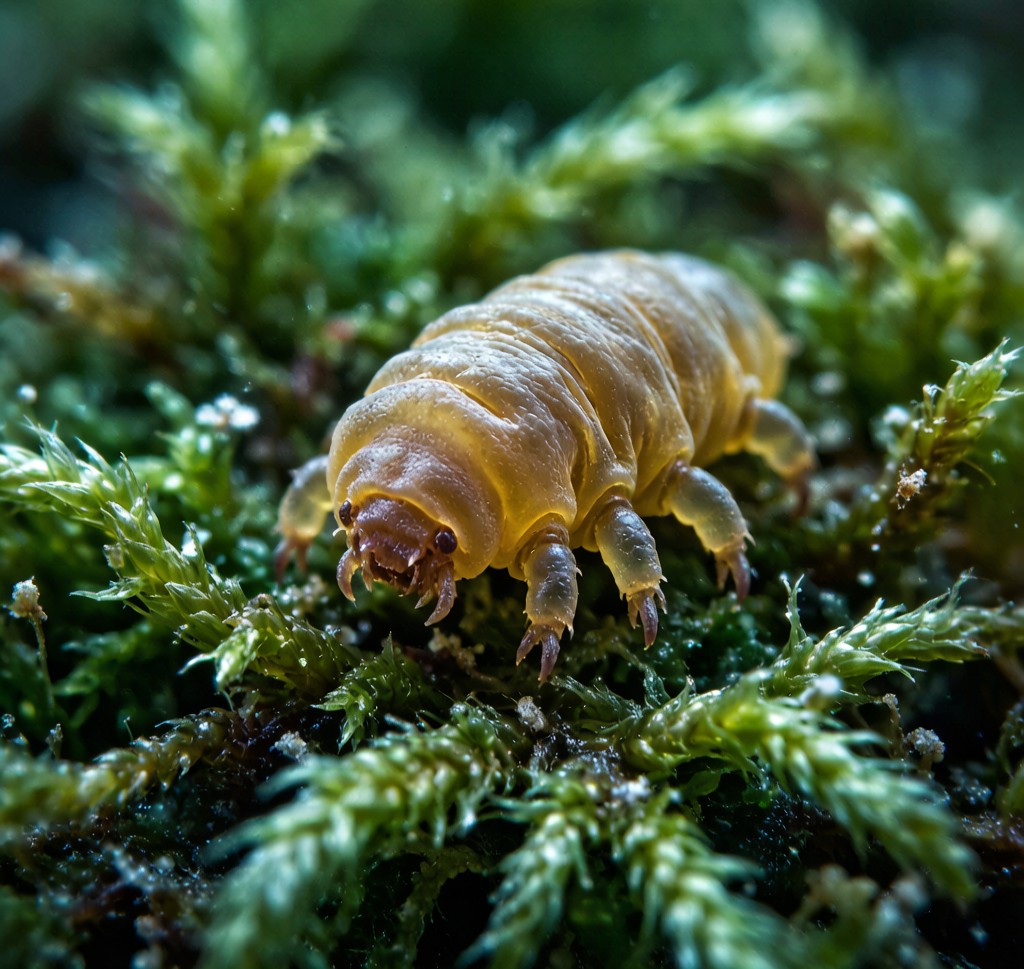
Overview
The Tardigrade (Tardigrada), commonly known as the “water bear” or “moss piglet,” is one of the most extraordinary animals on Earth – a microscopic, eight-legged creature so remarkably resistant to extreme conditions that it has survived all five of Earth’s mass extinction events and can withstand conditions that would be instantly fatal to virtually any other known form of life. Tardigrades are tiny – most species measuring 0.3 to 0.5 millimeters in length when fully grown, about the size of a grain of salt – and are found in almost every environment on Earth, from the highest mountains to the deepest ocean trenches, from tropical rainforests to the Antarctic ice. They are most commonly found in mosses, lichens, and leaf litter, where they feed on plant cells, algae, and small invertebrates. The name “tardigrade” means “slow stepper,” referring to the creature’s leisurely, bear-like gait.
The tardigrade’s most extraordinary feature is not its appearance but its virtually indestructible nature. Tardigrades can survive temperatures close to absolute zero (minus 272 degrees Celsius), temperatures as high as 150 degrees Celsius, pressures six times greater than the deepest ocean trench, the vacuum of space, and doses of radiation thousands of times greater than would kill a human. They accomplish this through a remarkable biological process called cryptobiosis – a state of suspended animation in which they lose almost all their water, retract their legs, and form a hard, barrel-shaped structure called a tun. In this state, their metabolism effectively ceases, and they can remain dormant for decades before being rehydrated and resuming normal life.
Survival Extremes
The tardigrade’s cryptobiotic state – called the tun stage – is the key to its extraordinary survival capabilities. When environmental conditions become hostile – due to dehydration, extreme cold, lack of oxygen, high salinity, or other stressors – the tardigrade undergoes a remarkable transformation. It contracts its body, retracts its legs, synthesizes a protective sugar called trehalose that replaces the water in its cells, and forms a protective tunnel-like structure called a tun. In this state, the tardigrade can survive for decades in a dormant condition, effectively pausing time until conditions improve.
Perhaps the most dramatic demonstration of tardigrade resilience came from a 2007 experiment in which scientists exposed living tardigrades to the conditions of outer space – vacuum, extreme cold, and cosmic radiation – aboard a European Space Agency FOTON-M3 rocket. A remarkable 68 percent of the exposed tardigrades survived the spaceflight, and many of those that survived were able to reproduce normally after rehydration. This was the first time any animal had been shown to survive full exposure to the vacuum and radiation of space – a finding that has profound implications for our understanding of the limits of life and for the possibility of life on other planets.
Biology and Ecology
Tardigrades have a simple but complete body plan: a head (with a mouth containing two stylets used to pierce plant cells or small invertebrates), a body with four segments each bearing a pair of legs with clawed feet, and a body cavity (haemocoel) filled with fluid. Most tardigrades feed by piercing plant cells or small invertebrates with their stylets and sucking out the contents. Some species are predatory, eating whole small animals; others are vegetarian, feeding exclusively on plant cells and algae. Tardigrades reproduce sexually or through parthenogenesis (asexual reproduction in which unfertilized eggs develop into clones of the mother).
Despite their microscopic size, tardigrades are considered to be true animals (Metazoa) based on their multicellular body plan, embryonic development, and genetic relationships. Molecular phylogenetic studies place tardigrades as close relatives of the arthropods (insects, crustaceans, spiders) and onychophorans (velvet worms), forming a group called the Panarthropoda. The discovery that tardigrades share a common ancestor with arthropods has profound implications for understanding the evolution of the major animal body plans and the history of life on Earth.
Significance and Research
Tardigrades have become one of the most intensively studied organisms in modern biology and astrobiology, offering insights into the fundamental mechanisms of survival, DNA repair, and stress resistance that have direct relevance to human medicine and space exploration. Scientists studying tardigrades have identified a suite of novel proteins – called tardigrade-specific proteins (TDPs) and Damage suppressor proteins (Dsup) – that appear to play a key role in protecting cells from radiation and other forms of DNA damage. When researchers introduced the Dsup gene from tardigrades into human cells in the laboratory, the modified cells showed a 40 percent reduction in radiation-induced DNA damage – a finding that has sparked interest in developing tardigrade-inspired radioprotective therapies for astronauts and cancer patients.
The tardigrade’s cryptobiosis mechanism is also inspiring research into new methods for preserving biological materials – including vaccines, cells, and tissues – without the need for conventional cryopreservation. The European Space Agency’s TARDIgrade experiment on the International Space Station is studying how tardigrades respond to long-duration spaceflight conditions, providing data that will inform both fundamental biology and future space missions. As we continue to explore the cosmos, the humble tardigrade – barely visible to the naked eye and found in virtually every environment on Earth – may hold the key to understanding how life can survive in the most extreme environments in the universe.